
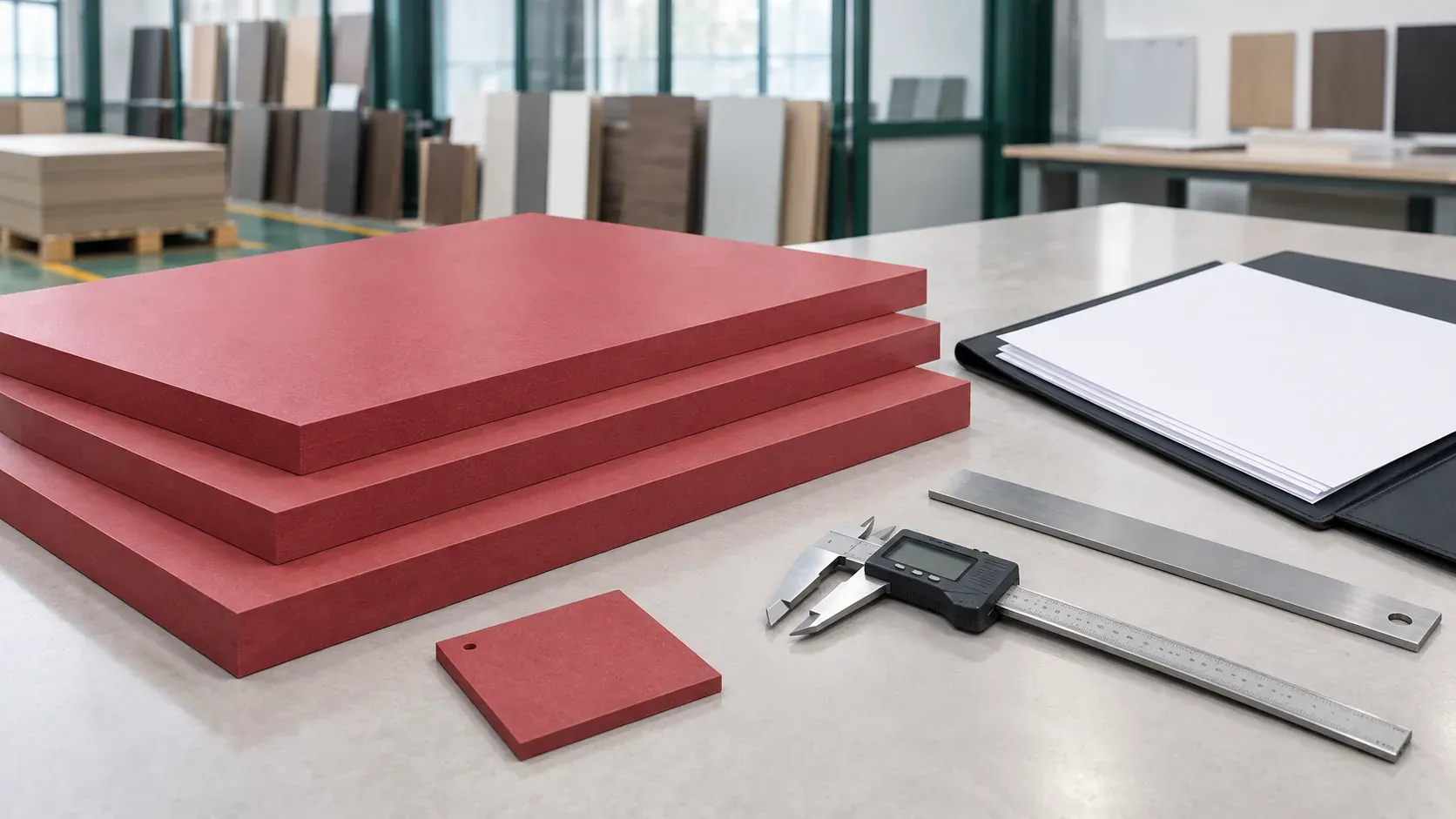
Fire Rated MDF is formulated to be more difficult to ignite and to slow flame spread under specified test conditions. Its classification comes from matched documents identifying the product, thickness, construction, test method, result and field of application. This checklist connects those records to an order review.
Understand what the fire-rated term means
Fire Rated MDF, fire retardant MDF and FR MDF describe a wood-based panel with a flame-retardant formulation. Different standards and test methods produce different grades or classifications. Fire Rated MDF remains a combustible wood-based panel that can char and burn under sufficient heat or prolonged flame exposure. Non-combustible materials form a separate category, and the complete wall, ceiling, furniture or fit-out assembly follows its own project fire design and approval process.
Start with the project requirement
Translate the project specification into a document request before comparing suppliers.
| Project input | Information to record |
|---|---|
| Destination and authority | Country, market, project or responsible approval process |
| Intended use | Furniture component, wall panel, fit-out part or another protected-interior application |
| Required standard or method | Exact reference named by the project or responsible specialist |
| Target result | Required classification, grade or reported value |
| Product construction | Thickness, raw or faced condition, coating, machining and installation context |
| Required test reports and certificates | Test report, classification document, technical data, declaration or other named record |
The buyer, project fire consultant or responsible authority defines the applicable requirement. The supplier then identifies the proposed product and the current test reports or certificates available for that exact scope.
Separate the roles of each document
Each record answers a different question.
| Document type | Primary role in review |
|---|---|
| Product technical data | Identifies material, thickness, dimensions, density, surface and other declared product information |
| Test report | Records the tested specimen, method, conditions, observations and results |
| Classification or assessment document | States the classification and the product or application scope covered by the underlying test or assessment record |
| Supplier quotation | Identifies the exact panel construction being offered, including qualifications and exclusions |
| Purchase order and specification | Converts the accepted product, supporting documents and commercial scope into the order requirement |
| Inspection and shipment records | Preserve product identity, quantity, labels, packaging and document traceability for delivery |
Use the complete set to connect technical documents and test reports with the quoted and delivered panel. A product photograph or red board colour supports physical identification within the factory process, while the document set controls the performance claim.
Build one identity chain from documents to shipment
Every stage should repeat the same controlled product identity.
| Stage | Identity to carry forward |
|---|---|
| Project requirement | Intended use, required method, target classification and responsible reviewer |
| Technical documents | Manufacturer or source, product name or code, specimen construction, thickness and supported scope |
| Supplier quotation | Offered product code, thickness, face/reverse build, processing, qualifications and referenced documents |
| Purchase order | Accepted construction, document numbers, labels, inspection points and change-control requirement |
| Production and packing | Batch or production reference, dimensions, quantity, bundle identity and applied labels |
| Shipment and receiving | Packing list, bundle labels, accepted document set and receiving record |
Use a single order specification or document register to link these records. This gives project reviewers, purchasing, production and receiving teams the same product reference from approval through delivery.
Check issuer, identity and completeness
Record the laboratory, certification or assessment body, report or document number, issue date, revision, page count and referenced annexes. Confirm that every page belongs to the same record and that signatures, stamps or digital validation elements are present where the issuing format uses them. Where project rules require laboratory accreditation or a named issuing body, verify that requirement through the responsible project approval process. Keep the complete received file and its source with the order review record.
Confirm authenticity and current document status
Use the issuing body's published verification method, document portal or direct contact details when the project requires authenticity confirmation. Record the verification date, reviewer and result beside the document number. Review revision history, referenced standards, annexes and any replacement, withdrawal or superseding notice available from the issuer or responsible certification process.
The responsible project party should confirm whether the document format, issuer status and issue date meet the current project and destination requirements. Preserve the received original file, verification record and accepted version together so later quotations and shipments refer to the same document set.
Match the document to the quoted MDF
Create a line-by-line identity match between the supporting document and quotation.
- manufacturer or production source stated in the document;
- exact product name or code;
- formulation or product family where identified;
- nominal thickness and tested thickness range;
- density or other identifying technical data where provided;
- raw, coated, veneered, melamine-faced or other surface construction;
- adhesive, facing, backing or balancing layers included in the specimen;
- machining such as grooves, perforations or routed details;
- edge condition, fixing and support included in the assessed scope;
- test method, result and classification wording.
Record every matched item, clarification and scope difference in the quotation review. This allows purchasing to see exactly which offered construction carries the supporting test report or certificate.
Extract the tested specimen before reading the headline result
Summarize the specimen construction in a review table before transferring any classification into the quotation.
| Specimen field | What to extract |
|---|---|
| Product identity | Name, code, manufacturer or source and formulation family where stated |
| Board properties | Tested thickness, dimensions, density and conditioning information where reported |
| Face and reverse | Raw surface, coating, veneer, melamine, laminate, backing or balancing layer |
| Machining and edges | Grooves, perforations, routed areas, exposed edges and edge treatment |
| Mounting construction | Orientation, substrate or backing, air gap, frame, fixing and joint details |
| Test conditions | Method, specimen preparation, conditioning and declared deviations |
| Reported result | Measured values, observations, classification and stated scope |
This table makes the physical specimen visible during commercial review. Purchasing can then compare the offered board, processed component and installed build-up with the construction that generated the reported result.
Read the classification and field of application
Find the stated classification, standard or method, specimen description and field or scope of application. Review which thicknesses, densities, facings, substrates, orientations, fixings and end uses the document covers. Extended-application rules or assessment statements should be interpreted by a qualified project party where required. Quote the classification with the same wording and scope used by the supporting document so the commercial description remains aligned with that document.
Review facing, machining and installation changes
A raw Fire Rated MDF panel, a melamine-faced panel, a veneered panel, a coated component and a grooved or perforated panel are different constructions. Machining can change thickness, exposed area and edge condition; facing and coatings add materials; fixings and backing form part of the installed build-up. Compare the proposed finished construction with the tested or assessed construction and route any scope question through the responsible project specialist before order release.
Keep fire performance and emission class separate
Fire performance and formaldehyde emission are separate specification lines with their own methods and test reports. State the required E0, E0.5 or E1 option together with the applicable emission test standard and destination requirement. Then state the fire test method, classification and document coverage independently. Both requirements should identify the same proposed product construction before purchasing accepts the combined specification.
Connect the document review with supply parameters
Current CUZI MDF website planning information for Fire Rated MDF includes:
- 2–35 mm nominal thickness range, matched to the selected construction and document coverage;
- reference formats of 1220 × 2440 mm, 2100 × 2800 mm, 1830 × 3660 mm, 1830 × 2440 mm, 2440 × 3660 mm and 1830 × 4200 mm;
- nominal thickness tolerance of ±0.1 mm, subject to the confirmed measuring method;
- thickness-based density schedule confirmed for the proposed panel;
- E0, E0.5 and E1 emission options specified separately;
- indicative board-supply range of **US$220–360 per m³**.
These values support early purchasing review. The written quotation confirms the available thickness, format, density, surface, fire-performance document coverage, emission requirement, quantity, processing, packaging and delivery basis for the selected order.
Create a document register before order release
Use a simple register with one status for every required record:
| Status | Meaning for purchasing |
|---|---|
| Received | File is present and awaiting scope review |
| Matched | Product identity, construction and applicable scope align with the quotation |
| Clarification required | A specific identity, result or scope question remains open |
| Replacement required | A current, complete or correctly scoped record is requested |
| Accepted by responsible party | The project-designated reviewer has accepted the documents for the stated use |
Link the final accepted document versions to the quotation, purchase order, product code and shipment record. Keep superseded files identified so production and inspection use the current approved set.
Release the shipment with a matched document pack
Prepare the shipment file from the accepted order identity. Include the final quotation and purchase-order references, approved product specification, required fire-performance records, emission-class records, inspection results, packing list and bundle-label schedule. Record each file name, document number, revision and responsible reviewer in the register.
At receiving, compare product and bundle labels, thickness, faced construction, quantities and packing-list references with the accepted specification. Keep shipment photographs and receiving findings under the same order and batch references. This closes the traceability chain between the documents reviewed before production and the panels delivered to the project supply option.
Prepare a Fire Rated MDF RFQ
Provide the information needed for an document-matched quotation:
- destination market, project and intended end use;
- named fire standard or test method and target classification;
- responsible party for project test reports and certificates acceptance;
- required test report, classification or assessment document format;
- thickness, format, density and ±0.1 mm tolerance requirement;
- raw or faced construction, coating and reverse face;
- E0, E0.5 or E1 requirement and applicable emission method;
- cutting, routing, grooves, perforations, drilling and edge details;
- fixing, backing and installed construction information where relevant;
- quantity, packaging, labels, destination and delivery basis.
Capacity is 300 m³ per day for each thickness. The normal MOQ is 1 × 20'GP for each individual specification, and normal production lead time is 7–15 days after the fire-performance requirement, complete product specification, applicable test reports and product documents and commercial requirements are confirmed. This article provides a verification method; CUZI MDF fire classification remains outside its published scope and requires applicable current product documents and test reports. Use the Fire Rated MDF product page and MDF certificate and test report guide for the related review processes. Request a specification review with the project requirement, quantity and destination.
Buyer review checklist
Before relying on this guidance, record the finished component, service environment, MDF product or unresolved product requirement, thickness, dimensions, supplied surface, visible edges, machining, hardware, quantity and destination. Identify which values need current technical documents and test reports and which appearance decisions need a physical sample.
For international supply, also confirm drawing and sample revisions, packaging construction, part or bundle labels, handling limits, required documents and the party responsible for finished-product design and destination compliance. Ask the supplier to list unresolved items and exclusions in the quotation, and keep every missing value visible for confirmation.
Compare quotations only after these inputs have been normalized. Check whether the offered price covers a full board, a faced construction, a machined part or a finished component, and whether samples, secondary work, protective materials and documentation are included. Record every change after approval so purchasing, production, inspection and receiving teams use the same revision.
Typical lead time is 7–15 days after requirements are confirmed. Final timing depends on specification, quantity, production scheduling and destination. This planning range covers production; arrival timing also depends on the confirmed logistics route.
Request an MDF quotation
Share the application, specification, quantity, packaging and destination with CUZI MDF for an order-specific review.