Component and exposure
Identify the part, position, humidity, cleaning route and any sink, dishwasher, worktop-joint or floor-level exposure.
Kitchen cabinet component specification
Turn cabinet doors, carcass panels, shelves, end panels and fillers into an order-ready MDF specification. Define exposure, finish, machining, hardware, required documents, packaging and quantity by component group before requesting a quotation.
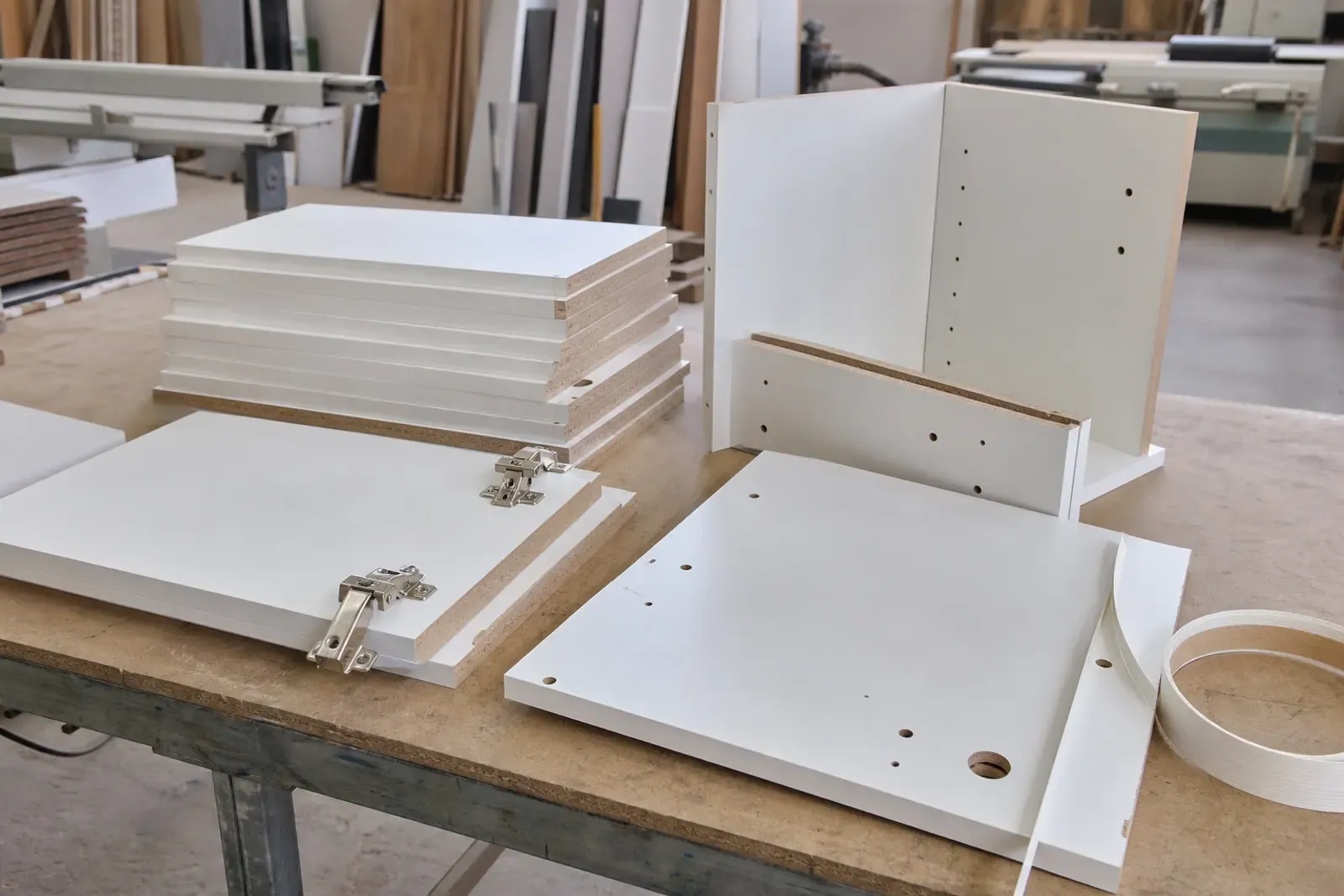
Direct answer
Separate every cabinet part by exposure, supplied surface, visible edge, machining and hardware so the quotation reflects the finished component.
Create one controlled line for each component group: doors, carcass sides, shelves, end panels, fillers or machined parts. Record finished dimensions, quantity, substrate requirement and the supplied condition of every face and edge.
Identify the part, position, humidity, cleaning route and any sink, dishwasher, worktop-joint or floor-level exposure.
Define face, reverse, décor or coating reference, direction, visible edges, cut-edge protection and the physical approval sample.
Attach the drawing revision, hardware work, tolerances, inspection records, part labels, packing group and required quantity.
State unresolved values as review points before grade selection. Moisture-resistant terminology still requires a complete face, cut-edge, joint and installation protection plan for the real exposure.
Component decision matrix
One cabinet may need several material and finish constructions. Use this matrix to separate their approval questions.
| Cabinet component | MDF option to compare | Critical information | Approval point |
|---|---|---|---|
| Painted or routed doors | Paint-grade or otherwise reviewed MDF substrate | Profile depth, remaining section, face and cut-edge preparation, primer and topcoat system | Approve a finished representative door or routed profile |
| Decorative slab doors and end panels | Melamine, acrylic, PVC, laminate or veneered construction as specified | Face and reverse face, colour, texture, gloss, grain direction, edge solution and protective film | Approve the physical face-and-edge combination under relevant lighting |
| Carcass sides and partitions | Specified raw or faced MDF option | Interior humidity, face balance, edges, connectors, dimensions and assembly method | Confirm the complete component construction and hardware plan |
| Shelves | Product and thickness selected after component review | Finished span, expected load, support positions, edge treatment and finished weight | Designer or responsible project party verifies the shelf design |
| Drawer parts, fillers and plinth-related parts | Component-specific MDF or alternative material review | Position, cleaning exposure, floor or sink proximity, edge protection and assembly | Assign direct or prolonged water exposure to a separately approved construction |
Component exposure code
Add an exposure note to each component line so the proposed substrate, supplied finish and edge treatment can be reviewed against its real position.
Record normal room humidity, ventilation, cleaning method and nearby heat sources. Identify which faces and edges arrive finished.
Mark the component position and likely intermittent splash or cleaning exposure. Define the responsible face, cut-edge, joint and installation protection.
Flag the component for a separate construction decision and approve its complete substrate, surface, edge, joint and installation protection.
Supplied-condition schedule
The order line should state what CUZI MDF supplies and what the buyer or downstream processor completes. Link appearance-critical lines to an identified physical sample.
| Supplied construction | Order-line context | Details to approve |
|---|---|---|
| Raw or paint-grade MDF | Buyer or processor controls the coating process | Face and edge preparation, routed profile, primer, topcoat, sanding between coats and sample approval |
| Melamine-faced MDF | Production-ready decorative panel option | MDF substrate, one- or two-sided construction, décor reference, texture, direction, edge banding and reverse face |
| Veneered or laminated MDF | Natural veneer or specified laminate appearance | Species or laminate identity, lay-up, face balance, variation boundary, adhesive/process and edge treatment |
| PVC- or acrylic-faced MDF | Appearance-sensitive fronts and panels | Flat or routed construction, film or sheet reference, gloss/matte level, edge solution, cleaning, protection and finished sample |
Comparable quotation scope
A comparable quotation identifies the delivered construction and every included processing, approval and packing step. This separates a material-only price from a complete component offer.
| Supply level | Quotation basis | Scope details to record |
|---|---|---|
| Full MDF board | Board grade, thickness, format, density or performance requirement, emission class, supplied surface and sheet quantity | Cutting, edge work, machining, finishing and component packing remain separate buyer-controlled scope items |
| Faced panel | MDF substrate, face and reverse construction, décor or veneer reference, direction, total thickness and panel quantity | Edge treatment, film removal, downstream machining and acceptable surface variation are stated explicitly |
| Cut or CNC-machined component | Finished dimensions, part ID, drawing revision, tolerances, orientation, holes, routing, edge condition and part quantity | First-part approval, measuring method, labels and component grouping are included in the review |
| Finished cabinet door or front | Complete substrate, face, reverse, edge or profile, coating or facing process, hardware machining and finished size | Representative finished-door approval, protective packing and supplied-condition responsibility are included |
Drawing and hardware data
Control repeat machining with a released drawing that states dimensions, orientation, datum, hardware reference and revision information.
Record finished dimensions, quantity, front/back orientation, handed parts and visible edges against each part number.
Record units, revision, datum, required tolerances and the relationship between drawing and cut list.
Specify hinge cups, pilot or through holes, connector holes, diameters, depths, coordinates and edge distances.
Check profile, remaining section, cut edge, hole positions, surface and finishing result before repeat production when required.
Sample and inspection plan
Choose checks from the cabinet part, finish and risk, and use product documents and test reports for the required hidden properties.
Approve the relevant face, reverse, edge, colour, texture, gloss, veneer variation or routed profile using an identified sample.
Agree measuring points, method, sample selection and acceptance criteria for thickness, component size, machining and hardware positions.
Match any emission, moisture or other required test reports and certificates to the exact proposed product, thickness, construction, date, method and scope.
Confirm clean separators, face protection, edge and corner protection, orientation, part labels and bundle grouping.
Record the requirement, result, affected quantity, inspection record, responsible party and rework, hold, reinspection or written-deviation decision.
Reconcile part and bundle counts, labels, packing list, weights and the agreed release record before loading.
Kitchen cabinet RFQ
If a field is undecided, state the finished-component requirement so the unresolved point can be reviewed before quotation.
Relevant MDF products
These links are starting points. Availability, construction, values and suitability remain subject to the exact order.
Review improved humidity performance for protected interior components against the exact grade, test method and supporting report.
View product →Product optionUse only when the proposed higher moisture-performance specification and intended application are confirmed.
View product →Product optionDefine substrate, face and reverse construction, décor, texture, direction and edge construction.
View product →Product optionCoordinate the substrate, routed edge, preparation and complete coating system.
View product →Product optionReview controlled profiles, dimensions, finish construction, hardware work and protective packing.
View product →Product optionApprove colour, gloss or matte appearance, reverse face, edge solution and protective film.
View product →Buyer questions
Use these answers to identify what still needs order-specific confirmation.
MDF can be reviewed for protected interior kitchen components when the exact component, environment, substrate, finish, edges, machining, hardware, test reports and product documents are specified together. Suitability is an order- and component-specific decision.
Specify doors, carcass panels, shelves, end panels and fillers by their individual surface, machining, support, hardware, appearance and exposure requirements.
No. Moisture-resistant terminology does not make an MDF component waterproof. Direct or prolonged water exposure must be excluded unless a complete reviewed system and written project requirement establish another boundary.
Density supports product and weight planning. Screw-holding verification also uses the hardware, hole geometry, edge distance, board construction and an applicable representative test method.
Send the component list, thicknesses, finished dimensions, quantities, MDF and surface construction, drawings and revisions, hardware work, samples, required documents, packaging, destination and requested timing.
Application to specification
Send the component list, dimensions, finish construction, drawings, quantities, required documents, packaging and destination. CUZI MDF will identify the proposed supply scope, supporting test report or certificate and open points for order-specific confirmation.