
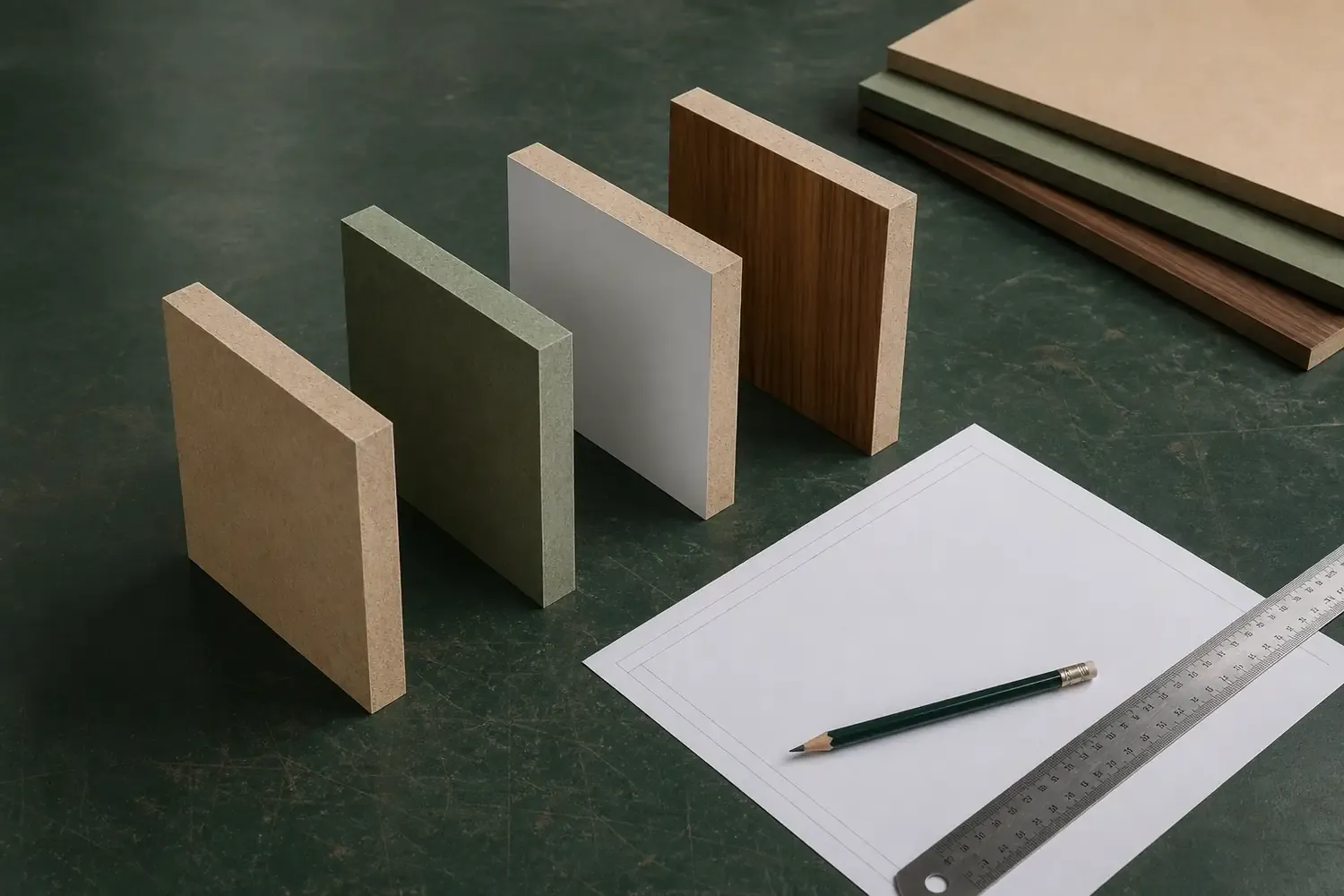
Choose MDF for furniture manufacturing from the finished component and the process used to make it. The useful question is: which MDF construction, thickness, surface and machining process will produce this specific part consistently through finishing, assembly, packing and repeat orders?
Direct answer: match MDF to the finished furniture component
Start by separating the furniture into component families. A cabinet side, long shelf, routed door, drawer bottom and decorative end panel may belong to one furniture set while requiring different material, machining and approval decisions.
For each component, record:
- its finished dimensions, span and support;
- the service environment and likely humidity, splash, heat or cleaning exposure;
- the visible face, reverse face, edges and grain or décor direction;
- cutting, drilling, routing, profiling and hardware interfaces;
- the paint, melamine, laminate, veneer, PVC or acrylic finish construction;
- quantity per furniture set, total quantity and spare-part requirement;
- the sample, first article or assembled unit used for acceptance.
This component schedule becomes the basis for comparing MDF grades and supplier quotations.
Component-to-material decision matrix
| Furniture component | Main decision | MDF option to compare | Approval check |
|---|---|---|---|
| Carcass sides, dividers and bases | Finished size, connector pattern, edge construction and cabinet squareness | Raw, sanded, melamine or laminated MDF selected for the supplied finish | One assembled carcass using the actual connectors |
| Shelves | Span, support spacing, expected contents, edge and visible face | Thickness- and density-specific MDF confirmed for the shelf design | Representative loaded assembly or buyer-defined furniture test |
| Cabinet and wardrobe doors | Door size, finished weight, face/reverse balance, hardware and gap control | Paint-grade, routed, melamine, veneer, PVC or acrylic construction | Finished door with actual hinges, runners or sliding hardware |
| Routed fronts and decorative profiles | Profile depth, remaining section, edge preparation and coating access | Raw, paint-grade, thick or moisture-resistant MDF matched to the section drawing | Coated first article containing the most demanding profile |
| Backs and drawer bottoms | Groove or rebate fit, support, face orientation and handling | Thin MDF, HDF or hardboard selected for the complete assembly | Part fitted into the actual groove, frame or drawer |
| Decorative end panels and visible fields | Colour, texture, grain direction, joint appearance and replacement expectations | Melamine, laminate, veneer, painted, acrylic or PVC-faced MDF | Identified physical sample and adjoining finished components |
Choose the MDF product family from the service environment
Standard raw or sanded MDF is a common starting point for dry protected interiors, painted components and downstream lamination or veneering. Moisture-resistant MDF is considered when protected-interior furniture faces elevated humidity or intermittent moisture exposure. HMR MDF provides a higher moisture-resistance option when the specified product and supporting test document match the application. MR and HMR MDF are moisture resistant, not waterproof; edges, holes, joints, finishes, ventilation and leak control remain part of the furniture design.
Fire-rated MDF belongs in projects with a defined classification, test method, thickness, construction and end-use scope. The classification must match the exact quoted product and project requirement. HDF, thin MDF and hardboard serve thinner supported components through product-specific face, density, fit and processing requirements.
Emission class is a separate specification. State the required E0, E0.5 or E1 class and the applicable destination or test requirement for the selected product.
Select thickness from geometry, support and machining
Nominal thickness becomes meaningful after the component geometry is defined. Review shelf span and support, door height and weight, connector depth, hinge-cup location, routing depth, remaining section and finished edge construction.
Density is also thickness-specific. Use the density data for the exact product and thickness, then connect it to the required machining, edge quality, weight and furniture validation. A heavier board can increase finished-part weight and affect hinges, runners, lifting, packing and container planning.
For cut or machined components, the drawing should state units, revision, datum edges, finished dimensions, tolerances, face orientation, mirrored parts, holes, profiles and critical fit points. The first article confirms how the selected MDF works with the actual geometry and hardware.
Match the supplied surface to the finishing process
Paint
Specify the sanded face condition, cut-edge preparation, routed-profile preparation, primer, topcoat, colour and gloss. Approve a finished component that includes the most difficult edge or profile because a flat raw sample represents only the face.
Melamine, laminate, acrylic and PVC
Identify the exact décor or film reference, texture or gloss, visible face, reverse construction, edge solution and protective-film requirements. Use a physical sample viewed under the intended lighting. Confirm how cutting, drilling, edging or membrane wrapping affects exposed core and finished appearance.
Natural veneer
State the species, veneer cut, matching method, grain direction, face sequence, balancing layer, supplied finish and acceptable natural variation. Large elevations, paired doors and replacement parts require identifiers that preserve the approved sequence.
Control hardware and assembly interfaces
Furniture problems frequently appear at the connection between parts. Record the actual hinge, runner, connector, handle or bracket reference and connect every machining coordinate to a named datum edge. Keep left, right and mirrored parts as separate part identities.
Assemble one representative furniture unit before repeat production. Review cabinet squareness, door and drawer gaps, shelf fit, connector engagement, hardware clearances, face direction and adjoining finished parts. Release the accepted drawing and machining revision together.
Compare quotations on the same delivered scope
A low sheet price may represent raw board while another quotation includes facing, cutting, CNC work, edge treatment, protective film, component labels and furniture-set packing. Build a comparison sheet with one row for each of these items:
- MDF product, thickness, board or finished-part dimensions and density requirement;
- E0, E0.5 or E1 emission requirement and required product documents and test reports;
- face, reverse, décor, veneer, paint or film construction;
- cutting, drilling, routing, edge work and first-article scope;
- quantity per part, per furniture set and total order;
- inspection method, labels, spares and reject handling;
- packaging, destination, delivery basis and included logistics.
Mark every item as included, excluded or awaiting confirmation. Compare unit prices only after every supplier is quoting the same component and delivery scope.
Plan repeat production, packing and replacements
Stable repeat orders depend on part identity and retained references. Use the same part ID and revision in the BOM, drawing, machining file, inspection record, label and pack list. Record décor, veneer, paint and approved-sample references with acceptable variation.
Choose component-family, furniture-set or line-side packing according to the buyer's receiving process. Use clean separators, flat support, protected faces and edges, isolated hardware and labels that show part ID, furniture ID, quantity, handed status, revision and pack number.
CUZI MDF's typical production lead time is 7–15 days after the complete specification and commercial requirements are confirmed. Final timing depends on product, quantity, surface, processing, sample approval, production schedule, packaging and destination.
MDF furniture manufacturing RFQ checklist
Send the following information for an order-specific review:
1. Furniture type, component list and service environment. 2. BOM with stable furniture and part IDs. 3. Finished drawings with units, revision, tolerances and datum edges. 4. MDF product, thickness, density or performance requirement and E0/E0.5/E1 class. 5. Face, reverse, colour, décor, veneer, paint, film and grain direction. 6. Cutting, drilling, routing, edge work and actual hardware references. 7. Quantity per part, per set, total quantity and spare requirement. 8. Sample and first-article approval method. 9. Inspection, labels, set-based packing, destination and requested timing.
Keep unresolved values visible in the RFQ. CUZI MDF can then review product availability, manufacturing feasibility, required documents, MOQ, production timing and the appropriate packaging route against one controlled order specification.
Request an MDF quotation
Share the application, specification, quantity, packaging and destination with CUZI MDF for an order-specific review.