
Provide a complete cut list
Record units, revision, material, thickness, part ID, length, width and quantity. Add grain direction and pack groups for faced components.
Professional MDF Manufacturer & Supplier
Order rectangular MDF sheets and furniture parts cut to your dimensions. Choose raw or decorative boards in 2–35 mm core thicknesses, with part labels, grain direction and grouped packing for your assembly line.
Technical specification
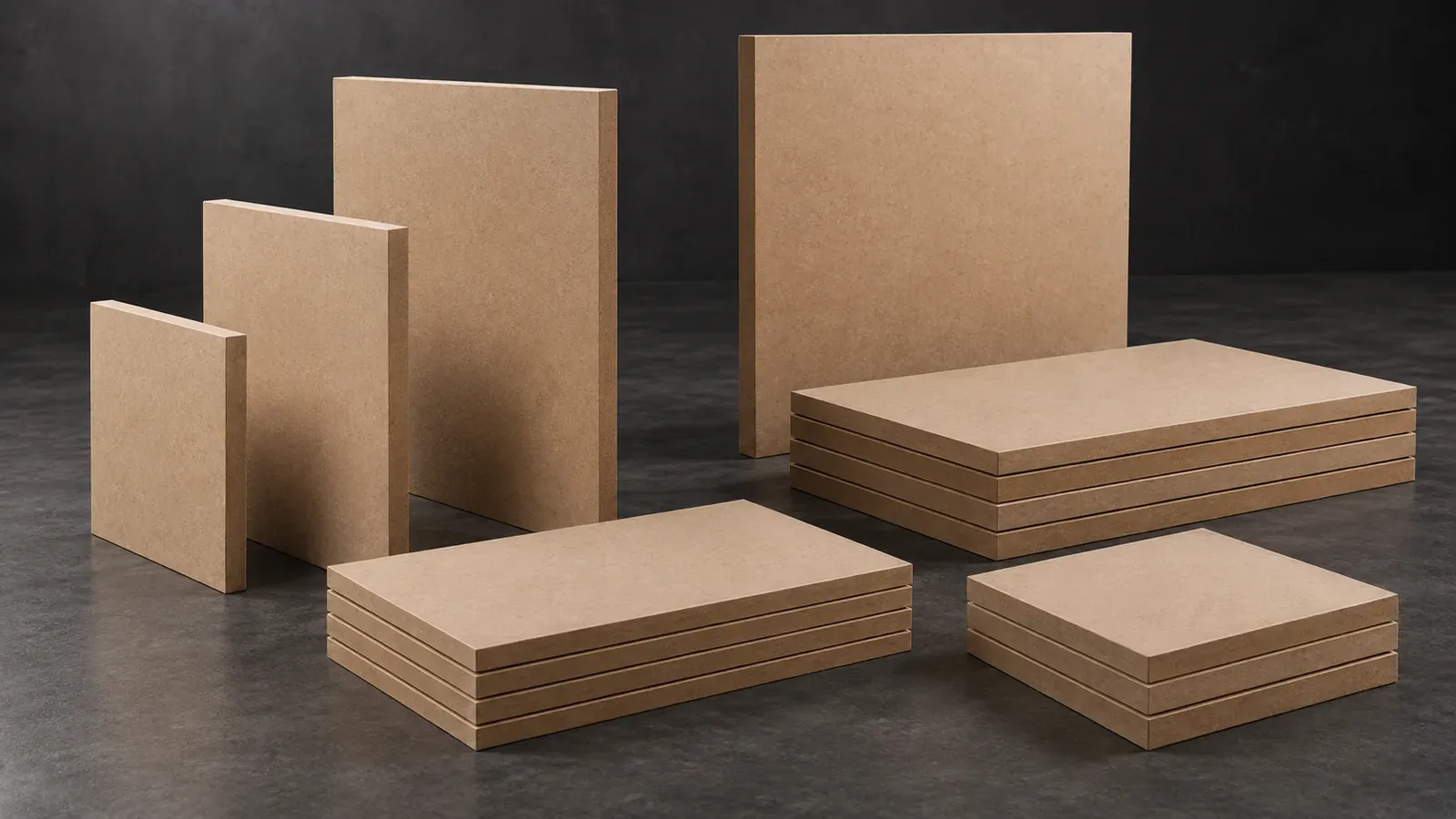
Cut-to-Size MDF supplies rectangular sheets or components cut from the selected MDF board. A dimensioned cut list identifies part sizes, quantities, face direction, edges and packing groups.
Finish and processing
Record units, revision, material, thickness, part ID, length, width and quantity. Add grain direction and pack groups for faced components.
State whether dimensions include edge banding. Agree cutting tolerances, diagonals, squareness and edge checks for the actual board and part sizes.
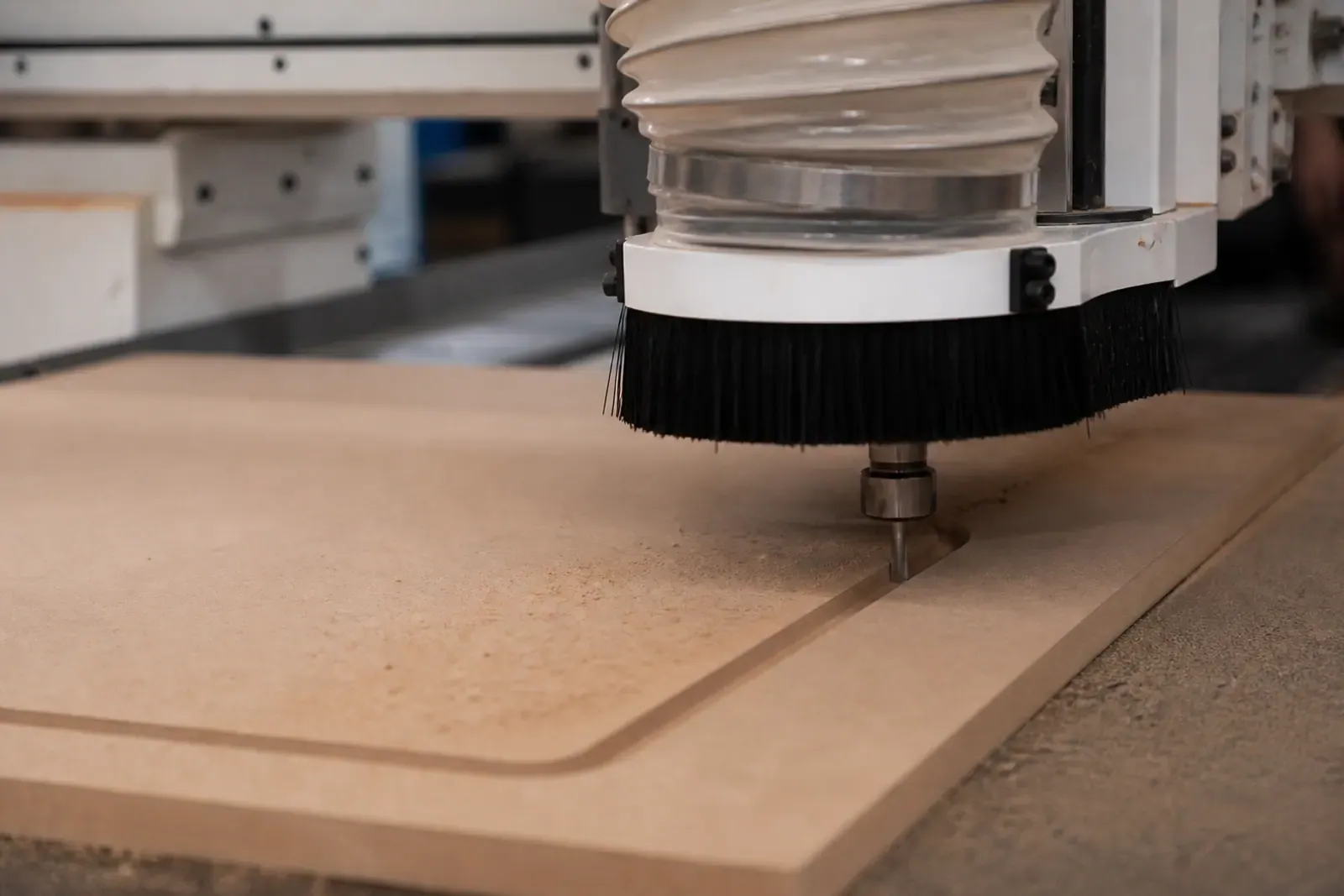
Group and label parts for assembly. Discuss holes, shaped cuts or secondary CNC work with the same order, and state the required surface and edges.
Selection guide
Cut-to-size MDF turns your component schedule into rectangular parts for the next step in your workshop. Start with one row per part ID and material. Our blank CSV template opens in Excel or another spreadsheet editor; the worked file shows three illustrative part lines with their material, dimensions and packing instructions. Its values demonstrate how to fill the file. Your own cut list and our quotation establish the actual order.
Use a revision for the complete list, and match that revision to any drawings. Give every different size, material, face direction or edge treatment its own part ID. Keep quantity in pieces for each row. If a component needs a left-hand and right-hand version, identify both versions separately so the drawing, label and receiving list refer to the same part.
| Cut-list field group | Information to include | What it connects in your order |
|---|---|---|
| File and part identity | Current revision, part ID and drawing reference | The correct geometry and quantity for each component |
| Material and thickness | Your material code, MDF construction, thickness and its measurement basis | Raw, moisture-resistant or decorative input board selection |
| Parent sheet | Source length and width, or a request for our proposed format | Material use, trimming, cutting allowance and packing |
| Finished dimensions | Length and width in mm; before or after edge work | The actual dimensions your workshop receives |
| Quantity and direction | Piece count, visible face and grain/decor orientation | Repeat cutting and the appearance of assembled parts |
| Edges | L1, L2, W1 and W2 treatment, band reference and thickness | Each visible edge and any added size |
| Fit checks | Requested length/width tolerance and squareness criterion | The checks agreed for the finished parts |
| Delivery groups | Pack group, label reference and notes | Finding and counting the parts on arrival |
Use our cut-to-size specification guide for the detail behind these fields. A spreadsheet identifies rectangular dimensions; a dimensioned drawing explains adjoining parts, measurement points and secondary operations.
We prepare parts from selected 2–35 mm MDF and faced constructions. Choose the actual input product first: Raw MDF for further processing, a decorative face for your chosen appearance, or the grade your component's conditions require. For a faced board, state whether the thickness describes the core or the complete panel. Source-board dimensions and finished-part dimensions occupy separate fields in the template.
| Dimension or check | Its meaning | How it is agreed |
|---|---|---|
| Input board thickness | Thickness of the selected board; core or complete faced panel identified | Nominal MDF core thickness tolerance of ±0.1 mm is a core parameter; complete faced-board tolerance is agreed separately |
| Finished length and width | Dimensions of the part in its stated supplied condition | Cutting tolerances and measurement points are confirmed for the part |
| Squareness | The specified relationship of adjacent edges or a diagonal check | State the requested criterion and measuring method |
| Edge quality | Saw-cut, prepared or banded condition on identified edges | Sample or first-part checks follow the selected face and edge work |
A requested ±0.5 mm length or width tolerance in the worked file is an example of a buyer requirement, with production confirmation stated in its notes. It expresses a request for a quotation; the confirmed cutting tolerance comes from our review of the actual material, dimensions, quantity and method. Keep critical fit dimensions visible in both the cut list and drawing. Board thickness tolerance, cut length/width and squareness each receive their own check.
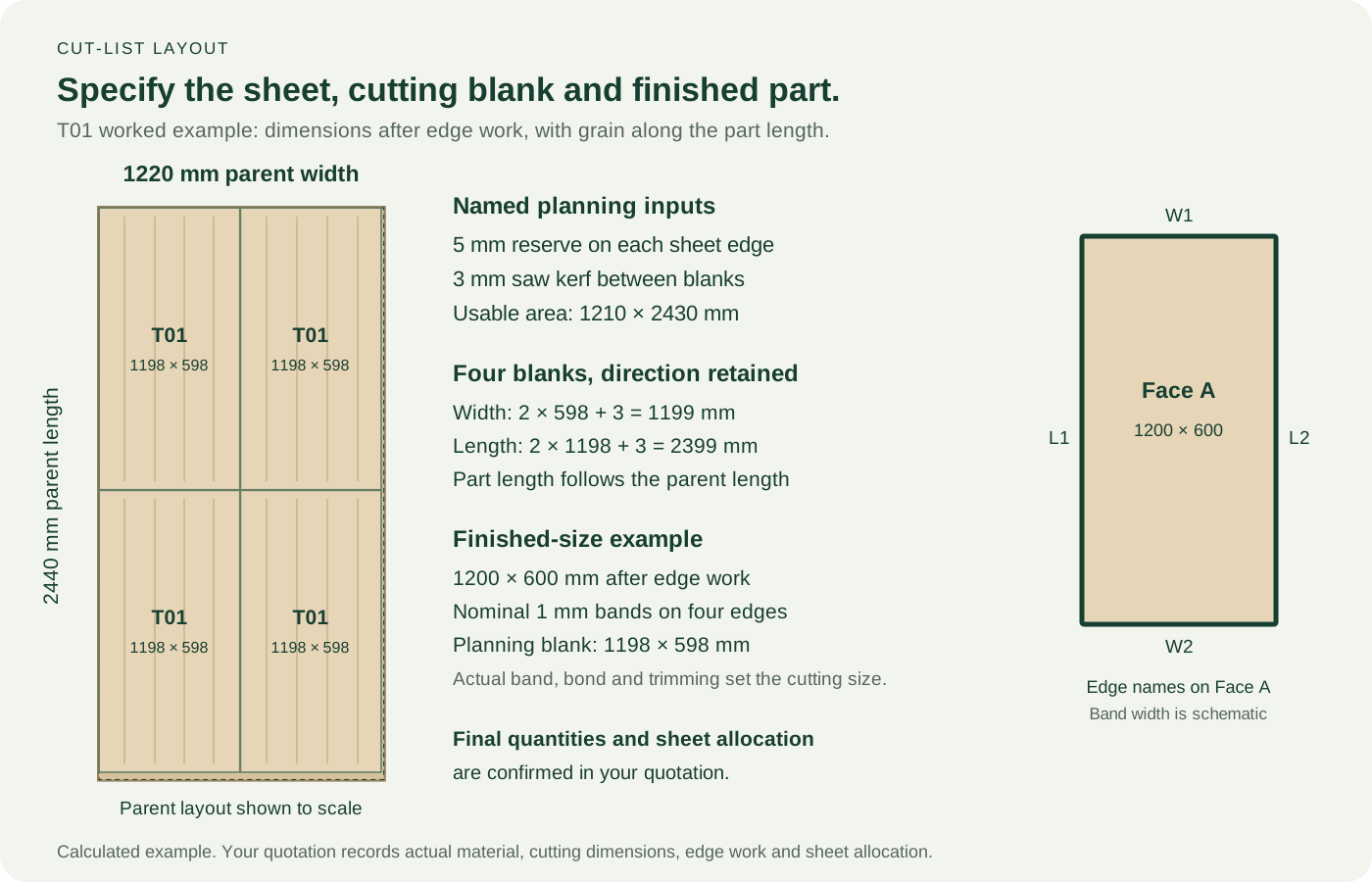
Finished dimensions also need an agreed condition. If a 1200 × 600 mm part is required after nominal 1 mm edge banding on all four sides, the simple planning subtraction gives a 1198 × 598 mm blank. Actual band thickness, bonding, preparation, trimming and finished tolerance determine the cutting dimension used in production. We confirm that dimension and the supplied condition with your edge specification.
The downloadable example is a fictional component schedule without customer details. It contains the following three lines. Each material code is an example buyer identifier; the quote records the actual board and decorative reference for your order. Quantities illustrate the file format and serve as calculation inputs.
| Example part | Input and requested finished size | Quantity and supplied condition |
|---|---|---|
| T01 | Melamine MDF; 18 mm complete faced board; 1200 × 600 mm | 40 pieces; dimensions after nominal 1 mm banding on four edges; grain along the 1200 mm length |
| S01 | Raw MDF; 18 mm; 600 × 300 mm | 80 pieces; saw-cut edges, with further preparation by the buyer |
| P03 | Raw MDF; 6 mm; 900 × 600 mm | 40 pieces; saw-cut edges, identified as a separate material and pack group |
For T01, take a 1220 × 2440 mm parent sheet, 5 mm edge trimming reserve on each side and a 3 mm saw kerf as named example inputs. Four nominal 1198 × 598 mm blanks fit in a two-by-two layout: 2 × 598 + 3 = 1199 mm within the 1210 mm usable width, and 2 × 1198 + 3 = 2399 mm within the 2430 mm usable length. The long part direction follows the parent sheet's long direction in this drawing. That preserves the example's specified grain orientation.
The layout drawing shows the calculation; actual source dimensions, edge condition, direction, tool allowance and finishing requirements establish the production layout. The nominal four-blank arrangement illustrates material planning. The quote confirms the sheet allocation and finished quantities for the actual order, including the other material lines, spares and any offcuts you want returned.
Mark the visible face on the drawing and relate grain or decor direction to the part's stated length. With a directional melamine or veneer face, a rotated nesting layout changes the finished appearance. Let us know when a non-directional face can be rotated for material use. For a veneered door or wall set, add the panel sequence and adjoining edges so cutting follows the selected veneer arrangement.
In the template, L1 and L2 are edges parallel to the finished length; W1 and W2 are edges parallel to the finished width. Locate those names on a face-A drawing so left/right and front/back stay clear. Specify the treatment for all four edges: saw-cut, prepared, banded or another agreed operation. Add the band material and colour/reference, nominal thickness and corner details. A part-ID sample lets you check the face, finished dimensions and corners together.
Clean edge quality depends on the selected face, tooling, support and cutting process. The European Panel Federation's sawing guidance discusses securing the workpiece and cutting faced MDF. Our order records the actual edge condition and checks your parts need. For holes, shaped outlines, grooves or pockets, add drawings and use our CNC MDF Processing service to quote those features with the rectangular cutting.
Choose packing by part ID, cabinet, room, batch or assembly sequence. The example uses separate groups for tops, shelves and the thinner panel, making quantities easy to reconcile. A furniture set can instead combine selected IDs in the same group. State the number of pieces per set, required spare quantities and the receiving order; we agree the supported stack, handling size and pack list with those requirements.
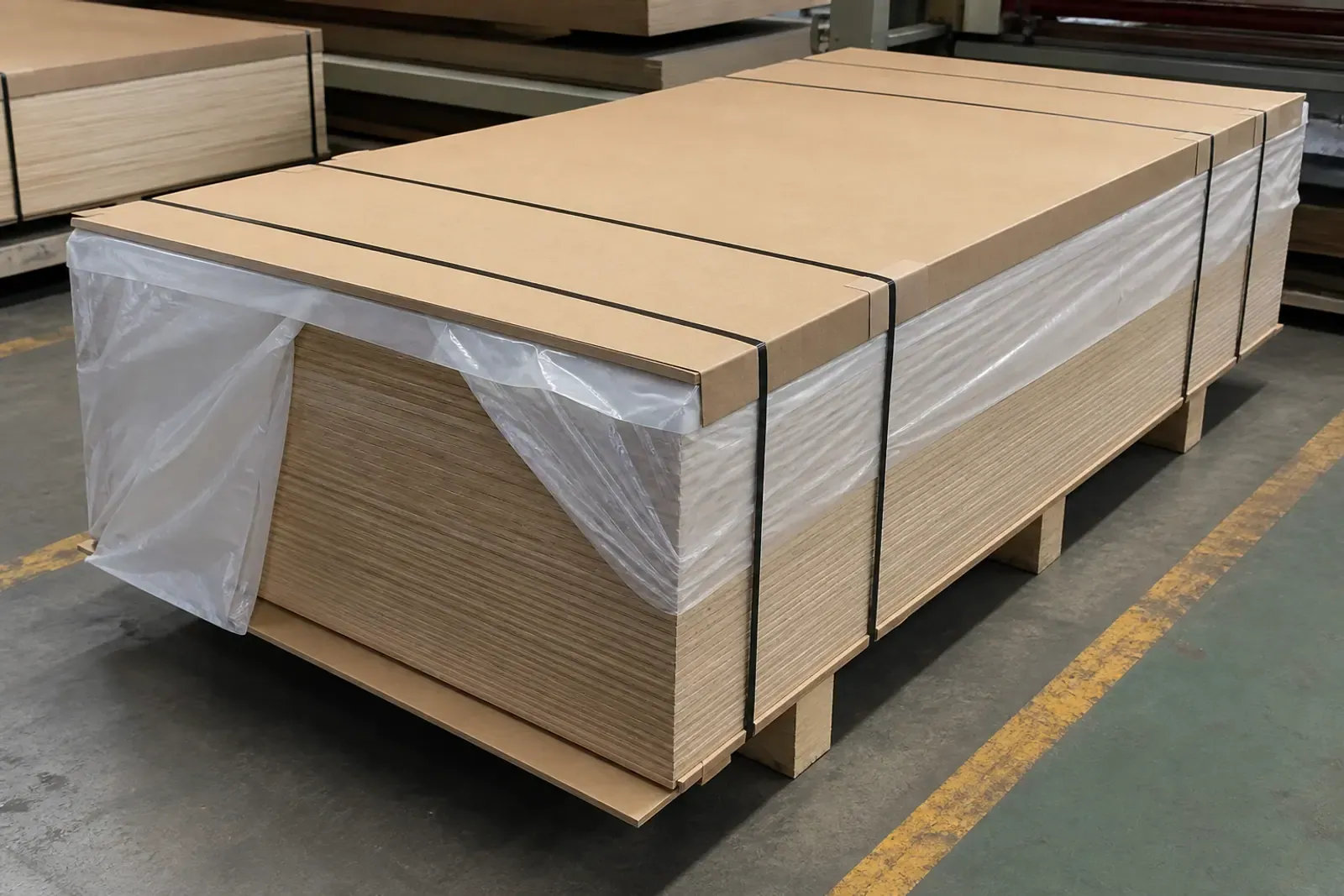
Labels connect the part ID and cut-list revision to the material, quantity and pack group. Clean separators protect decorative faces, and supported stacks, MDF cover boards, wrapping, edge/corner protection and controlled strap pressure suit the part dimensions and handling. Your furniture component schedule helps bring cutting, identification and assembly-ready delivery together.
Send the completed spreadsheet with dimensioned PDF drawings for the points that affect fit or orientation. For other CAD formats, include the file type with your enquiry so we can confirm the files used for quotation and production. Minimum part dimensions and handling limits are checked against the specific material and operations; the quote records the proposed supply. A representative first part or set can confirm the agreed dimensions, direction, edges and labels before repeat cutting. Third-party inspection is supported with the checks and timing agreed before shipment.
Use US$2–25/m² as a starting price range for cutting and component preparation. Your quote lists the board, finished parts, edge work, machining and packing. We show whether the material charge is based on full input sheets or finished-part area, so you can compare the total cost.
For the example's 40 finished T01 parts, the outer plan area is 40 × 1.200 × 0.600 = 28.8 m². A calculation using ten parent sheets at 1.220 × 2.440 m gives 29.768 m² of input-sheet area. These figures describe different areas, with the edge work and actual sheet allocation agreed separately. A clear pricing basis connects the material allowance to the parts you receive.
Start an enquiry with your part list, quantity and destination. Send completed files to sales@cuzimdf.com when ready; we reply within 12 hours to help complete the board selection and quote. Samples are free and generally in stock; you cover the courier cost, which can be credited against a formal order. We confirm preparation for a custom first part, dispatch and estimated transit time with the request. Normal MOQ is 1 × 20'GP per specification, with mixed-part quantities and grouping confirmed in the quotation. Normal production is 3–10 days after the specification and commercial terms are confirmed, including the agreed cutting, edging and packing schedule. The quote includes price/currency, FOB Qingdao or FOB Lianyungang, T/T or LC payment terms and validity. Export shipment is available through Lianyungang or Qingdao.
Applications
Build your wardrobe range with coordinated carcass panels, shelves, tall doors and backs. Our Shuyang factory supplies full boards, decorative panels or machined parts, with matched front pairs and cabinet-group packing for your assembly line.
Explore applicationOrder desk tops, meeting-table leaves, storage panels and drawer fronts for your office furniture range. Our Shuyang factory combines the selected board and surface with cut sizes, cable openings, hardware machining and labelled component packs.
Explore applicationSupply your shopfitting team with slotted panels, shelves, counter fronts and drawing-based display parts. Our Shuyang factory coordinates the selected surface, slots, openings and store labels for repeat fixtures and phased fit-outs.
Explore applicationPanels, plinths and display modules cut and labelled for transport, assembly and repeat use.
Explore applicationSheets and drawing-based components with agreed machining, face orientation, part IDs and packing groups for assembly.
Explore application
Boards and components
Request the selected-board reports and dimensional inspection records for the agreed cut-list revision, including length, width, squareness and edge checks.
Made in Shuyang, China
Work with Shuyang Cuzi MDF Co., Limited on board selection, machining, inspection and export packing. Our factory has a total daily production capacity of 500 m³ across its operations.
Made to order. The usual minimum is 1 × 20'GP per specification; mixed sizes or finishes are quoted together. Delivery lead time starts after specifications and terms are confirmed; sea transit is scheduled separately.
Freight is calculated for your ports and cargo quantity. Returns and exchanges, including timing and costs, are agreed in the order.
Delivery and freight terms · Returns and 180-day warranty · Packing and loading information
US$2–25 per m²
Your quotation confirms the specification, quantity, packaging and final price.
Buyer FAQ
Cut-to-size MDF provides straight rectangular cutting from finished length-and-width schedules. CNC processing adds shaped outlines, routing, grooves, pockets, holes and cut-outs. We can quote both together from one current drawing and cut-list package.
Yes. The blank CSV file opens in Excel or another spreadsheet editor and contains empty fields for your parts. The separate worked file shows three fictional example lines. Fill your own part IDs, material, dimensions, quantities, direction, edge treatments, requested tolerances and pack groups, then send the current file with your enquiry.
State the dimension condition for each part. If 1200 × 600 mm is the finished size after nominal 1 mm banding on four edges, simple planning gives a 1198 × 598 mm blank. Actual band thickness, bonding, preparation and trimming determine the cutting size confirmed in the quote. Identify all four edges and their treatments on a face-A drawing.
Send the actual part sizes and requested operations. Minimum dimensions and handling are checked for the selected material, cutting method and quantity, then confirmed in the quote. A spreadsheet defines rectangular parts; dimensioned PDF drawings clarify edges, orientation and critical fit. State other CAD file types so we can confirm the files used for quotation and production.
We agree the finished length, width, squareness, edge condition and measuring method after checking the selected MDF, part dimensions and cutting method. Identify the critical fit dimensions in your cut list. Nominal board-thickness tolerance and finished-part cutting tolerance are separate requirements.
Yes, when the complete faced construction and cutting method are compatible. Each part should identify the visible face, grain or decor direction, edge expectation and the protection needed between finished surfaces.
Yes. List each ID and the pieces needed per set, total sets, spares and pack group. We confirm the mixed-part quantities, selected material specifications, supported packs and labels in the quotation. Part ID, cut-list revision and the pack list stay connected through receiving and assembly.
Samples are free and usually in stock. You pay the courier charge, which can be credited against your order. Send the sample details and delivery address for availability, courier cost and timing. We will also give you a preparation date for custom samples.
Buyer guides
Prepare dimensions, part IDs, grain direction, edges and quantities for the parts you want to receive.
Read guideChoose the input sheet around your component sizes, cutting plan and workshop handling.
Read guidePlan a melamine MDF order with several colours and finishes. Use samples, quantities and packing groups to keep your furniture range coordinated.
Read guideKeep MDF furniture parts consistent across repeat orders. Plan drawing changes, matching finishes, samples and packing with a practical reorder example.
Read guideFor an inch-based MDF order, put the exact dimensions and tolerances beside the familiar size name. Three-quarter-inch MDF is 19.05 mm; a literal 4 × 8 ft sheet is 1219.2 × 2438.4 mm, slightly different from 1220 × 2440 mm.
Read guideA pre-shipment inspection helps confirm that the MDF order is ready to leave the factory. Compare the identified goods with the specification, drawings, samples and packing instructions you approved.
Read guideSend your current cut list, MDF construction, quantities and destination. Add face direction, critical tolerances, edge work and packing groups. We reply within 12 hours and can help plan a free sample or representative first part.