
Rebuild the 768-sheet calculation
A useful loading case lets your purchasing and logistics teams reproduce the numbers. Start with one sheet, multiply by the agreed pack count and then reconcile the container total. For this order, 18 mm becomes 0.018 m, 1220 mm becomes 1.220 m and 2440 mm becomes 2.440 m. Multiplying those three dimensions gives 0.0535824 m³ of nominal MDF volume per sheet.
| Calculation | Inputs | Result for this case |
|---|---|---|
| Sheets per container | 16 bundles × 48 sheets | 768 sheets |
| Nominal board volume per sheet | 0.018 × 1.220 × 2.440 m | 0.0535824 m³ |
| Theoretical net weight per sheet | 0.0535824 m³ × 680 kg/m³ | 36.436032 kg, approximately 36.436 kg |
| Total nominal board volume | 0.0535824 m³ × 768 | 41.1512832 m³, approximately 41.151 m³ |
| Theoretical net board weight | 41.1512832 m³ × 680 kg/m³ | 27,982.872576 kg, approximately 27,983 kg |
The calculated result uses nominal dimensions and nominal density. The recorded net shipment weight is 28,000 kg, about 17 kg above the theoretical result. Keep both figures with their descriptions: one supports early planning, while the other records the supplied shipment. Actual dimensions, density and weighing information are reviewed against the order when reconciling a difference. This case provides the two totals; the cause of the difference is established from the individual shipment records.
Use our MDF sheet weight and CBM calculator to change the inputs for your own purchase. For the board specification behind the calculation, see Raw MDF and MDF density explained. Keep the density stated in your quotation and order consistent with the density used by your logistics team.
Separate board volume from packed dimensions
The 41.151 m³ figure is the nominal solid volume of 768 boards. Booking and physical loading also use the external dimensions of each finished bundle, the container's actual internal dimensions and door opening, handling access and the agreed arrangement. These measurements answer different questions and belong in separate columns of the loading worksheet.
| Item | Calculation or measurement | Use in the loading plan |
|---|---|---|
| Nominal board volume in one bundle | 48 × 0.0535824 = 2.5719552 m³ | Board quantity and theoretical net-weight calculation |
| Nominal bare stack height | 48 × 18 mm = 864 mm | Starting point for the board stack before covers and supports |
| Finished bundle dimensions | Measure packed length, width and height | Check space, door clearance, handling and placement |
| Packed bundle weight | Use the confirmed weight for the finished bundle | Check handling and weight distribution |
| Container dimensions and limits | Confirm the specific container and booking | Check fit, permitted loading and transport acceptance |
Protective covers, supports and other packing materials contribute to the finished pack dimensions and weight. A nominal 864 mm board stack therefore starts the pack-height calculation; the completed bundle is measured after packaging. Using measured pack dimensions also helps your receiving team prepare its unloading equipment and storage positions.
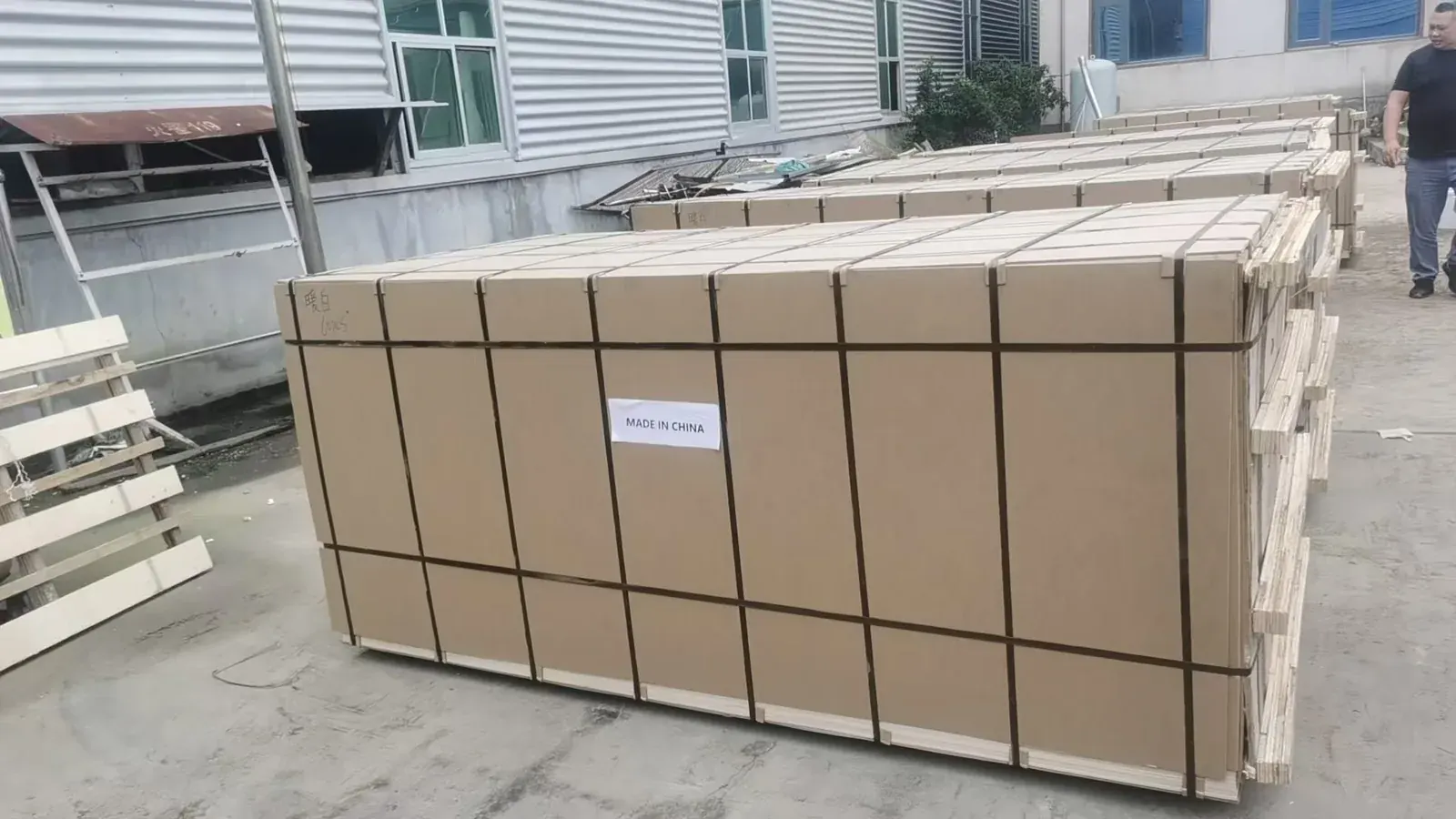
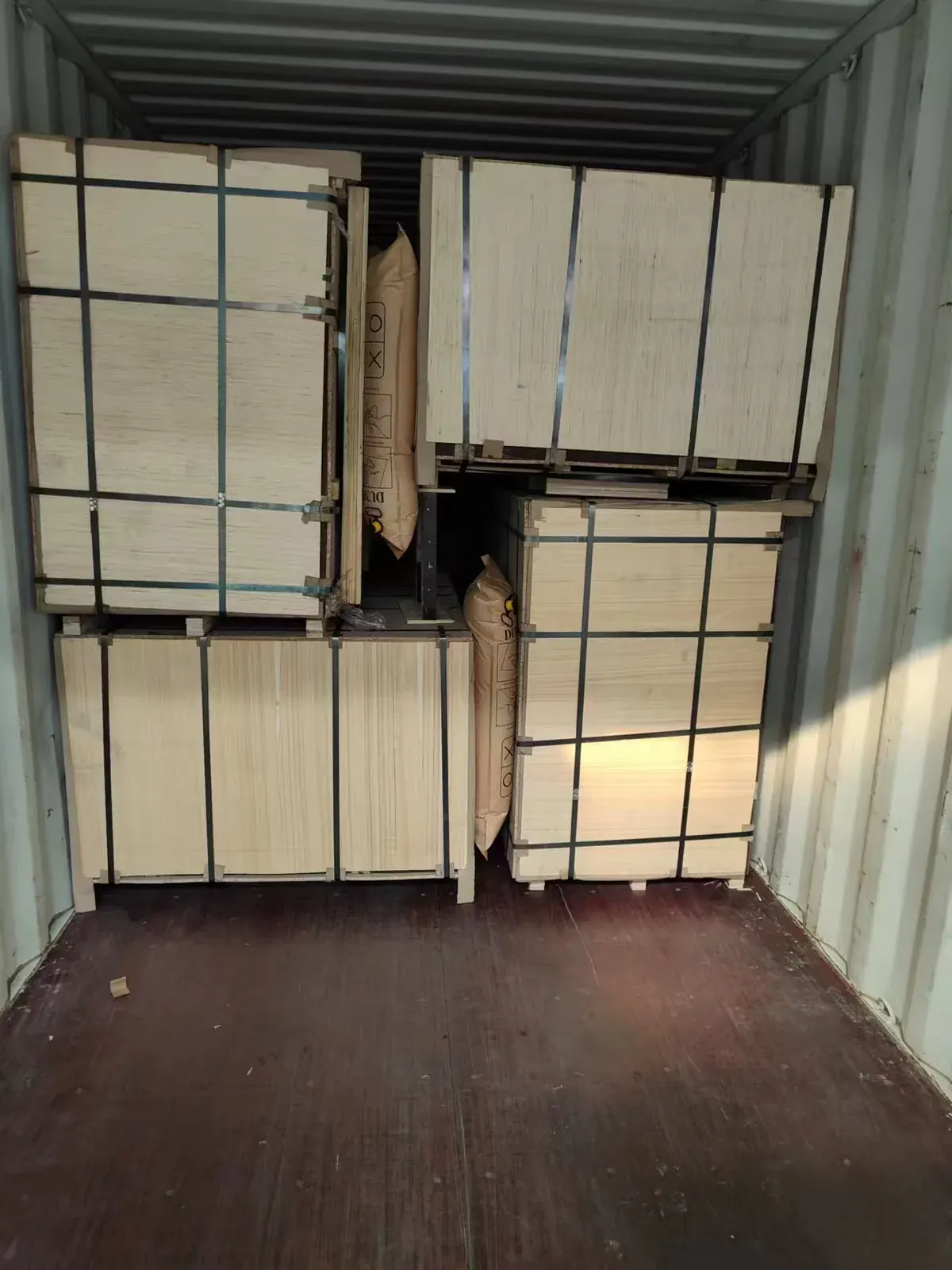
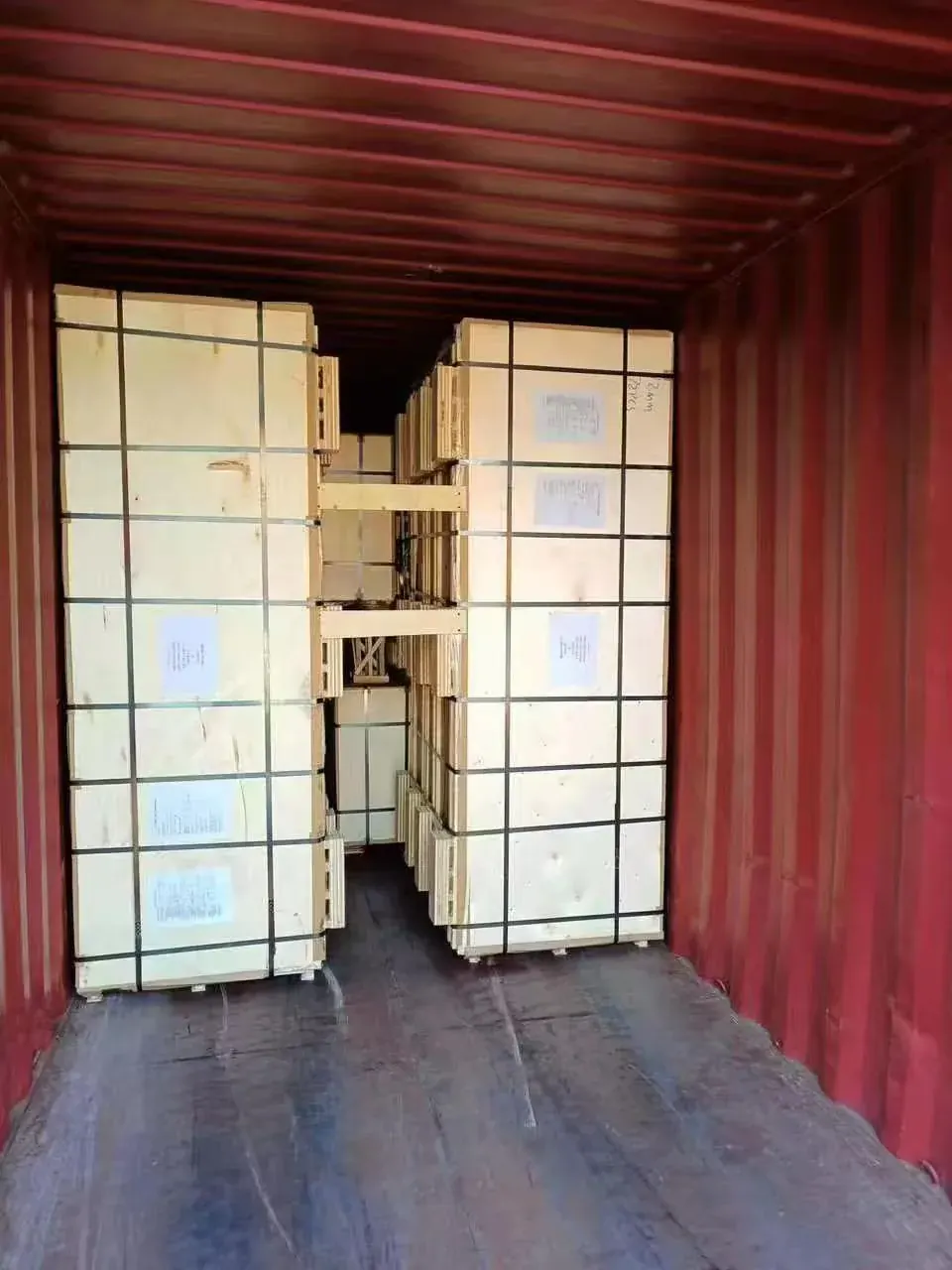
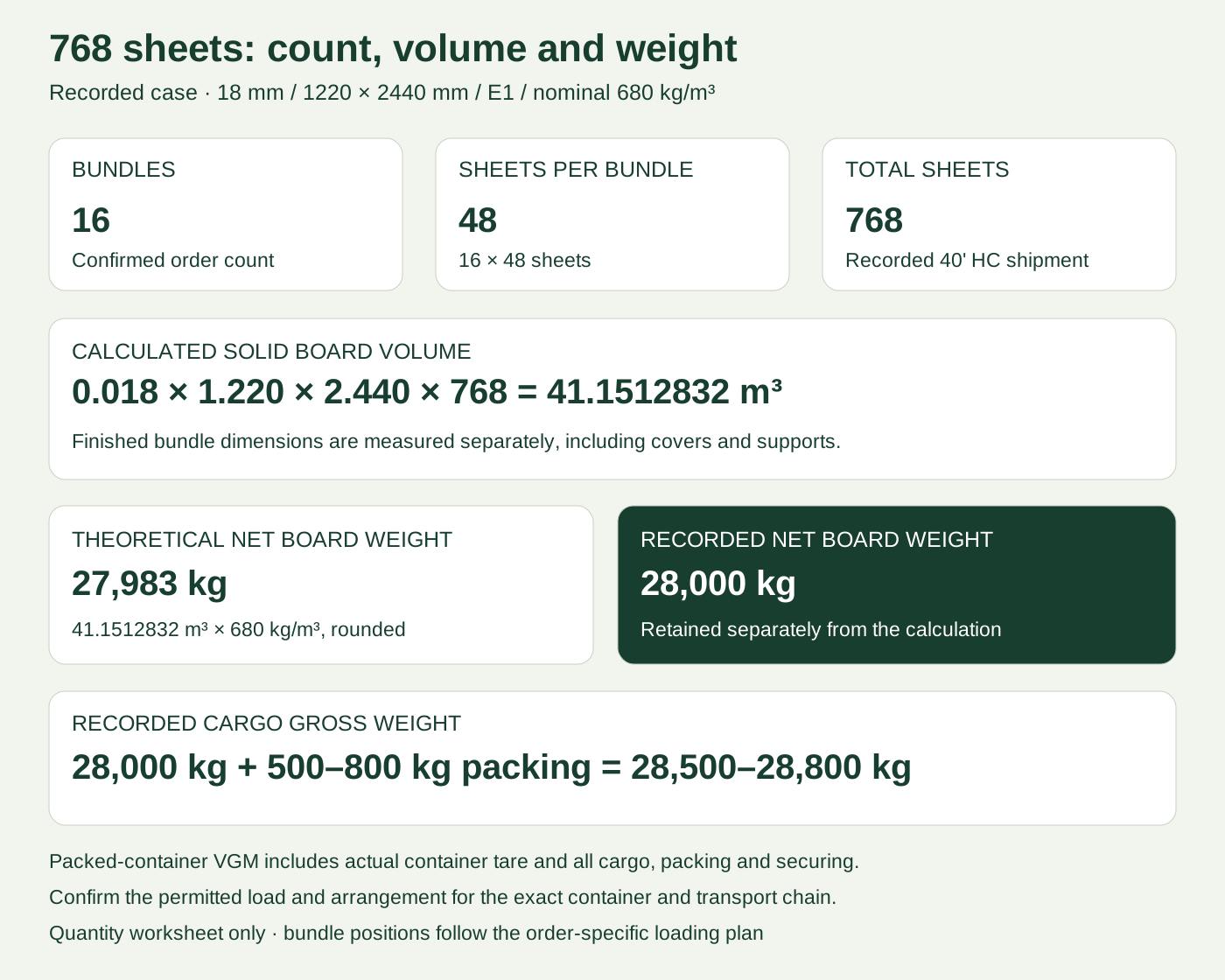
The numerical diagram above describes count, board volume and weight. The photographs show this shipment's packaging and loading. The actual bundle positions, stacking arrangement and securing details for a new order follow its loading plan. We confirm those details from the purchased specification and the available container.
Read net weight, packaging, cargo gross weight and VGM correctly
Clear weight descriptions help prevent a board calculation being passed to a forwarder as the wrong shipment figure. The recorded net board weight is 28,000 kg. Adding the recorded packaging allowance of 500–800 kg gives a cargo gross range of 28,500–28,800 kg. Container tare is a separate input to the packed-container mass.
| Weight description | Figure or basis | What it covers |
|---|---|---|
| Theoretical net board weight | Approximately 27,983 kg | Nominal MDF dimensions × nominal density × sheet quantity |
| Recorded net board weight | 28,000 kg | Net board weight in the shipment record |
| Packaging weight | 500–800 kg | Packaging allowance recorded for this case |
| Recorded cargo gross weight | 28,500–28,800 kg | Recorded net boards plus the packaging allowance |
| Shipment planning range | 28,500 ± 500 kg | A case planning band, equivalent to 28,000–29,000 kg |
| Packed-container VGM | Obtain for the loaded container | Verified mass of the complete packed container, including its tare |
The planning band helps reconcile this case's estimated shipment mass. Confirm the permitted cargo weight for the exact container, carrier and route used for your order. Cargo payload, maximum container gross mass, road limits and the carrier's booking conditions are checked with their own stated units and scope. A recorded cargo weight within the planning band still requires that booking review.
For VGM, IMO describes two verification methods: weighing the packed container, or weighing the cargo and all packing/securing items and adding the actual container tare through the approved certified method. The named shipper provides VGM in time for stowage planning. See the official IMO VGM guidance. In your weight schedule, reconcile the scope of each entry so every packing or securing item contributes once to the total.
Recalculate density and product changes before booking
Density changes the board weight even when thickness, dimensions and sheet count stay the same. The following comparison uses exactly 768 sheets of 18 mm, 1220 × 2440 mm MDF. The 680 kg/m³ row reproduces this case. The other rows are calculated comparisons for planning; each new supply specification and loading quantity is confirmed for its own order.
| Nominal density | Theoretical net weight for 768 sheets | Change from the 680 kg/m³ case |
|---|---|---|
| 680 kg/m³ | 27,983 kg | Case calculation |
| 700 kg/m³ | 28,806 kg | Approximately 823 kg more net board weight |
| 720 kg/m³ | 29,629 kg | Approximately 1,646 kg more net board weight |
These figures cover nominal MDF only. Add the confirmed packaging and any other cargo items when preparing the shipment mass, then obtain the packed-container VGM by the applicable method. The comparison illustrates why a quantity that worked for one density needs a fresh review when the density changes. Permitted payload and geometry together determine the order's usable loading quantity.
| Changed order input | Effect to calculate or measure | Information we confirm for your order |
|---|---|---|
| Thickness or sheet size | Board volume, stack height and physical fit | Dimensions, tolerances, sheet count and bundle dimensions |
| Density or MDF grade | Theoretical net board weight and actual supplied material | Agreed density, grade and weight records |
| Decorative face or other construction | Complete product weight and surface-protection needs | Finished construction and product-specific mass |
| Sheets per bundle or packing style | Pack height, gross weight and handling | Finished pack dimensions, protection and support |
| Mixed sizes or products | Individual item totals, placement and weight distribution | Line-by-line packing schedule and loading arrangement |
| Container or transport chain | Door clearance, payload and transport limits | Specific container details and carrier/road/destination acceptance |
A mixed purchase of Melamine MDF, HPL MDF or Veneered MDF is planned from the finished products and their packaging. We calculate each order line and combine the packs into the agreed loading plan. For the information to send before booking, use MDF container loading: data buyers should confirm.
Review packaging and handling with the receiving team
The original photographs show covered, strapped MDF bundles and bundles inside containers. They help you understand the shipment's packing form. For your order, confirm face and edge protection, supports, pack identification and the securing arrangement alongside the weight and dimensions. Packaging should support both the loading operation and the unloading method at your destination.
- Check covers, edge and corner protection against the board finish and agreed handling conditions.
- Confirm that supports and fork entry suit the packed bundle and the equipment used at both ends.
- Review pack labels against product, dimensions, quantity and the packing-list identification.
- Confirm container condition, load placement and securing for the complete transport chain.
- Share finished bundle dimensions and confirmed bundle weights with the receiving team before arrival.
- Agree loading, weighing and inspection records before shipment release.
Forklift loading was the method used for this case. Equipment selection for a new shipment uses the actual bundle weight, load centre, fork arrangement and the equipment's load chart for the intended operation. The nominal board weight per bundle is a calculation input; the complete pack weight and its handling geometry determine the handling review. Your unloading equipment and access are part of the same discussion.
The IMO/ILO/UNECE CTU Code provides non-mandatory guidance on packing and securing cargo transport units across sea and land transport, including receiving and unpacking. For the practical documents we discuss with you, see CUZI MDF packaging and shipping and the MDF pre-shipment inspection checklist.
Match the order, packing list and shipment records
A usable loading record connects the product that was ordered to the bundles that were packed and the shipment that was dispatched. Keep the same thickness, sheet size, density, grade and quantity descriptions across the quotation, order confirmation and packing schedule. Reconcile the final counts and weights before the transport documents are issued.
| Record | What your team checks | How it supports receipt |
|---|---|---|
| Quotation and order confirmation | Product, grade, density, dimensions, quantity and agreed terms | Establishes the purchased specification |
| Packing schedule and labels | Bundle identification, sheets per bundle, total sheets and finished dimensions | Links the received bundles to the order lines |
| Weighing information | Net, packing and cargo gross scope; actual container tare and VGM record | Gives logistics clear mass descriptions |
| Inspection record | Agreed checks, counts, product condition and packing condition | Connects shipment release to the agreed inspection |
| Loading record | Container identification, arrangement, condition and photographs | Helps receiving staff plan unloading and document arrival condition |
| Transport and commercial documents | Consistent cargo description, quantity, weights and delivery details | Supports booking, shipment and receiving reconciliation |
CUZI MDF supports buyer-arranged third-party inspection. Agree the inspection timing and checks with us while the order is being planned so the goods and relevant records are available for review. The final loading photos complement the quantity, packing and weighing records; each document has its own role in confirming the shipment.
At receipt, reconcile the bundle identification and quantities with the packing list and record the container and package condition before unpacking. Retain relevant photographs and the receiving count with the order reference. For a repeat purchase, carry forward the approved board specification and packing requirements while updating the new quantity, container and delivery details.
Confirm the destination requirements for the ordered board
E1 is the grade recorded for this order. For your purchase, we discuss the destination, end use and required product documents alongside the specification. The grade wording, test method, product coverage and applicable destination requirements are reviewed together. A loading count answers a logistics question; product documentation answers the material and market-entry questions for the supplied board.
For a US purchase, use our TSCA Title VI MDF documents guide to prepare the certification, labelling and shipment-document questions. For EU supply, see MDF formaldehyde documents for EU buyers. We confirm the available documents and their coverage for the ordered product. Request documents for your MDF specification with the destination and required grade.
If the order includes Moisture-Resistant MDF, Fire-Rated MDF or decorative finishes, include the intended application and complete construction. The product requirements, finished weight and surface-protection needs are then reviewed for those items. This lets us prepare the right material specification and the right loading calculation together.
Plan your own MDF shipment with our factory
If you want 18 mm E1 MDF in 1220 × 2440 mm sheets, send us the required density, quantity and destination. We can discuss whether a similar packing count fits your order and confirm the actual bundle data and loading proposal. For another thickness, size or finish, we build the calculation from that specification.
- Product and grade, including any finish or machining.
- Thickness, sheet dimensions, tolerances and required density.
- Quantity by specification and any mixed-product order lines.
- Packaging, labels and unloading requirements at your destination.
- Destination port or delivery location and preferred FOB shipment port.
- Required product documents, inspection and delivery timing.
We offer FOB delivery, with shipment through Lianyungang or Qingdao, and payment by T/T or L/C. Production lead time is generally 3–10 days after order confirmation; we confirm the schedule for the specification and quantity being purchased. Our usual minimum order is 1 × 20'GP per specification. The 40' HC case on this page is a shipment example for a specific order, and the quantity for your booking follows the product dimensions, density, packing and confirmed transport limits.
We reply to inquiries within 12 hours. A formal quotation includes the product specification, quantity, price and currency, packaging, delivery term and named place, lead time, payment terms and validity. Request an MDF quotation and loading proposal to put the material and shipping figures in one discussion.
Product samples are free across our range and usually available from stock. The buyer pays the courier charge, which can be credited against the formal order amount. We confirm sample preparation, dispatch and estimated courier transit for the request. Request an MDF product sample to check the board or finish before purchasing. For an existing specification with a loading question, discuss the calculation with our team.
Questions buyers ask about this 40' HC loading case
How many sheets were loaded in this case?
The recorded total is 768 sheets: 16 bundles with 48 sheets in each. The specification was 18 mm, 1220 × 2440 mm, E1 MDF with a nominal density of 680 kg/m³. Keep all of these inputs together when referring to the count. Your new order is calculated from its agreed specification, finished packing and transport conditions.
Why are the calculated and recorded net weights different?
The calculation uses nominal inputs and gives 27,982.872576 kg, rounded to 27,983 kg. The shipment record gives 28,000 kg. The approximately 17 kg difference is reconciled with the actual product and weighing records. The page reports both descriptions; the calculation supports planning and the recorded value describes this shipment.
Is 41.151 m³ the packed cargo volume?
It is the nominal solid board volume. Packed cargo dimensions are measured around the completed bundles, including protection and supports. Physical loading also considers the container door, internal dimensions, placement and handling. We confirm the finished pack measurements for your loading plan.
Does 48 sheets mean a finished bundle is 864 mm high?
Forty-eight nominal 18 mm boards make a nominal bare stack of 864 mm. Finished pack height includes the agreed packaging and supports, and actual dimensions are measured after packing. Share that completed pack height with the loading and receiving teams.
Can I use 768 sheets for MDF with a higher density?
Use 768 as the recorded count for this specification, then recalculate the proposed order. At the same sheet dimensions, 700 kg/m³ gives approximately 28,806 kg of theoretical net board weight and 720 kg/m³ gives approximately 29,629 kg. Packing, container and transport checks determine the count agreed for the new shipment.
Is 28,500–28,800 kg the packed-container VGM?
It is the recorded cargo gross range, covering the net boards and the packaging allowance. VGM covers the complete packed container, including its actual tare and the cargo, packing and securing items. Confirm the applicable verification method, completed mass record and submission timing with the shipment parties.
Does 28,500 ± 500 kg state the permitted payload?
It states the planning band recorded for this shipment case. The permitted load is confirmed from the exact container details and applicable carrier, road, port and destination conditions. We review those conditions with the final cargo and packing figures when planning your booking.
Do the photographs show the layout for every order?
They show packaging and container loading for this shipment. For your purchase, the finished bundle dimensions, product mix, weight distribution, handling access and securing requirements determine the arrangement. We confirm the order-specific loading plan and record the completed loading.
What should I send for an E1 MDF quotation?
Send thickness, dimensions, required density, quantity, destination and end use, together with the documents and packaging you require. We confirm the board specification, available product documents, pack data, terms and proposed loading quantity. The E1 designation is reviewed with the test method and destination requirements for the ordered product.
Can I arrange inspection and obtain a sample before shipment?
Yes. We support buyer-arranged third-party inspection and confirm the timing and scope with you. Product samples are free and usually in stock; the buyer pays the courier charge, which can be credited against the formal order amount. We confirm dispatch and estimated transit for your sample request and respond to inquiries within 12 hours.