
Name the laminate construction
Specify the face material, series, decor, texture and gloss. A laminate name alone does not identify the complete panel or its performance.
Professional MDF Manufacturer & Supplier
Pair the decorative laminate you want with the MDF panel your furniture needs. Our Shuyang factory supplies Laminated MDF with the face, reverse, edge treatment and component layout agreed from your sample and drawings.
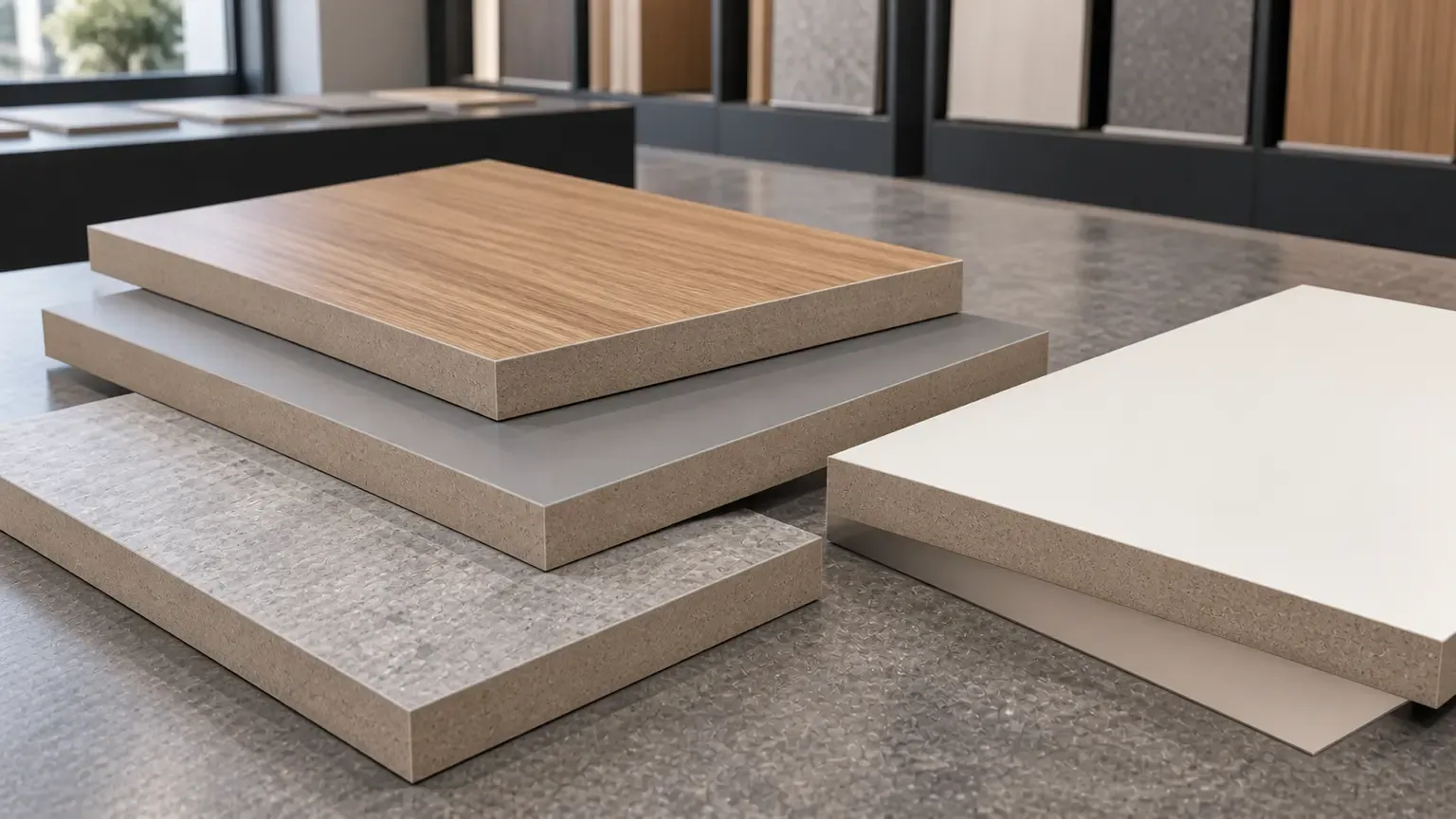
Technical specification
Laminated MDF combines an MDF core with a specified decorative laminate or facing. Identify the face material, bonding system, reverse and edges to define the complete supplied panel.
Finish and processing
Specify the face material, series, decor, texture and gloss. A laminate name alone does not identify the complete panel or its performance.
Choose the reverse construction with the face, core and adhesive. Agree conditioning, storage and the flatness requirements for the finished component.
Send part sizes and machining drawings. State whether dimensions include edge bands, and define visible edges, corners and protective handling.
Selection guide
A cabinet front, desk top or retail counter can look convincing in a colour sample, while its reverse, edges and supplied dimensions still need decisions. Laminated MDF brings a named decorative laminate together with an MDF substrate and a bonding construction. CUZI MDF manufactures and supplies the core and agreed laminate-faced panels from our factory in Shuyang, Jiangsu, China. Work with us on the complete panel your workshop will receive.
On this page, laminated MDF means a separately manufactured decorative laminate bonded to MDF, including identified HPL constructions. Pre laminated MDF describes a board supplied with its chosen surface already bonded; the quotation still names the material and both faces. The word laminate by itself can cover different products in a buying request. The table below helps connect that request with the actual construction and the appropriate product specification.
| Description in the request | Construction to identify | Product information for that material |
|---|---|---|
| Laminate-faced MDF or HPL laminated MDF | A separate laminate sheet, adhesive, MDF core and specified reverse | This complete-construction guide and the HPL MDF page for HPL grade, 0.5–1.2 mm face options and surface references |
| Melamine laminated MDF or directly pressed decorative-paper MDF | Resin-impregnated decor paper pressed directly onto the board | Melamine MDF owns the directly pressed melamine construction, decor and texture specification |
| Film-faced or acrylic-faced MDF | The actual PVC, PET or acrylic material and its flat-facing or forming process | PVC, PET and Acrylic Faced MDF identify those separate material families |
| Natural wood-faced MDF | Real veneer, its thickness, matching, reverse and supplied coating condition | Veneered MDF covers wood species, leaf matching and natural variation |
European Panel Federation guidance on melamine surfacing describes the direct pressing of resin-impregnated papers. A separately bonded laminate has its own adhesive and composite-panel construction. Choose by the material and delivered work, with colour, grain, texture and gloss recorded against the actual sample. Our HPL versus melamine guide compares those two purchasing choices.
This page covers the complete bonded-laminate order. The Decorative MDF page helps shortlist the broader appearance and surface families. Once you have a selected laminate or sample, the specification below connects that choice with the core, reverse, bonding, processing and finished edges.
Identify the visible decorative laminate by manufacturer/collection or another controlled material reference, decor code, texture/gloss, nominal thickness and direction. Add the grade and relevant test data for the intended use. A familiar colour name can occur across different laminate constructions; the actual reference gives purchasing and production a precise starting point.
Specify the MDF core separately. Our core capability is 2–35 mm with the listed thickness-specific density schedule and six input-board formats. Final faced-panel formats follow the selected laminate sheet, handling and component plan. A sheet-size capability and a particular face/core/format combination are different order details; your quotation identifies the available combination and quantity.
| Layer or detail | Information to put in the order | What to check on the sample or documents |
|---|---|---|
| Decorative face | Actual laminate reference/grade, nominal thickness, decor, texture/gloss and direction | Face identity, appearance, specified surface performance and care information |
| Face bond | Compatible adhesive system and bonding process for the selected laminate/core | Preparation, coverage, cure/handling conditions and agreed bond-quality check |
| MDF core | Grade, nominal thickness, density, input format, emission requirement and intended use | Core specification, measuring method and relevant product documents |
| Reverse bond and layer | Reverse laminate or balancing reference, thickness, orientation and bonding | Actual reverse construction, compatibility and panel-condition checks |
| Complete thickness | Core, face, reverse and bond-line contributions; finished tolerance | Finished thickness measured in the supplied condition |
| Cut edges and openings | Exposed or covered edges, band reference/thickness, corners and hole/cut-out finish | Visible-edge match, bond line, local finish and assembly fit |
| Part layout | IDs, visible faces, pattern direction, drawing revision and adjoining parts | Orientation, repeat/panel sequence and quantities |
| Supplied state | Full sheets, cut blanks, edge-finished parts or other defined machining | Work included in the quote and the next operation your workshop performs |
Adhesive selection follows the actual laminate, MDF grade, reverse, pressing process and end use. The order and current material instructions establish preparation, application, pressing, cure and handling; a representative bonded trial establishes the agreed checks. The visible surface, core glue and face-laminating adhesive are separate parts of the panel specification.
For humidity, cleaning chemicals, heat, wear or fire requirements, name the required property and method. The selected laminate's surface data addresses that material; adhesion, moisture response or fire behaviour may concern the complete panel. Tell us the destination and document list so the proposed construction and available information address the purchasing requirement.
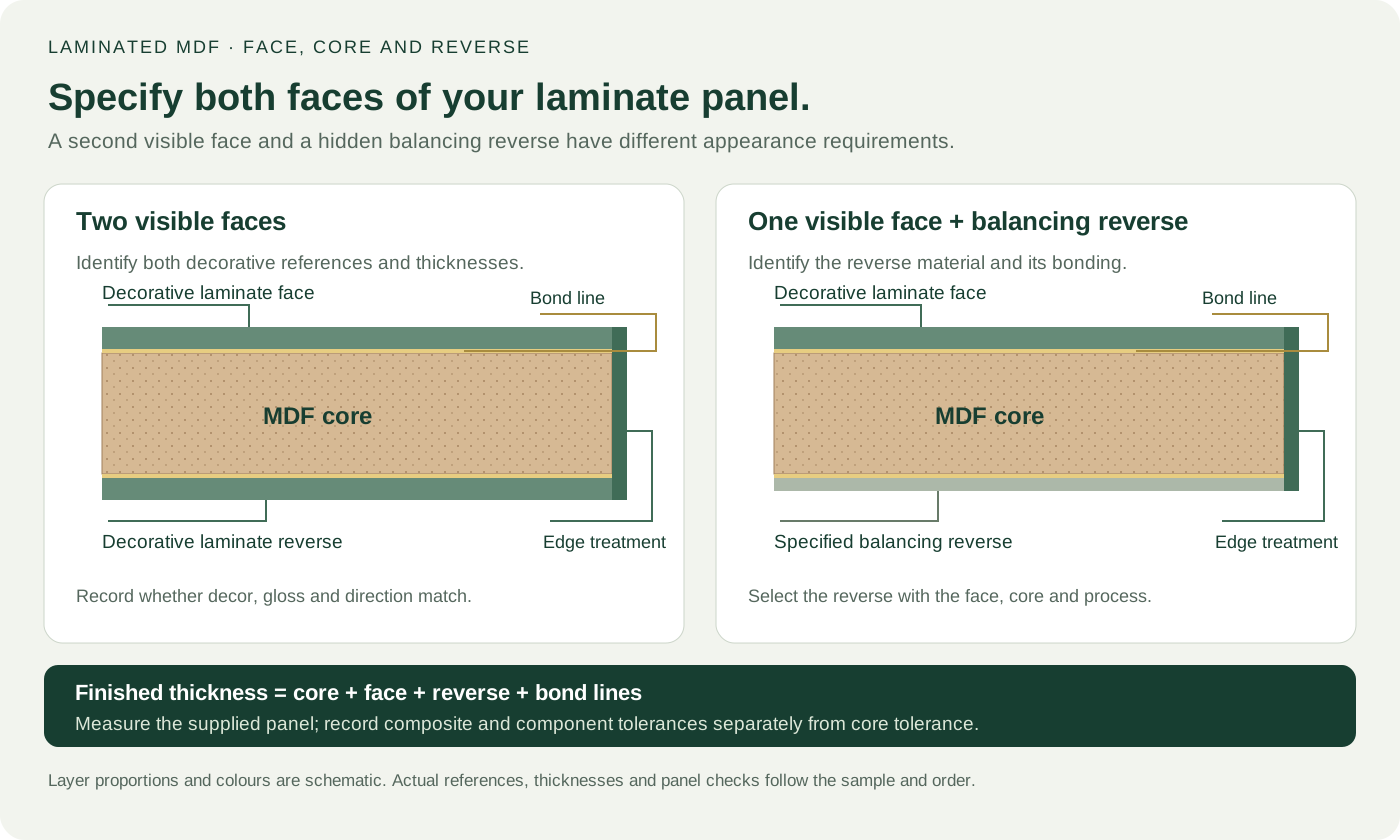
A second visible face and a hidden balancing reverse have different appearance requirements. For a double-faced part, identify both decorative references, thicknesses and directions, including whether the two sides match. For a single visible face, identify the actual reverse laminate or balancing material. A description such as white back records a colour; it also needs the material, thickness and bonding construction.
Face and reverse stresses, the MDF core, moisture conditions and support all affect panel flatness. A compatible backing is selected with the face and process. Its appearance can differ from the decorative face, while its construction must suit the intended panel and handling. The agreed combination and representative sample establish the reverse choice and flatness checks for the order.
Formica's substrate selection guidance relates the substrate to application and environment. European Panel Federation moisture-content guidance explains why MDF condition matters in subsequent processing. Use the selected material instructions and actual workshop conditions when planning conditioning and bonding. Fixed temperature, humidity, adhesive or press-time recipes belong to the specific system and process.
Store the core and laminate as specified for the selected materials, prepare clean surfaces, and provide flat supported handling for the bonded panel. Agree when the panel can be machined and handled after pressing. At inspection, record the supported condition, measurement method, environment and agreed flatness criteria. Those details make a comparison of two sample panels more useful than appearance alone.
For a door, long unsupported face or large wall panel, send sizes, span/support, fixing and service conditions with the layer specification. A worked shape or curved/postformed edge also needs a suitable laminate grade, core geometry, bonding and forming process. An ordinary flat-faced construction has its own scope; the proposed formed component is selected and checked with its complete section and actual sample.
Finished panel thickness combines the MDF core, face laminate, reverse layer and bond lines. Record each material's nominal thickness and the finished dimension/tolerance you need. Core nominal tolerance of ±0.1 mm applies to the MDF core measurement; finished composite and machined-part tolerances are agreed separately. The measured sample confirms the supplied thickness for grooves, hardware, fittings and neighbouring parts.
A cut exposes the core and layer edges. Agree whether your workshop will receive cutting blanks for further finishing or parts with completed edge banding. Define the edge material/reference, colour/texture, thickness, adhesive/process, corner detail and accepted appearance at the face-to-edge joint. For matching fronts and tops, inspect the actual face and edge together under agreed light.
| Processing stage | Dimension or drawing requirement | Sample/receiving check |
|---|---|---|
| Faced sheet | Input core/face format, finished panel thickness and trim allowances | Identified face/reverse, panel condition and supplied usable size |
| Cutting blank | Cut size, datum, pattern direction and allowance for the next edge operation | Cut quality, exposed core and orientation |
| Edge-finished part | Overall finished length/width, band thickness and corner/joint detail | Edge reference, completed dimensions and appearance |
| Machined component | Hole/cut-out/profile coordinates, depth, remaining sections, exposed finish and tolerance | Fit with hardware and adjacent parts; actual local face/edge condition |
State whether overall finished dimensions include the edge band. A cutting blank and a banded finished component can use different drawing dimensions. Part IDs and drawing revisions keep those stages connected. The Cut-to-Size page expands blank and finished-size planning; CNC processing explains machining references and remaining sections.
Routing into or through a laminate changes the exposed local construction. Define whether an opening or profile is cut before or after facing, and how the cut face, edge or groove is finished. For a shaped or wrapped front, specify the process and complete section. Share a representative component drawing so our quote includes the actual machining and finish your assembly needs.
A small face swatch establishes the decorative reference; an identified complete panel sample shows the layers, edge and supplied work. Request the chosen laminate with the actual core and reverse, plus edge or machining where it matters. Compare colour, texture, gloss, pattern scale/direction and the finish on both visible and adjoining parts under the same agreed viewing conditions.
For two proposed layer constructions, keep a separate sample identity and specification for each. A two-visible-face sample and a single-visible-face/balancing sample can answer different purchasing needs. The sections on this page explain those choices schematically. Actual samples establish the material thicknesses, construction, appearance and panel condition your team reviews.
| Sample record | What to retain | How the next order uses it |
|---|---|---|
| Material identity | Face and reverse references, nominal thicknesses, core grade and bond-system record | Quotes and production use the same complete construction |
| Appearance | Physical sample ID, decor/texture/gloss, direction and accepted variation | New panels and matching edges follow the chosen reference |
| Dimensions and component | Supplied thickness, overall/blank sizes, edge details and current drawing | Hardware fit, quantities and prepared parts can be checked |
| Quality and performance | Agreed bond/flatness/edge checks; actual method and product data for required properties | Inspection and document requests address the selected series and panel |
| Packing and reorders | Part IDs, layout, quantities, pack groups and material-change record | Receiving and repeat supply follow the same part set |
Agree checks for adhesion, edge quality, dimensions and panel condition, with the measurement or test method and any required acceptance values recorded. A clean appearance is one check; bond quality and specified performance have their own checks and documents. Third-party inspection is supported with scope and timing agreed for the order. The laminated-panel construction guide provides a fuller purchasing review.
For a repeat batch, provide the previous product/laminate references, sample ID and drawings. Agree any change in face, reverse, core, adhesive, edge or supplied work before production and update the order record. For visible matching parts, include spare quantities and the intended panel/part sequence with the original order.
Send the laminate reference or sample, MDF core thickness/grade, panel or part sizes, quantities and destination. Add the reverse/balancing choice, visible sides, pattern direction, finished thickness, machining and edges. If you have a look in mind but are still choosing the laminate, share it with the furniture use and required surface properties. We reply within 12 hours to help complete the specification and quote.
FOB China price: US$195–450/m³ for Laminated MDF. Your quotation identifies the actual face, reverse, core and supplied work, with the charging unit and processing or edge work included or separately listed. It also covers quantity, price/currency, packing, FOB Qingdao or FOB Lianyungang, lead time, T/T or LC payment terms and validity. Compare offers for the same material, construction and delivered component.
All product samples can be requested free of charge and are generally in stock. You cover the courier cost, which can be credited against a formal order. We confirm the available sample, custom bonded or machined preparation where needed, dispatch and estimated transit time for your address. A physical face sample and a complete component trial have their preparation scope identified with the request.
Normal MOQ is 1 × 20'GP per specification, with any mixed sizes, faces or part groups agreed in the quotation. Normal production lead time is 3–10 days after the materials, complete specification and commercial terms are confirmed. MDF board production capacity is 500 m³ per day across the factory; laminating, machining and edge-finished output follow the selected construction and order schedule.
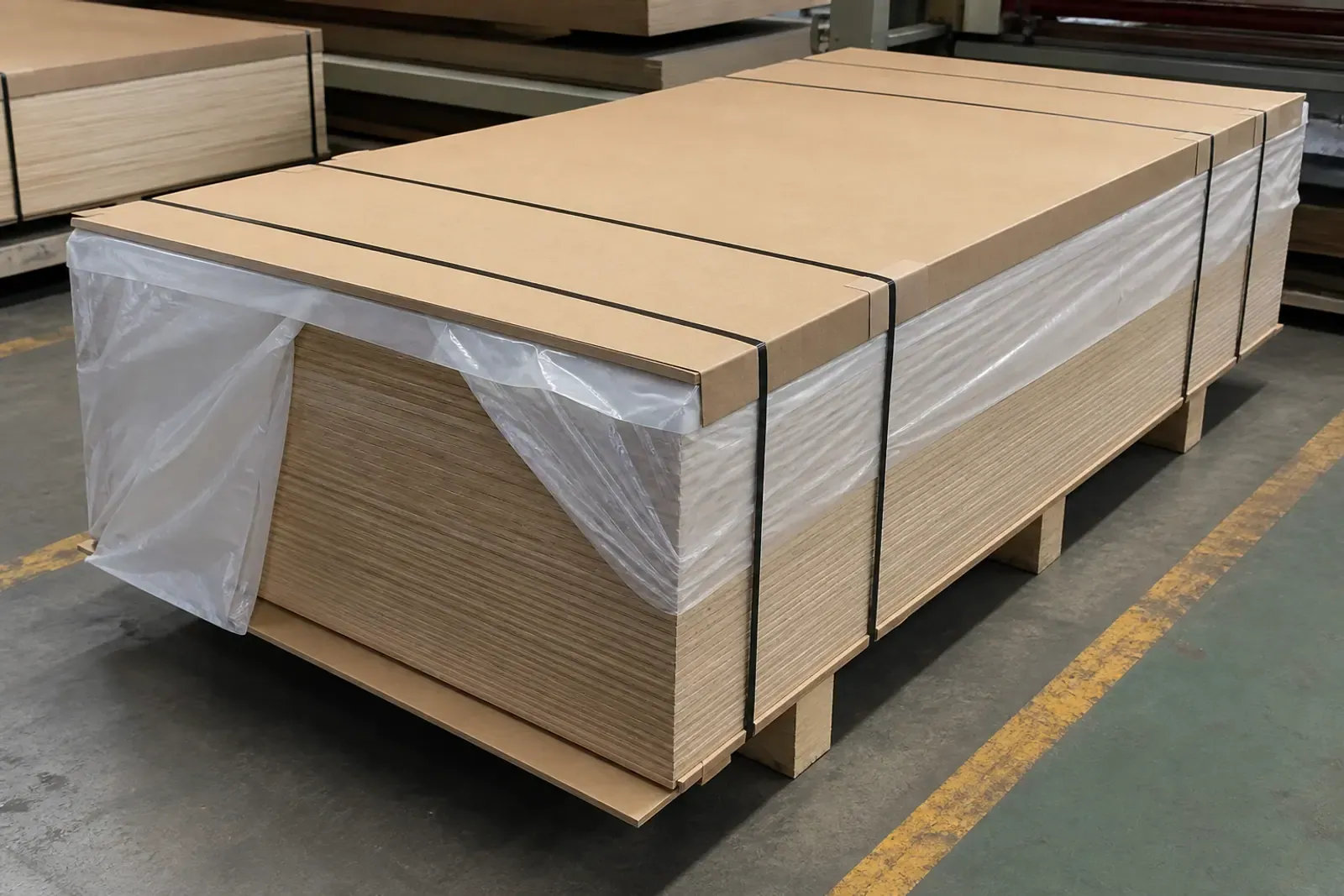
Clean separators, suitable face/edge/corner protection, supported packs, controlled straps and clear labels protect the chosen finish. Protective film, removal timing and handling follow the material instructions where applicable. Pack groups and pattern orientation follow your part list and assembly plan. Shipments use Lianyungang or Qingdao, with loading planned from actual dimensions, density and packaging.
Applications
Order desk tops, meeting-table leaves, storage panels and drawer fronts for your office furniture range. Our Shuyang factory combines the selected board and surface with cut sizes, cable openings, hardware machining and labelled component packs.
Explore applicationSupply your shopfitting team with slotted panels, shelves, counter fronts and drawing-based display parts. Our Shuyang factory coordinates the selected surface, slots, openings and store labels for repeat fixtures and phased fit-outs.
Explore applicationOrder MDF boards, decorative panels and machined parts for hotel headboards, wardrobes, desks and bedside units. Coordinate finishes, component quantities and labelled packs by room, floor or delivery phase.
Explore applicationPanels, plinths and display modules cut and labelled for transport, assembly and repeat use.
Explore applicationBoards and components
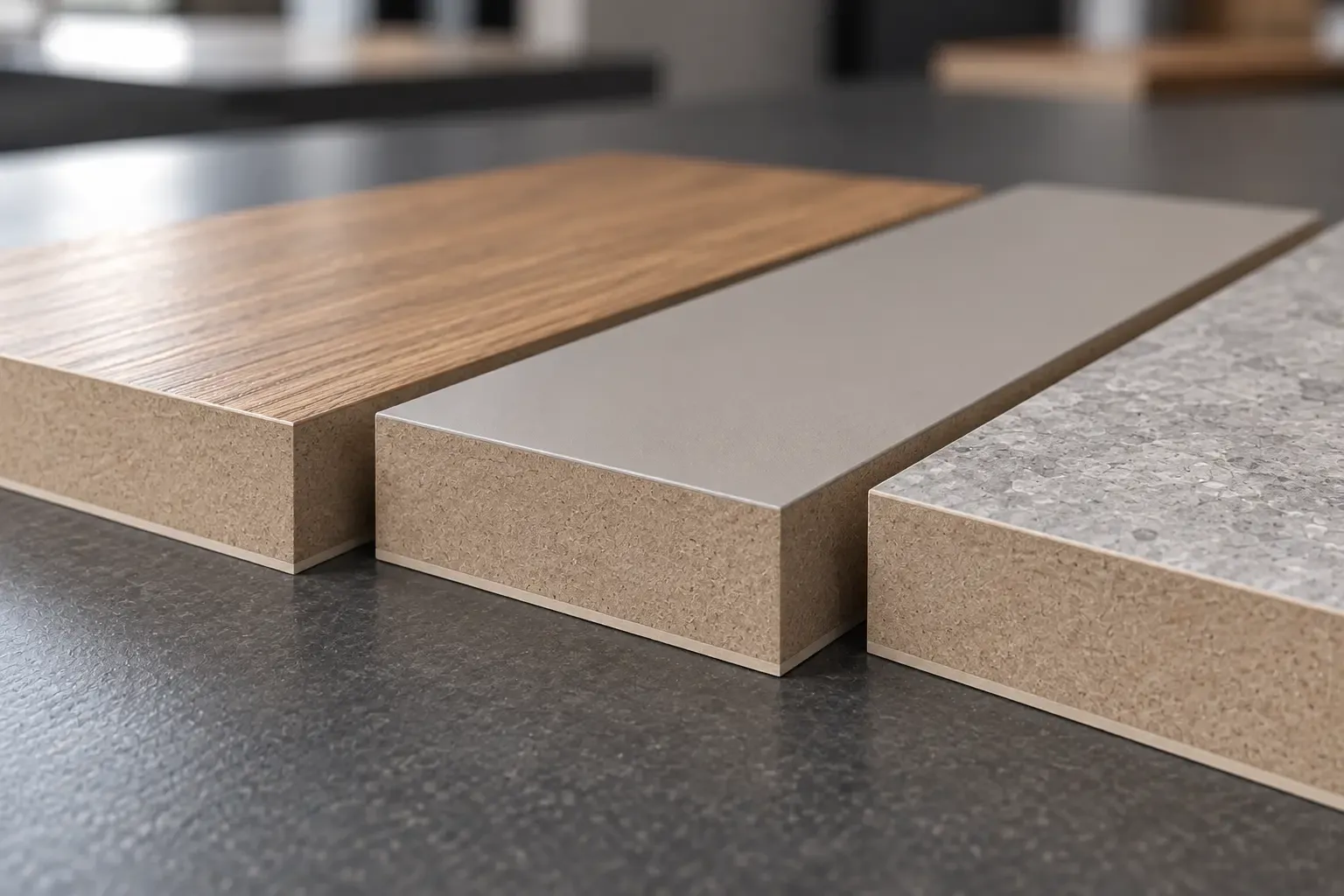
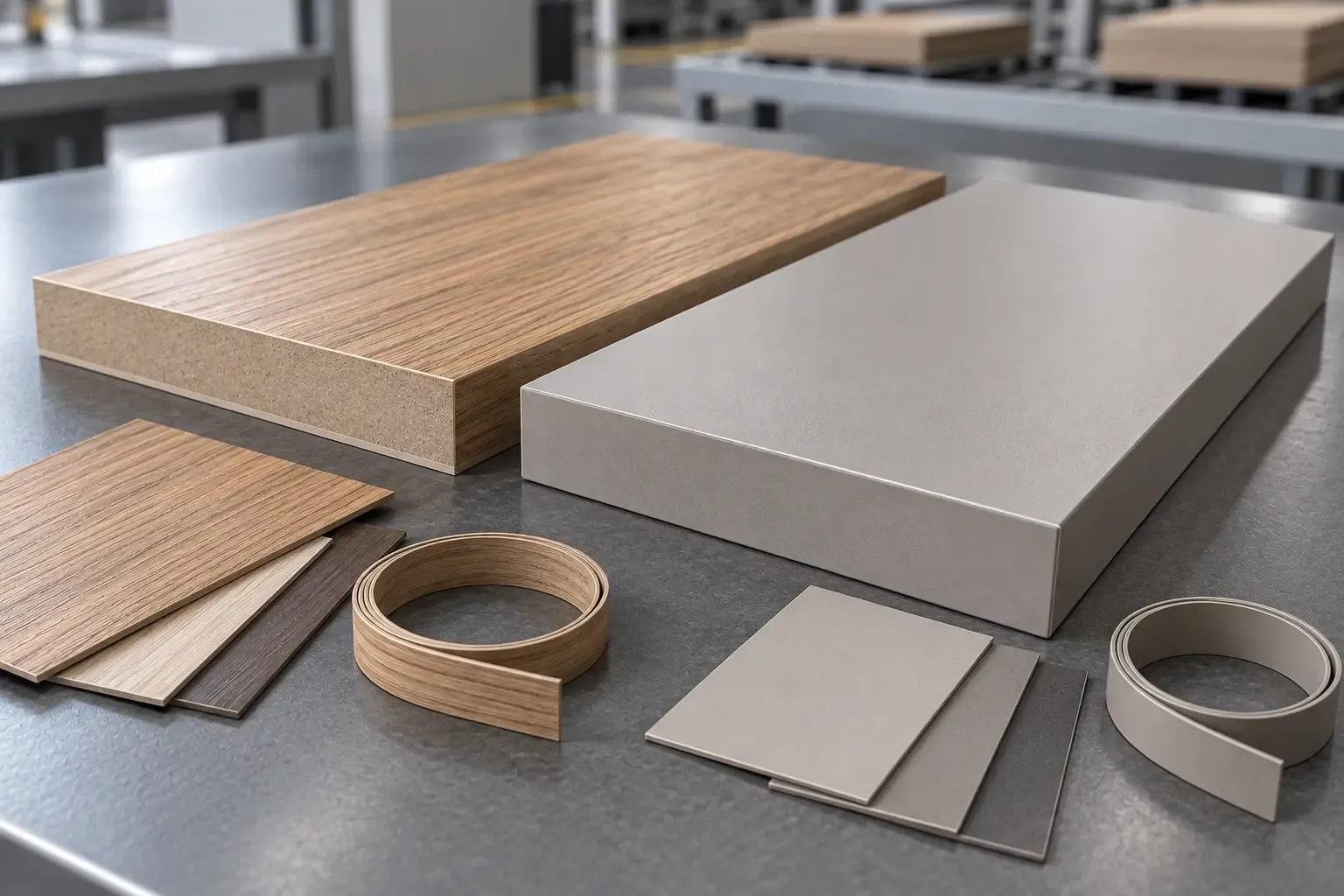
Request MDF core data and the relevant laminate, bonding and finished-panel information. Match fire, moisture and emissions requirements to the supplied construction.
Made in Shuyang, China
Work with Shuyang Cuzi MDF Co., Limited on board selection, machining, inspection and export packing. Our factory has a total daily production capacity of 500 m³ across its operations.
Made to order. The usual minimum is 1 × 20'GP per specification; mixed sizes or finishes are quoted together. Delivery lead time starts after specifications and terms are confirmed; sea transit is scheduled separately.
Freight is calculated for your ports and cargo quantity. Returns and exchanges, including timing and costs, are agreed in the order.
Delivery and freight terms · Returns and 180-day warranty · Packing and loading information
US$195–450 per m³
Your quotation confirms the specification, quantity, packaging and final price.
Buyer FAQ
Laminated MDF uses a separately manufactured decorative laminate sheet, including identified HPL-faced constructions. Melamine MDF uses resin-impregnated decor paper pressed directly onto the panel face. Choose by the actual construction and finishing requirements for your furniture.
Yes, when an identified high-pressure laminate sheet is bonded to the MDF substrate. Tell us the HPL finish and thickness you need, along with any required reports, so we can quote the complete panel.
Choose Laminated MDF for protected interiors with the core, reverse face, adhesive, sealed edges and joints matched to the exposure. For sustained water contact or exterior use, specify a complete system designed and tested for those conditions.
Samples are free and usually in stock. You pay the courier charge, which can be credited against your order. Send the sample details and delivery address for availability, courier cost and timing. We will also give you a preparation date for custom samples.
It describes MDF supplied with its chosen surface already bonded. The quote names the actual laminate or face material, MDF core, reverse, complete thickness and supplied work. Full sheets, cutting blanks and edge-finished components have their own size and processing specification.
Finished thickness includes the MDF core, face laminate, reverse and bond lines. Record each nominal layer thickness and the complete supplied thickness/tolerance. Nominal MDF core tolerance of ±0.1 mm is separate from composite and machined-part tolerances. Check the actual sample with grooves, hardware and adjoining parts.
Give the face/reverse materials, thicknesses and direction, core, panel sizes, support and service conditions. Agree conditioning, supported handling, measurement method and flatness criteria. The actual layer combination and sample are reviewed together; appearance descriptions such as white back are accompanied by the material and bonding specification.
Surface wear, scratch, stain or heat information follows the identified laminate series and method. Adhesion, moisture response, fire and other requirements may concern the complete panel, including core, reverse, bonding and edges. Request documents for the actual construction and intended use alongside the selected surface data.
Buyer guides
Choose HPL MDF for a specified laminate surface on furniture that sees frequent contact. Choose melamine MDF for decorative boards ready for cutting, edging and assembly.
Read guidePlan MDF retail fixtures around slot geometry, fittings, supported shelves and brand finishes. Follow shared panel datums and a three-store installation schedule.
Read guideSpecify MDF office furniture with finished top sizes, frame contacts, cable openings and hardware datums. Work through dimensions and a repeat component schedule.
Read guideLaminated MDF pairs an MDF substrate with a separately manufactured laminate surface. Specify the face sheet, core and reverse together to choose the appearance and performance your furniture needs.
Read guideSend the laminate reference or sample, core thickness, panel or part sizes, quantities and destination. Add the reverse-face, pattern direction and edge requirements. We reply within 12 hours to help complete your sample and quote.