
Match the actual insert and hook
Provide a fitting reference or sample with the slot drawing. Inserts and hooks are not universally interchangeable; identify what is included in the panel order.
Professional MDF Manufacturer & Supplier
Prepare your display panels around the fittings you use. Our Shuyang factory machines Slotted MDF and Slatwall panels to the slot section, insert reference and fixture layout, with finish and identified packs for your store fit-out.
Technical specification
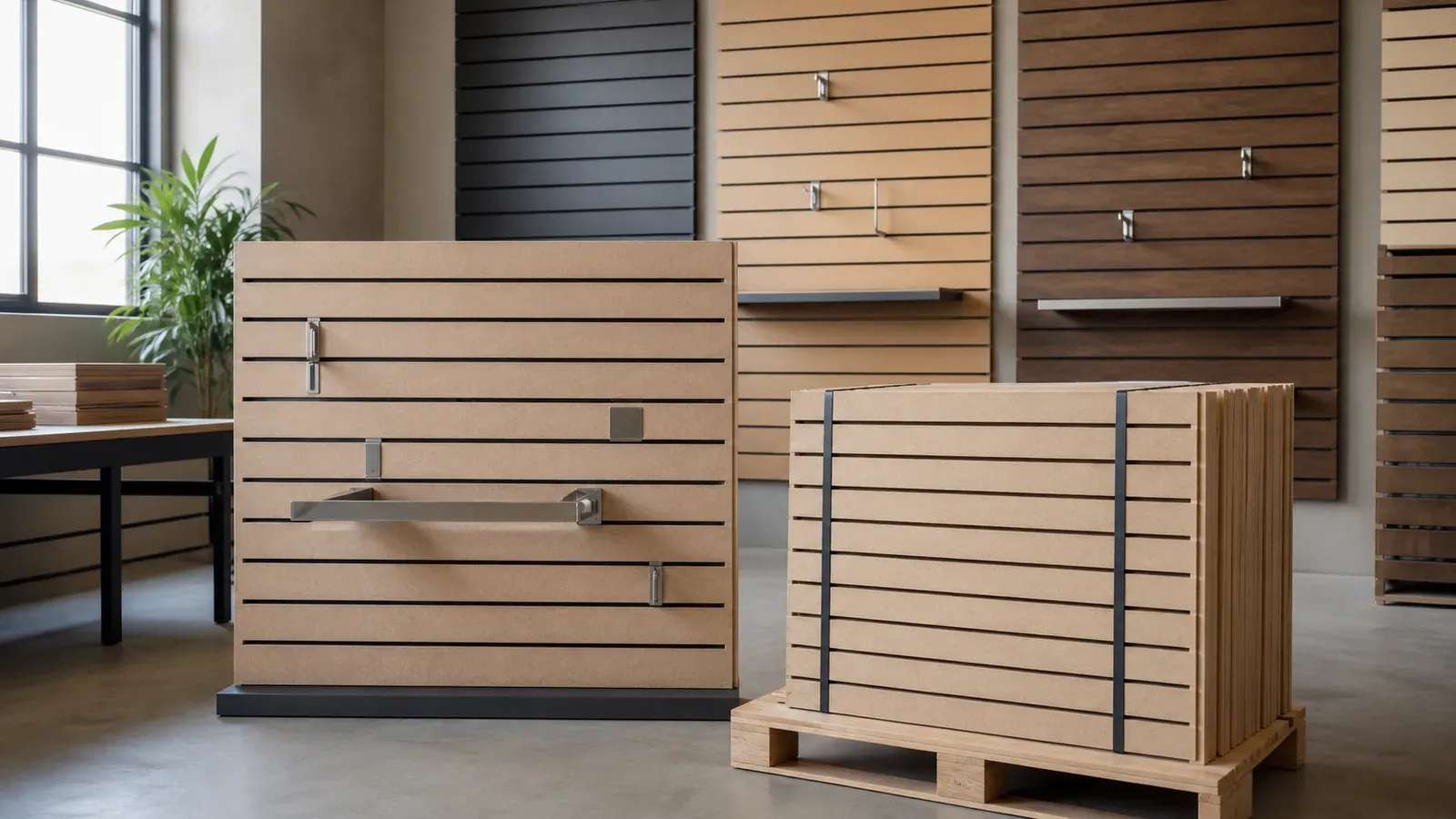
Slotted MDF Panels are machined for specified display inserts, hooks or brackets. Match the slot section, MDF core, panel layout and support to the complete retail fixture.
Finish and processing
Provide a fitting reference or sample with the slot drawing. Inserts and hooks are not universally interchangeable; identify what is included in the panel order.
Bracket projection, merchandise position, panel fixings and support affect the fixture. An insert or fitting trial alone does not establish a working load.
Set slot spacing, orientation, edge offsets and joint gaps across adjoining panels. Specify the face, edges, insert installation and module labels.
Selection guide
Slotted MDF Panels, also called MDF Slatwall panels, give retail displays a repeated interface for selected hooks, brackets, shelves and baskets. The useful starting point is the merchandise and the fittings you plan to use. A matched section and first-panel trial turn that choice into a repeatable shopfitting order, with the panel finish and installation groups prepared for your store layout.
CUZI MDF manufactures and supplies drawing-defined Slotted MDF Panels from our factory in Shuyang, Jiangsu, China. Send an existing fitting sample or controlled hardware reference, panel dimensions, layout, finish and quantities. We connect the MDF core, slot machining, insert arrangement and supplied finish in the quotation. This helps your team compare the complete requirement and receive identified panels for the next fit-out.
The primary purpose on this page is a functional retail hanging interface. Grooved MDF Panels covers decorative face patterns and module appearance. A sound-absorbing panel uses the complete acoustic construction: opening geometry, absorbing backing, cavity and mounting. See acoustic panel substrates or Perforated MDF with the actual tested system specification. A retail T-slot and insert establish a fitting interface; acoustic performance follows its own tested assembly.
Our input MDF range is 2–35 mm, with six listed board formats and the existing thickness-specific density bands. That range describes input-board production. The selected slatwall core needs adequate material around its particular slot, hardware and mounting. Core grade, thickness, internal-bond data where required, emission documents and finished panel construction belong with the component specification. Density helps identify the board; the complete fixture design establishes its intended loading.
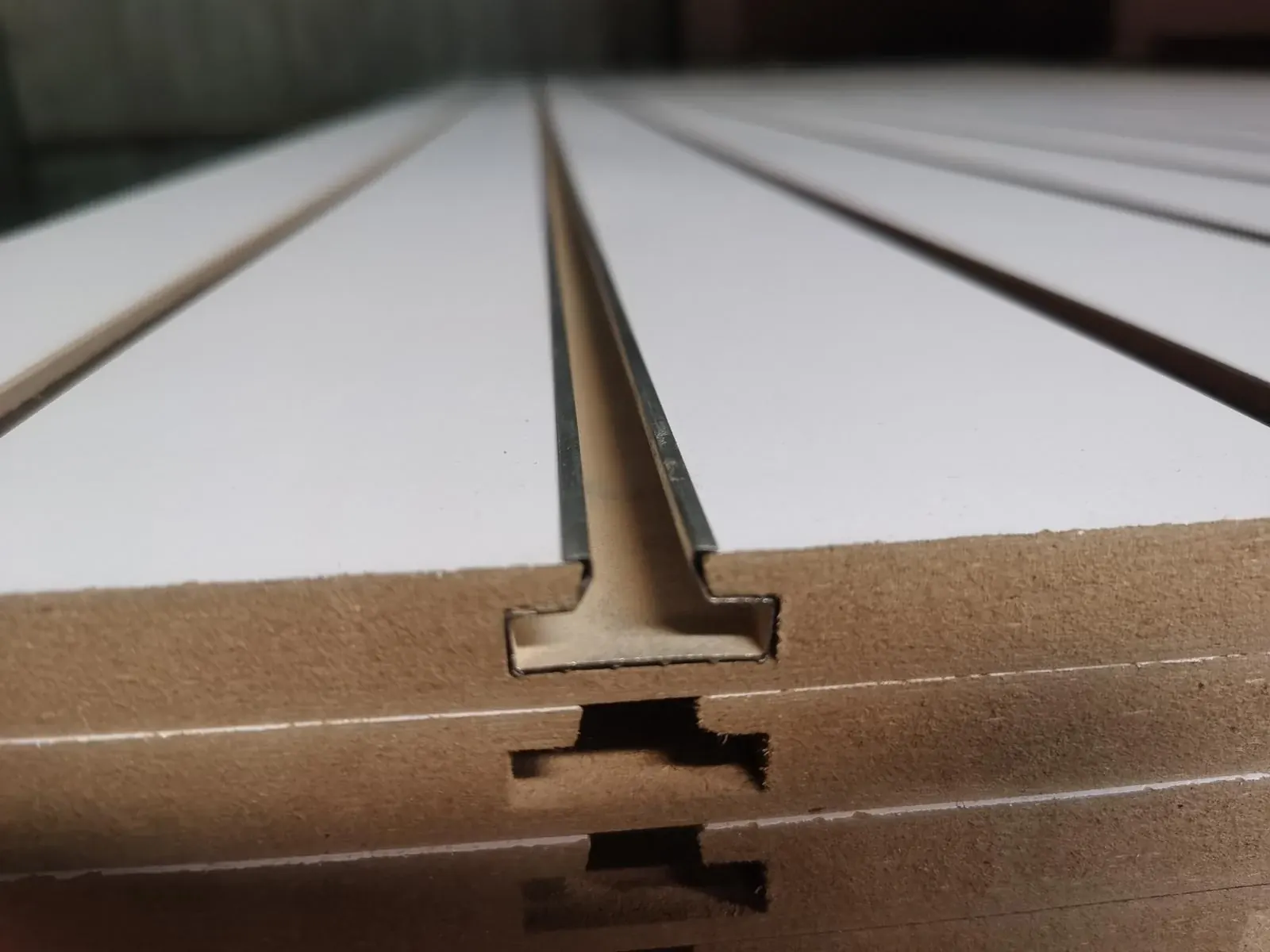
Use a cross-section through the actual slot and fitting, plus a face view showing slot positions. Identify the measurement datum: original MDF face, machined core or finished decorative face. Facing and coatings affect the finished opening and contact, so keep the completed section with the first-panel reference. A matching groove pitch or an insert described as standard gives only part of the information needed for compatibility.
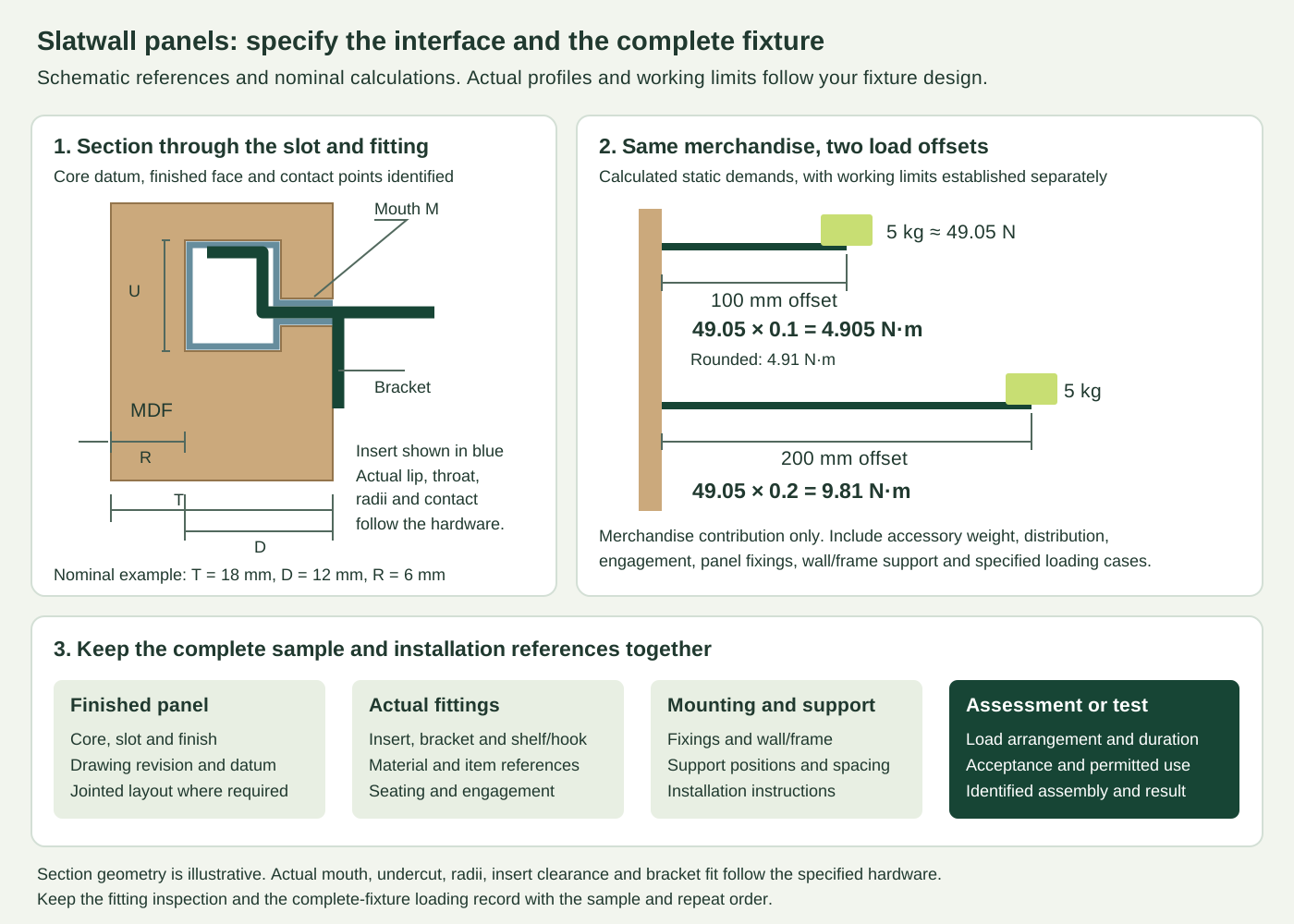
The diagram is a schematic dimension checklist. T is core thickness, M the slot mouth, U the undercut height, D the deepest routing depth and R the remaining core behind the cut. Show the retaining lip, throat length and root radii on the actual section as well. The metal insert and bracket engagement are illustrative; the real profile drawing, material and sample establish their dimensions and contact surfaces.
| Interface item | Information to put on the drawing | First-panel check |
|---|---|---|
| MDF core and routing | T, M, U, D, remaining R, lip/throat geometry and radii | Measure the machined section and material around the slot |
| Insert profile | Supplier/reference, material, outer section, wall thickness and internal opening | Seating, clearance, retention and intended contact with the routed core |
| Bracket or hook | Reference, tang dimensions, engagement, contact pad and projection | Insertion, full engagement, intended bearing and removal |
| Finished surfaces | Face/reverse build, slot finish, edge treatment and dimensional datum | Appearance and fit after all supplied layers |
| Layout and ends | Pitch, first-slot offset, groove length, end access and margins | Positions, insert installation sequence and panel orientation |
| Mounting details | Fixing holes/zones, edge distances and support references | Remaining material and access for the specified fixing arrangement |
For an explicitly nominal geometry example, T = 18 mm and D = 12 mm gives R = 18 − 12 = 6 mm. This describes the core remaining behind the deepest cut. The slot lips, radii, core properties and support still need their own design checks. Agree the actual dimensions and tolerances after reviewing the profile and representative part; the example supplies a nominal calculation. Actual CUZI MDF slot dimensions follow the agreed section and sample.
List the insert as a separate identifiable item. Metal reinforcing inserts, decorative plastic liners and a bare routed profile have different constructions and contact conditions. State material, profile, finish, length and quantity. For a rigid insert that enters from a panel end, plan access, end treatment and the installation sequence before the panel is enclosed. A different fitting method follows that insert's instructions.
Keep the bracket reference with the insert reference. Check tang width and shape, clearance through the mouth, engagement behind the lip and bearing against the face or insert. Include the actual shelf, hook, basket or rail used in the fixture. Coating inside a groove or adding a face layer can change the fitting clearance, making the completed sample the useful comparison for repeat orders.
Plan the load for the complete display: brackets, inserts, routed panel, fixings and wall or frame. The fixture designer should check this assembly for the weight and use you expect.
Bracket projection is especially useful information. Record the distance from the defined panel or support reference to the load's centre of gravity, as well as the total merchandise mass and accessory weight. A shelf with goods near its front has a different load distribution from a uniformly loaded shelf. The support spacing, bracket stiffness, number of fittings and distances to panel ends also affect the design.
| Loading information | What to record | Why it belongs with the fixture |
|---|---|---|
| Merchandise and accessory | Mass, dimensions, accessory self-weight and intended arrangement | Establishes the total force and its location |
| Projection and distribution | Load centre, shelf depth, concentrated or distributed placement | Establishes the overturning moment at the chosen reference |
| Fitting group | Hook/bracket references, number, spacing and distance from slot ends | Defines contact and how the assembly shares loading |
| Panel construction | Actual core, slot, lip, insert, finish and condition | Identifies the load-bearing component under review |
| Support and anchorage | Frame/wall type, support spacing, fasteners, fixing positions and substrate | Defines the complete path into the building or fixture |
| Use and assessment | Loading cases, duration, handling, environment and acceptance criteria | Connects the result to the intended service conditions |
For a simple static illustration, a 5 kg point mass gives approximately 49.05 N under gravity. At a 100 mm offset, its moment is 49.05 × 0.1 = 4.905 N·m, about 4.91 N·m. At 200 mm, it is 49.05 × 0.2 = 9.81 N·m. The diagram compares only that merchandise contribution. The complete assessment also includes accessory self-weight, the actual support reference and the specified loading cases. These values are calculated demands, with the fixture's working limit established separately.
For a shelf carried by several brackets, use the designer's load-sharing assessment. Actual stiffness, supports and loading positions establish each reaction. Describe foreseeable repositioning and handling in the use brief, with store personnel following the permitted arrangement and inspection instructions for the finished fixture.
As an external method reference, Wind Mill's slatwall support guidance distinguishes breakout-test results from recommended working loads and discusses accessory projection, weight distribution, installation and panel-end position. Those results concern its named products and test arrangements. Your CUZI MDF panel and selected hardware need the corresponding assembly-specific assessment or test and installation record.
A small section sample establishes the routed profile and finish. A representative completed panel adds the actual insert, bracket, shelf or hook, fixing and support arrangement. For a repeated store layout, include neighbouring panels and their intended joint so the trial also checks continuous slot alignment, hardware access and visible finish.
Identify the sample with the core grade/thickness, drawing revision, insert reference, bracket reference, finish and panel datum. Check dimensions, slot pitch and depth, mouth/undercut geometry, lip condition, remaining core, chips and completed edges. Fit and remove the actual accessories using their intended sequence, and inspect the seating and contact surfaces. Keep those records with the sample for production and repeat orders.
Ask the fixture designer or test provider to check the assembled display with its intended mounting, brackets and loads. Record how and where the load is applied and the result. This gives your team a useful loading guide for the finished fixture.
A report for another core, insert, hook, panel size or mounting arrangement needs a documented assessment of applicability to the proposed assembly. Breakout force and a permitted working load represent different criteria. Keep the named construction and assessment with any load stated for the finished fixture, including maintenance and permitted accessory changes.
The finished sample also settles surface appearance and handling. Review colour/decor, slot interiors, insert colour, reverse, corners and visible edges under the agreed viewing conditions. Sample approval guidance helps connect the finish reference to a completed part. Third-party inspection is supported with an agreed scope; dimensional inspection and full-system loading validation have their respective criteria.
Mark top, front and datum edge on each panel drawing. Dimension the first slot, pitch, end margins and interrupted areas from those references. Adjacent panels share a layout datum; their joint gaps, trims and final fixing positions belong on the elevation. A cropped or rotated panel can need a different slot offset or hardware access detail.
| Delivery item | Information to agree | Receiving or installation reference |
|---|---|---|
| Panel set | Finished dimensions, panel IDs, orientation, slot positions and zone quantities | Current fixture elevation and panel schedule |
| Finish | Raw/painted/melamine/laminate construction, reverse, slot and outside edges | Completed physical finish and interface sample |
| Inserts and accessories | Item references, lengths/counts, fitted or loose arrangement | Separate hardware list matched to the panel groups |
| Mounting and protection | Support/fixing design, clear zones, separators, covers and handling | Installation instructions and identified protected packs |
Choose raw machined panels for your coating process or the agreed painted, melamine, laminate or other decorative construction. Routing a faced panel can expose core inside the slot. Agree the supplied treatment and assess the finished hardware clearance after coating or inserting liners. Melamine MDF, HPL MDF and Laminated MDF describe their corresponding face constructions.
The installer follows the fixture design for substrate, support, fixings, spacing and clearances. Provide drawings for holes, services, trims and site cuts, with the remaining material and final finish at each change considered. Protected dry and humid interiors have different core and finish requirements. Cleaning and service instructions follow the selected surface and hardware system.
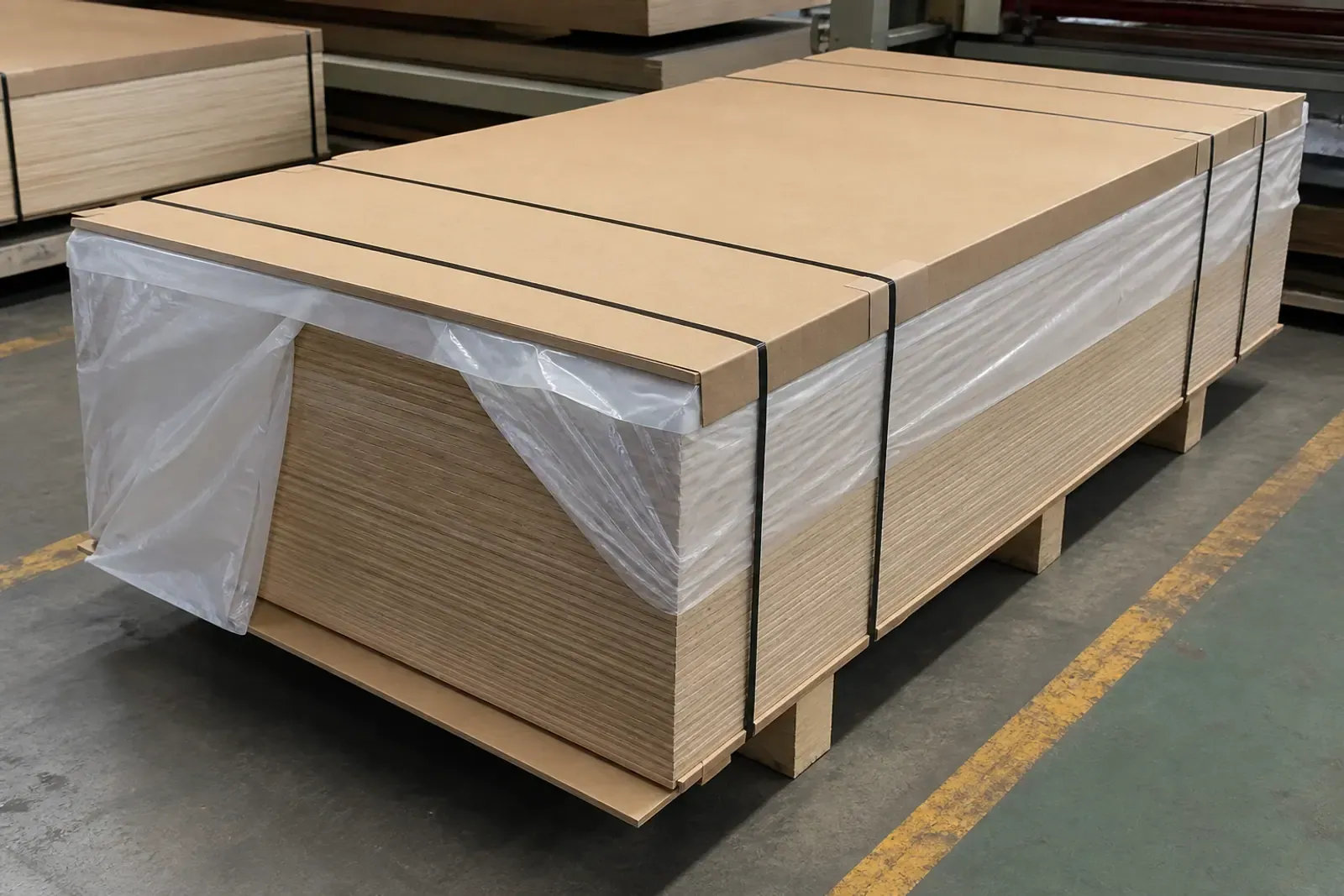
Pack panels on flat support with suitable clean separators, cover boards and edge/corner protection. Protect routed lips and insert ends from handling impacts. Identify panels by installation zone, separate loose fittings and provide a matching count list. Receiving checks can then follow the fixture schedule and retain spare-panel and hardware identity for the next store or replacement part. Retail fixture guidance connects those components to the fit-out brief.
Send your fixture drawing or an existing section/fitting reference, finished panel sizes, quantities by ID, core requirements, finish and destination. Include the merchandise, accessory projections and intended support arrangement for the fixture review. Our CNC MDF Processing and Cut-to-Size MDF services cover the drawing-defined operations within the panel set.
| Purchasing step | What you receive or confirm | Information that sets the scope |
|---|---|---|
| Sample request | Free product sample, dispatch and estimated transit plan | Address and required section, finish or completed trial |
| Hardware arrangement | Named inserts/accessories and fitted or loose supply in the quote | Profiles, references, counts, fit and installation sequence |
| Written quotation | Panel specification, quantities, price/currency, packing, terms and schedule | Current drawings, supplied finish, hardware scope and destination |
| Repeat order | The specified panel and fixture groups against their retained references | Sample ID, drawing revision and changes to finish or hardware |
All our products can be requested as samples free of charge, and samples are generally in stock. The buyer pays the courier cost, which can be credited against a formal order. We confirm sample availability, dispatch and estimated transit time for your address. We will give you a preparation date for a custom sample. We reply to inquiries within 12 hours.
FOB China price: US$3–11/m² for Slotted MDF Panels. Your quote lists the panel, slot machining, finish and any inserts, brackets or trims. Compare the same included items when choosing between panels and a complete fixture set.
Normal MOQ is 1 × 20'GP per specification. Normal production lead time is 3–10 days after specification and commercial confirmation; additional machining, finishing or fitting trials follow the schedule in your quote. MDF board production capacity is 500 m³ per day across the factory. Slat machining and assembled-component output follow the pattern, supplied stage and quantities.
The quotation includes product specification, supplied condition, quantity, price and currency, packaging, FOB Qingdao or FOB Lianyungang, lead time, T/T or LC payment terms and validity. Shipments use Lianyungang or Qingdao, with loading quantity based on panel dimensions, density, hardware and packing. Send the current fixture brief and we will help organize the sample, panel set and quotation for your project.
Applications
Supply your shopfitting team with slotted panels, shelves, counter fronts and drawing-based display parts. Our Shuyang factory coordinates the selected surface, slots, openings and store labels for repeat fixtures and phased fit-outs.
Explore applicationMachined substrates for a specified acoustic assembly. Performance depends on the backing, absorber, cavity and mounting as well as the panel.
Explore application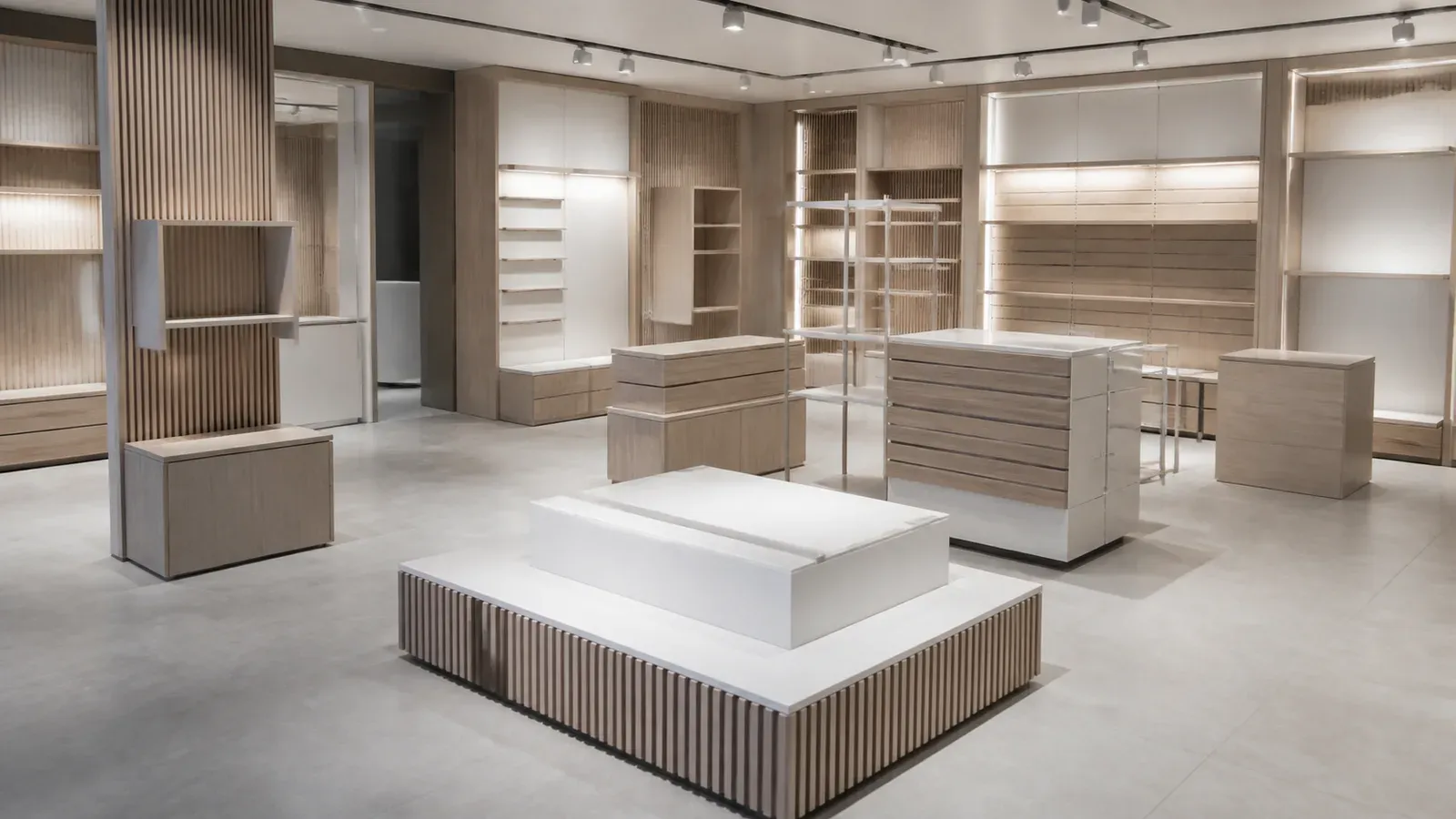
Boards and components
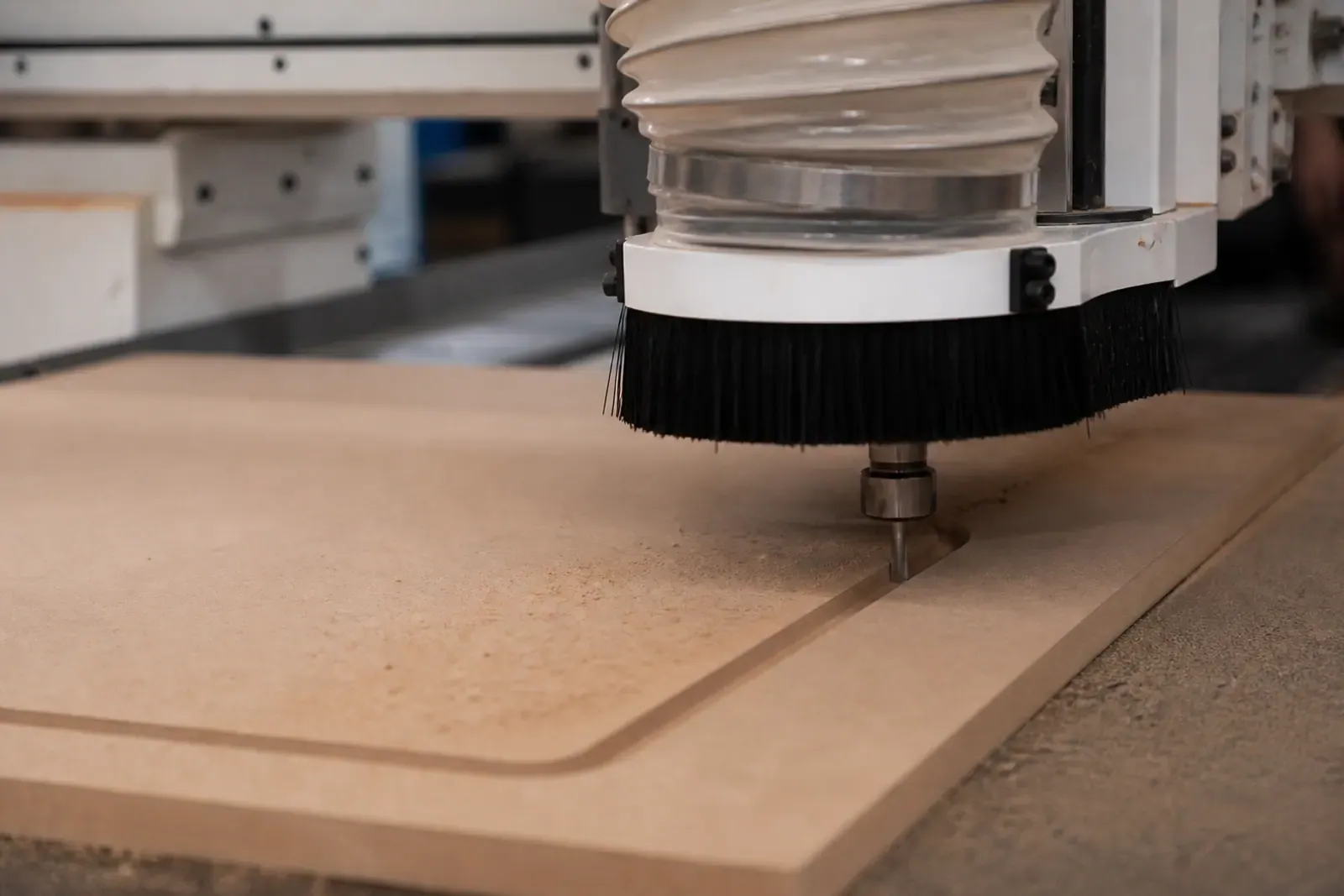
Request core and emissions documents, slot dimensions and fitting records. Any load rating must apply to the complete fixture, fittings, fixings and load arrangement.
Pre-shipment inspection · 20 October 2026
Follow a 980-panel order in white and brown melamine. See the slot profile, thickness and weight checks, and the aluminium channel fitted into both finishes.
HQC Inspection recorded Pass, with final approval by the buyer. Inspection took place before the panels were packed.
View the inspection case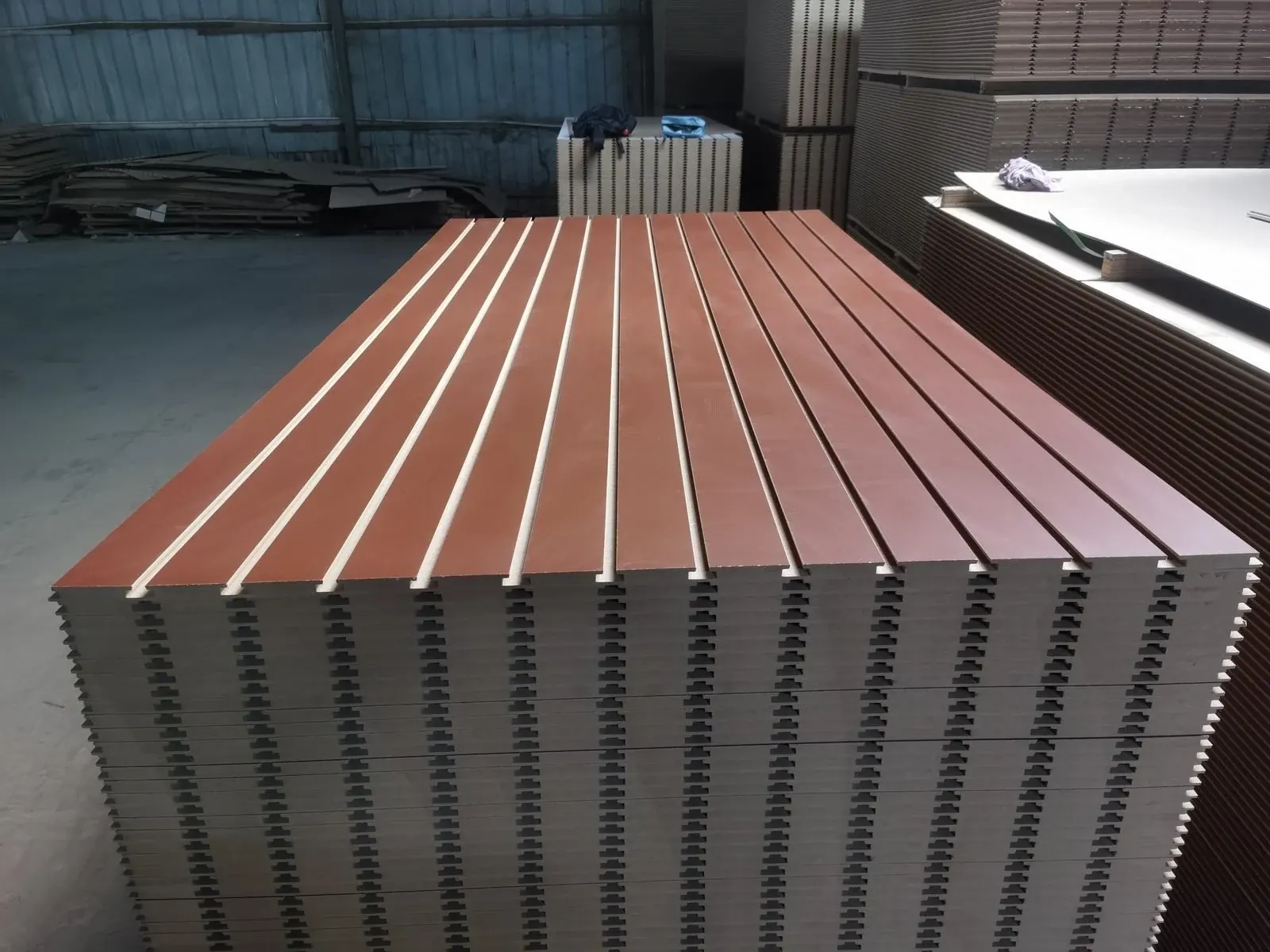
Made in Shuyang, China
Work with Shuyang Cuzi MDF Co., Limited on board selection, machining, inspection and export packing. Our factory has a total daily production capacity of 500 m³ across its operations.
Made to order. The usual minimum is 1 × 20'GP per specification; mixed sizes or finishes are quoted together. Delivery lead time starts after specifications and terms are confirmed; sea transit is scheduled separately.
Freight is calculated for your ports and cargo quantity. Returns and exchanges, including timing and costs, are agreed in the order.
Delivery and freight terms · Returns and 180-day warranty · Packing and loading information
US$3–11 per m²
Your quotation confirms the specification, quantity, packaging and final price.
Buyer FAQ
Inserts are included when identified in your written quote. Specify the material, profile, colour and quantity, plus fitted or loose supply. List the brackets as well so the first-panel trial uses the complete fitting.
Send a representative sample or dimensioned section, overall thickness, mouth and undercut, slot depth and pitch, plus the actual insert and bracket. The section and fitting reference establish the hidden geometry needed to reproduce the panel.
An insert is one part of the load path. Its fit, slot geometry, remaining MDF, bracket projection, panel fixings and wall or frame support all matter. Use an assessment or test applicable to the assembled fixture and intended loading.
Dimension the first slot from a shared datum and specify panel orientation, joint gap and slot repeat. Check a jointed sample or first installation set so a slot line remains consistent across the fixture.
Retail slots are specified around fittings and the fixture design. Decorative grooves are specified around visual profiles and module appearance. Select the product from its section and end use because similar-looking parallel channels serve different functions.
Samples are free and usually in stock. You pay the courier charge, which can be credited against your order. Send the sample details and delivery address for availability, courier cost and timing. We will also give you a preparation date for custom samples.
Record the load centre and its offset from the defined support reference. For the same merchandise force, a greater offset increases its moment. Include accessory self-weight, distribution, fitting positions, mounting and the intended loading cases in the complete-fixture assessment.
A first-panel fitting trial checks seating, engagement, removal, dimensions and appearance. Loading validation uses the agreed complete fixture, support, accessories, load arrangement and assessment or controlled test criteria. Retain both records for the intended use.
Buyer guides
Plan MDF retail fixtures around slot geometry, fittings, supported shelves and brand finishes. Follow shared panel datums and a three-store installation schedule.
Read guideDimension grooved MDF profiles, pitch, remaining core and panel joints. Work through corner returns, end details and a four-module feature-wall layout.
Read guideA clear CNC drawing helps your MDF parts arrive with the profiles, holes and orientation your assembly expects. Bring the material specification, file revision, datums and tolerances into one component definition.
Read guideSend a slot section or fitting sample, panel dimensions, finish, quantities and destination. Add inserts, brackets and the fixture layout. We reply within 12 hours to help with a free sample, first-panel fitting and a written quote.