
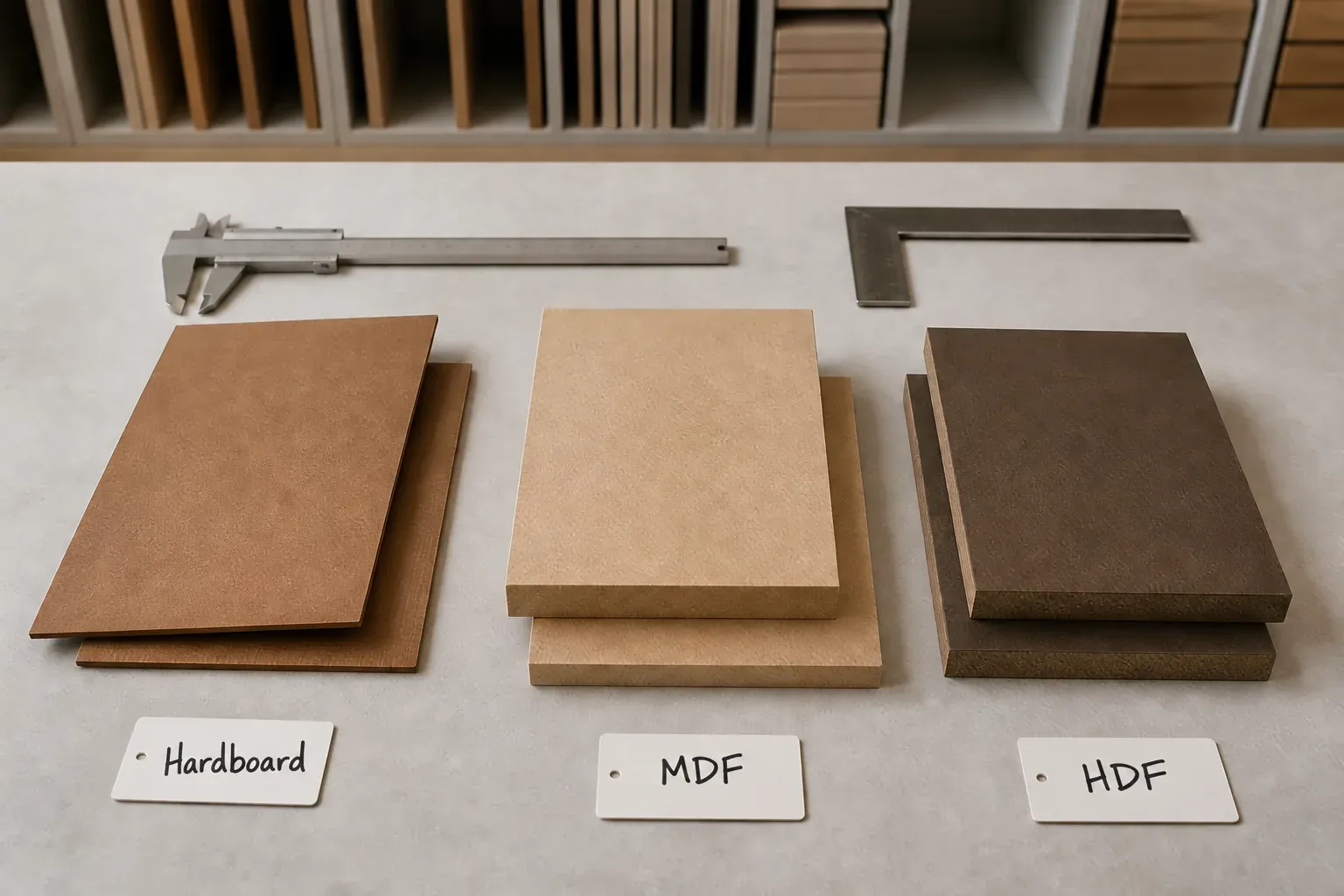
Hardboard, MDF and HDF are separate fibreboard purchasing categories. Choose between them through the component thickness, face and reverse construction, support, machining, finish and packing requirements; density is one comparison value within that complete specification.
Compare the three product categories
The most useful comparison begins with the supplied panel and the work it must perform in the finished component.
| Product category | CUZI MDF supply reference | Construction and purchasing focus | Typical component option |
|---|---|---|---|
| Standard MDF | 2–35 mm; thickness-specific density ranges from 650–810 kg/m³ | Smooth panel faces, selected thickness, machining depth, edges and downstream facing or painting | Furniture parts, routed components, cabinet parts and interior panels |
| HDF | 2–35 mm; thickness-specific density ranges from 680–930 kg/m³ | Higher-density schedule, exact thickness, face condition, machining, support and component weight | Dense furniture components and thickness-specific processed parts |
| Hardboard | 1.5–5 mm at 810–960 kg/m³ | Thin section with its ordered smooth face and reverse-face construction, groove or fixing interface and flat support | Furniture backs, drawer bottoms, framed infill and other supported thin components |
The quotation should identify the category by name and connect every thickness, density and surface value to that category. This gives purchasing, production and receiving teams the same material identity. The separate MDF vs HDF guide provides a matched-specification comparison when Hardboard is outside the shortlist.
Start with the finished component
Map the component before comparing board names.
| Component question | Why it changes the material decision |
|---|---|
| Is the part a load-carrying panel, a supported liner or a decorative component? | The support condition defines how the sheet works in the assembly. |
| Which faces remain visible? | Hardboard may have a smooth face and a different reverse texture; MDF and HDF constructions require their own face confirmation. |
| Does the part sit in a groove, rebate, frame or surface fixing? | Actual thickness, tolerance and fit affect assembly more directly than the category name. |
| Will the part be routed, drilled, painted, laminated or printed? | Processing exposes different face and edge requirements. |
| How is the finished component lifted, stacked and transported? | Thin sheets and narrow parts need support and protection matched to their geometry. |
For furniture backs and drawer bottoms, continue with the assembly-specific Hardboard guide. For machined furniture parts, use the MDF furniture-components guide.
Compare weight at the same size and thickness
A matched calculation shows the effect of density while keeping panel geometry constant. A 3 mm 1220 × 2440 mm panel has a volume of 0.0089304 m³. Using the applicable CUZI ranges, standard MDF at 800–810 kg/m³ calculates to about 7.14–7.23 kg, HDF at 850–930 kg/m³ to about 7.59–8.30 kg, and Hardboard at 810–960 kg/m³ to about 7.23–8.57 kg.
These theoretical figures cover the fibreboard material and exclude coatings, laminates and packaging. The ordered density and measured shipment data remain the relevant inputs for handling and freight planning. Use the MDF sheet weight and CBM calculator for another confirmed size and density.
Specify face, reverse and edge condition
Record the principal face, reverse face, colour or raw appearance, supplied sanding or texture and every visible edge. A Hardboard sheet can combine a smooth face with a screen-pattern reverse, so face orientation belongs on the cut list and assembly drawing. MDF and HDF orders should state whether both faces are raw and smooth, faced differently or prepared for another process. Approve the actual sheet or finished corner when face orientation and edge appearance affect the product.
Match processing to the board construction
For rectangular cutting, confirm the cutting method, finished dimensions, squareness and edge acceptance. For drilling or punching, identify hole geometry, datum and supported handling. Routed profiles need a section drawing with depth, radius and remaining material; this route usually points the review toward MDF or HDF at the selected thickness. Coating, printing, laminating and painting should be qualified on the proposed face and edge construction through a representative sample.
Control groove fit and support
A thin furniture back or drawer bottom works together with its frame, groove, rebate, fixings and spans. State nominal thickness and tolerance, then test a representative part in the actual interface. Record insertion, fit, face direction and supported position in the approved drawing. Shelves, doors and load-carrying parts require a component design and material option developed for those functions; the furniture designer should release the support and hardware arrangement before repeat production.
Separate density from other performance requirements
Density supports weight and product comparison when the test basis and product identity are clear. Moisture performance, emission class, fire classification, strength and finished-assembly suitability each use their applicable product or system test reports. State the destination requirement and requested report or certificate beside the relevant order line. This keeps a density value connected to its proper decision and gives technical documents a defined review purpose.
Plan flat handling and export packing
Thin sheets can reflect unsupported storage, uneven bearers, strap pressure and exposed-corner handling. Define pack length, width and height, base supports, top and bottom protection, face orientation, separators, corner protection, straps, bundle weight, labels and unloading method. Keep the bundle fully supported during factory movement, container loading and buyer storage. Finished or printed faces require protection matched to their sensitivity.
Prepare a comparable fibreboard RFQ
Create one order line for each product and thickness. Include:
- product category: Hardboard, MDF or HDF;
- full-sheet size or finished component dimensions;
- nominal thickness, tolerance and required density;
- face, reverse and edge construction;
- support, groove, rebate or fixing interface;
- cutting, drilling, routing, coating or laminating scope;
- emission or other destination requirement;
- quantity and pricing basis;
- sample and technical-document request;
- packing, labels, destination and unloading method.
Use the Hardboard product page, Raw MDF product page and HDF product page for current supply specifications. Request a specification review with the component, quantity and destination so the quotation can identify the proposed category and every remaining confirmation point.