Professional MDF Manufacturer & Supplier

Routed MDF Cabinet Doors Manufacturer in China

Custom CNC-routed MDF cabinet doors from Shuyang, China, produced to controlled front and section drawings, substrate, profile, finish construction, hardware machining and pack plan.

Product focus
Routed MDF Cabinet Doors supply
Buyer review
Grade · size · finish · processing
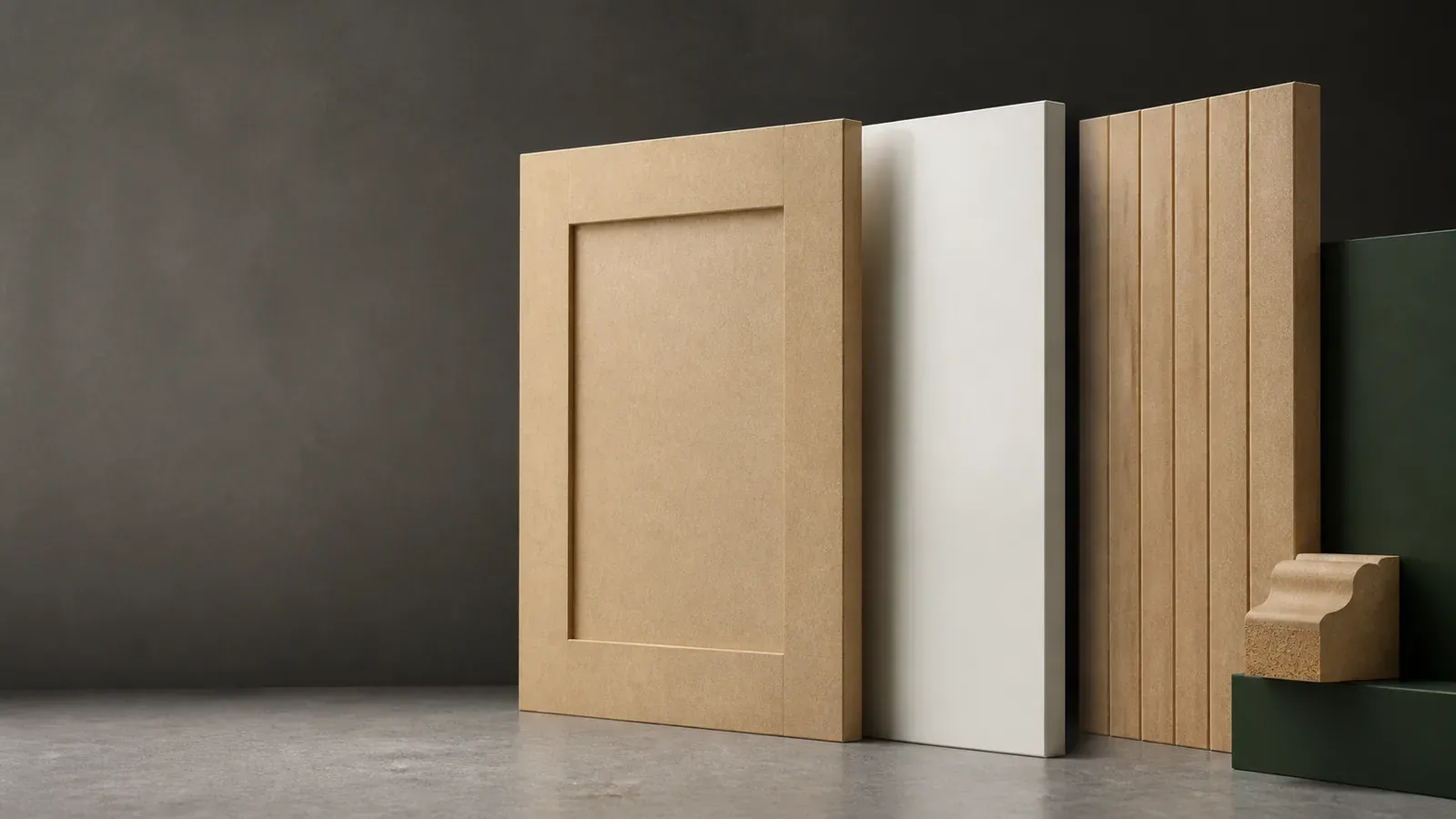
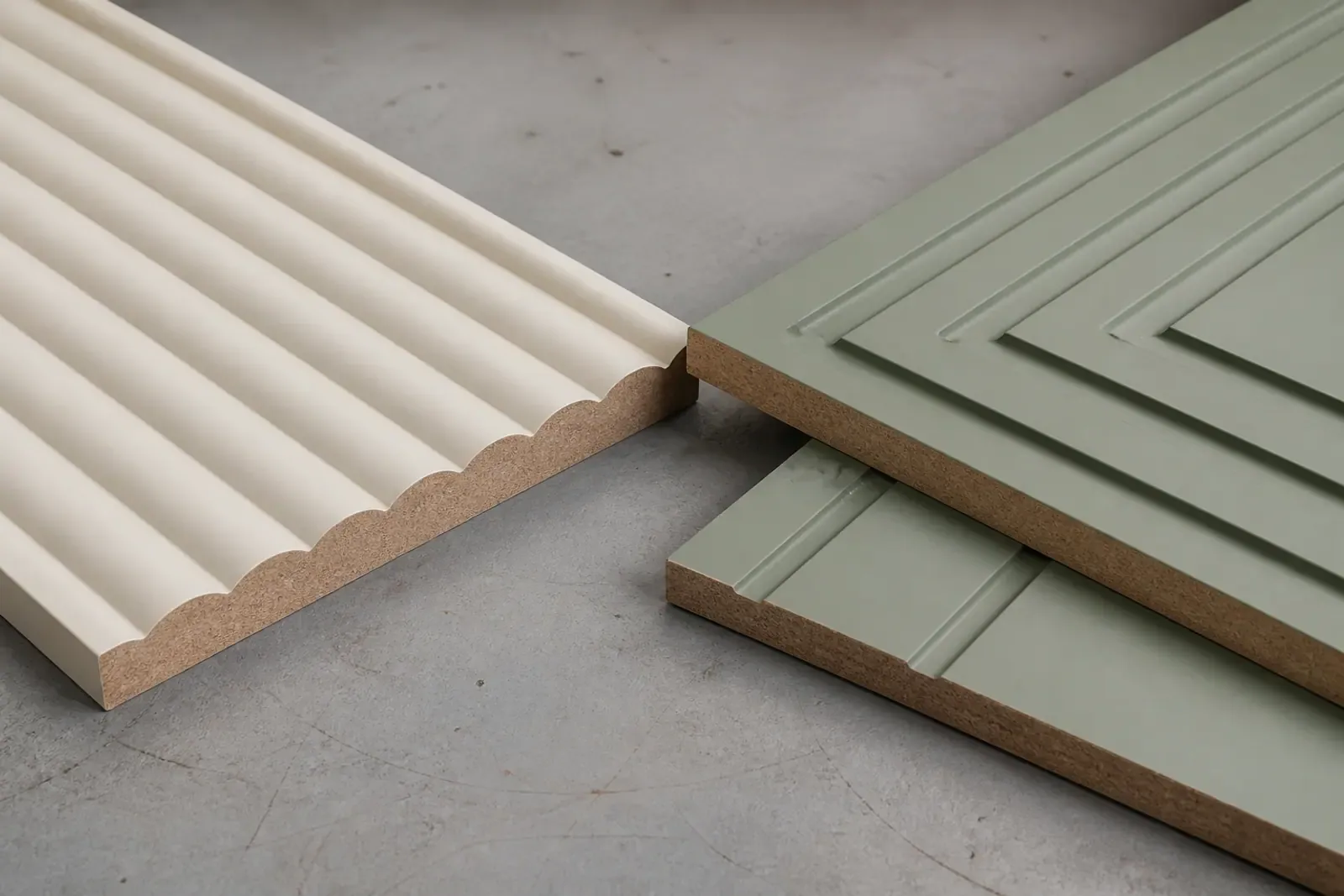
Routed MDF cabinet-door samples with recessed and linear profiles

Why this component exists

Routed MDF cabinet doors prepared to controlled profiles and finishing requirements.

This page serves buyers sourcing finished-shape routed MDF cabinet-door components, including one-piece shaker-style, recessed, raised-effect, grooved and custom-profile doors. It controls door geometry, MDF substrate, face and back details, remaining thickness, finishing preparation, hardware machining, labels and protective packing. General-purpose routing, drilling and mixed MDF parts remain within CNC MDF Processing.

Product introduction

What is Routed MDF Cabinet Doors?

Product definition

What is Routed MDF Cabinet Doors?

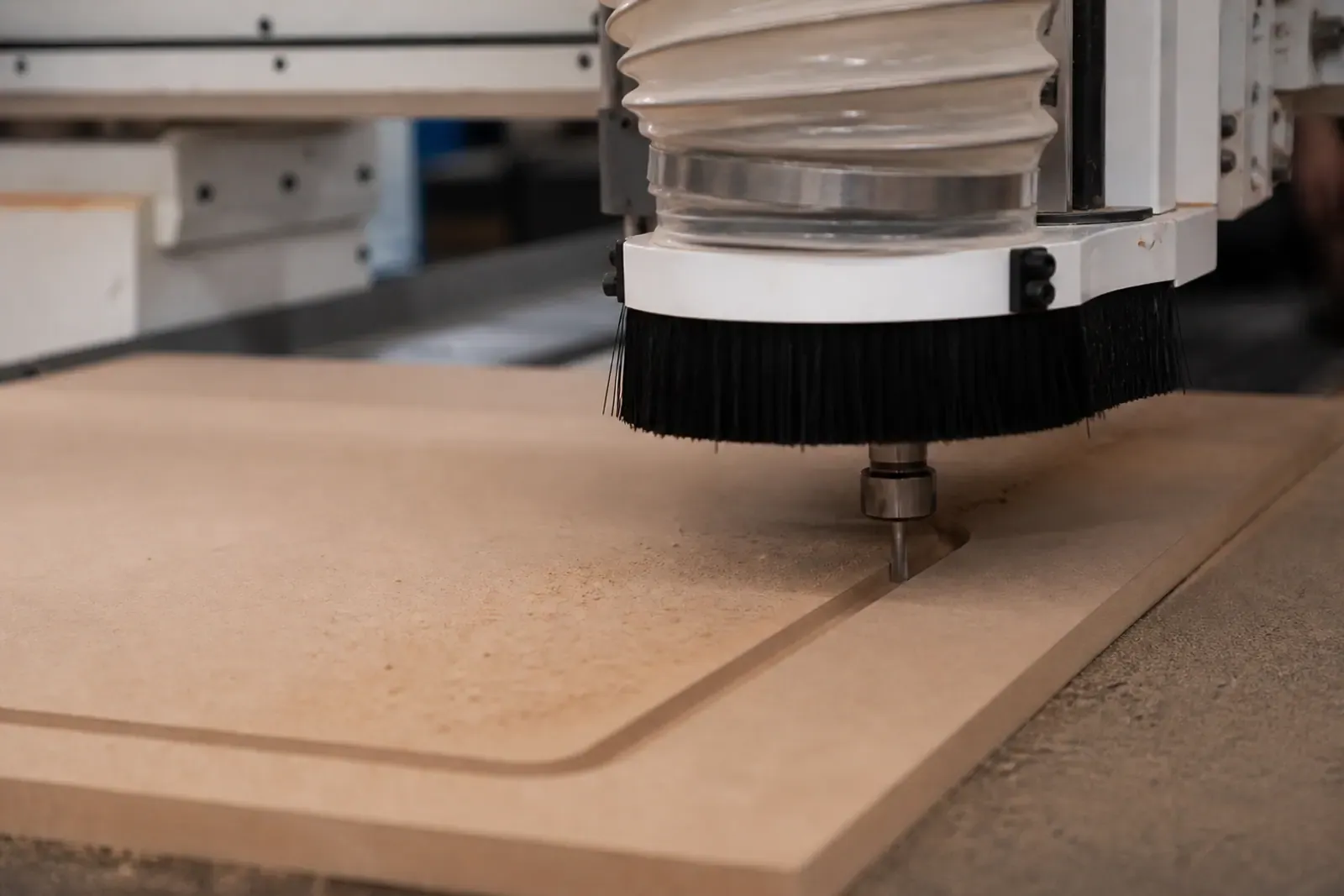
Routed MDF cabinet doors are one-piece components machined from a selected MDF substrate. A style name such as shaker, recessed panel or raised-effect door is only a visual direction: production requires a controlled front view and section drawing that define finished width and height, thickness, rail and stile appearance, profile width and depth, corner radius, back-face condition and hardware positions. The machining process must also match the intended paint, primer, PVC membrane or other confirmed finish. Deep profiles reduce the remaining MDF section, while sharp internal corners, porous routed edges and unsuitable radii can create finishing or film-forming problems. CUZI MDF therefore reviews the substrate, geometry, sample, supplied finish condition and packaging as one door specification.
Buyer advantage

Why choose Routed MDF Cabinet Doors?

Shaker, recessed, raised-effect, slab or grooved describes appearance but does not define profile width, depth, slope, radius, internal corner or back-face machining. Door thickness, deepest cut, groove position and any back machining must be reviewed together. Excessive machining can leave a thin local section that is difficult to finish or handle. Machined edges and internal profiles can absorb primer differently from sanded faces. The supplied sanding condition and the buyer's sealing, primer and topcoat process must be agreed. Tight radii, deep recesses, sharp transitions or unsuitable edge details can prevent stable forming. Confirm the film, adhesive, substrate, profile and vacuum-forming parameters through a representative trial. Hinge cups, handle holes and pilot holes need side, datum, depth and coordinate control. Front and back views must use the same door ID and revision. Dust, face-to-face contact, unsupported stacks and concentrated strap pressure can mark routed doors before painting or damage an approved decorative finish.

Application fit

Applications

Relevant application discussions include kitchen cabinets, wardrobes, cabinet doors. Final product suitability must be reviewed against the buyer's actual application and confirmed specification.

Supply support

Why choose CUZI MDF?

CUZI MDF coordinates routed MDF cabinet-door production and export packing from Shuyang, Jiangsu, China. The normal MOQ is 1 × 20'GP for each individual substrate, profile and supplied-finish specification. Normal lead time is 7–15 days after the released front and section drawings, representative sample plan, quantity, packaging and commercial requirements are confirmed. Buyer terminology: Routed MDF Cabinet Doors may be searched as custom MDF cabinet doors, CNC routed MDF doors, shaker MDF doors, paint-grade MDF doors or routed kitchen cabinet doors. This page covers finished-shape door components. General mixed-part routing and drilling remain within CNC MDF Processing, while PVC Faced MDF covers the complete film-faced construction.

Product USP

Why Buyers Choose Routed MDF Cabinet Doors

The purchasing priorities below connect Routed MDF Cabinet Doors with specification, processing and order requirements.

Door-specific drawing control

Front and section drawings define finished dimensions, profile geometry, corner treatment, face/back orientation and critical acceptance points for each door ID.

Profile and remaining-section review

Profile depth is checked together with door thickness so routed fields, grooves and edge details leave the confirmed remaining MDF section.

Machining matched to finishing

Tooling, sanding and edge preparation are reviewed against the buyer's primer, paint, PVC membrane or other confirmed downstream finish construction.

Repeat-door identification and packing

Door IDs, left/right or grain direction, hardware details, batch grouping and protective separators remain connected from released files to export packs.

Buyer problems solved

Routed MDF Cabinet Door Purchasing Risks to Control Before Production

A style name replaces the section drawing

Shaker, recessed, raised-effect, slab or grooved describes appearance but does not define profile width, depth, slope, radius, internal corner or back-face machining.

The routed profile leaves too little material

Door thickness, deepest cut, groove position and any back machining must be reviewed together. Excessive machining can leave a thin local section that is difficult to finish or handle.

Paint builds differently on faces and routed edges

Machined edges and internal profiles can absorb primer differently from sanded faces. The supplied sanding condition and the buyer's sealing, primer and topcoat process must be agreed.

Geometry exceeds the forming range

Tight radii, deep recesses, sharp transitions or unsuitable edge details can prevent stable forming. Confirm the film, adhesive, substrate, profile and vacuum-forming parameters through a representative trial.

Hardware data conflicts with the door face

Hinge cups, handle holes and pilot holes need side, datum, depth and coordinate control. Front and back views must use the same door ID and revision.

Finished faces rub during shipment

Dust, face-to-face contact, unsupported stacks and concentrated strap pressure can mark routed doors before painting or damage an approved decorative finish.

Why choose CUZI MDF

MDF manufacturing, customization, inspection and international supply.

CUZI MDF reviews different MDF grades and specifications for furniture factories, distributors and international B2B buyers.

Professional MDF manufacturing

CUZI MDF focuses on MDF manufacturing and specification-led supply for international B2B buyers.

Customized MDF review

Thickness, size, surface, processing and packaging requirements are reviewed against the requested product and order.

Quality and document control

Quoted technical values are matched to the selected product, current test reports and the written order specification.

International supply planning

Order planning covers confirmed specification, quantity, packaging needs, destination and shipment coordination.

Technical specification

Routed MDF Cabinet Doors Specifications

CUZI MDF supplies standard and customized specifications for furniture factories, distributors and project orders.

ThicknessInput MDF: 2–35 mm. Final door thickness follows the controlled profile, remaining section, edge geometry, hardware machining and finish construction.
DimensionsInput board formats1220 × 2440 mm; 2100 × 2800 mm; 1830 × 3660 mm; 1830 × 2440 mm; 2440 × 3660 mm; 1830 × 4200 mmFinished panel or door dimensionsFollow the controlled front and section drawings and nesting plan.
DensityStandard MDF input density range: 2–4 mm: 800–810 kg/m³; 5–8 mm: 780–800 kg/m³; 9–11 mm: 760–780 kg/m³; 12–18 mm: 680–750 kg/m³; 19–35 mm: 650–680 kg/m³. MR, HMR and paint-grade inputs follow their selected product specification.
GlueThe bonding system follows the selected product grade and construction.
Formaldehyde gradeE0, E0.5 and E1 options. The specified emission class, test standard, product scope and destination requirement must be confirmed for each order.
SurfaceMachined and sanded raw MDF, or another confirmed primer, paint or PVC membrane-related supplied condition defined by the order and approved sample.
Door component scopeDrawing-controlled routed MDF cabinet-door component; profile, remaining thickness, dimensions, hardware machining and finish acceptance are confirmed for the order.

All product options, processing, packaging and timing remain subject to confirmation against the final specification, quantity, production schedule and destination.

Indicative export pricing

A practical starting range for quotation planning.

US$8–95 per piece

Availability
Available to order
Specification review
5.0/5.0

Custom specifications determine the final price.

This price range is an indicative export reference for configurable B2B orders, not a fixed or binding offer. Final unit pricing is confirmed in a written quotation.

  • Product grade, thickness, density and board size
  • Surface construction, color, processing and packaging
  • Order quantity, payment terms and production scheduling
  • Incoterm, destination, freight and document requirements

Technical specification completeness review

The product page states the principal board or component specification, configurable order factors, indicative price basis and quotation requirements needed for an initial B2B purchasing review.

Reviewed by CUZI MDF Product & Technical Team.

Request an exact quotation

Features

Specify what matters on the factory floor.

One-piece routed door styles

Review slab, shaker-style, recessed-panel, raised-effect, arch, grooved or custom-profile directions as one-piece MDF components against controlled drawings.

Front and section drawing package

Record door ID, units, revision, finished width and height, thickness, profile section, rail/stile appearance, groove geometry, radii and critical dimensions.

Face and back machining control

Separate front profile work from hinge cups, handle holes, pilot holes, relief details or other back machining using a stated datum and viewing direction.

Edge and profile preparation

Define saw-cut or machined edges, sanding sequence, internal-corner treatment and the supplied condition needed before primer, paint or membrane processing.

Representative sample or first article

Approve the actual substrate, profile, dimensions, routed edge quality and finish response on a representative door before repeat production when appearance is critical.

Dimensional and visual acceptance

The order can identify finished width and height, thickness, diagonal difference, profile position/depth, hardware coordinates, edge condition and an approved appearance reference.

Moisture-content range

Moisture performance follows the selected MDF substrate and protected-interior service requirement; routed doors are not automatically moisture resistant or waterproof.

Processing notes

Control the front and section drawing, door ID, finished dimensions, profile width and depth, radii, remaining section, front/back machining, datums, hardware coordinates, sanding and sample acceptance.

Applications

Applications of Routed MDF Cabinet Doors

MDF for Kitchen Cabinets

MDF for Kitchen Cabinets is a B2B application guide for kitchen cabinet material selection. Buyers should begin with the finished component and service environment, then select MDF against those requirements. Protected interior kitchens with ambient humidity, occasional spills, cleaning and ventilation; cabinet layout, sink-zone detailing, dry storage and prompt spill removal preserve the finished components.

Explore application

MDF for Wardrobes

Select wardrobe MDF separately for each component and its finished use. Carcass sides, long shelves, hinged or sliding doors, drawers and backs need separate dimensions, surfaces, support, hardware, finished-weight checks and cabinet-set packing.

Explore application

MDF for Cabinet Doors

MDF cabinet-door selection connects flat or routed front geometry with the substrate, finish, reverse face, hinges and gaps. Decide the construction before comparing door prices.

Explore application

Buyer guides

Continue the Routed MDF Cabinet Doors purchasing review.

These guides explain the next specification, application and procurement decisions connected to this product.

Procurement Scenario: Routed MDF Cabinet Door Drawing Approval

Approve routed MDF cabinet doors through controlled elevations and sections, profile geometry, remaining material, tool radii, hardware interfaces, first components and protected batch packing.

Explore application

MDF Sample Approval: From Colour Swatch to First Component

An MDF sample approval should identify exactly what the sample represents, which attributes were accepted and which production record carries the decision forward. A colour swatch, constructed corner and first finished component answer different questions.

Explore application

MDF Cabinet Door Guide: Material, Routing, Finish and Hardware

An MDF cabinet-door specification connects the finished door style to its substrate, dimensions, face and reverse construction, profile section, remaining material, edges, finish, hardware machining, finished weight, first article and protective packing. This guide forms a production-ready door schedule.

Explore application

Wardrobe MDF Guide: Tall Doors, Grain Direction and Component Sets

Wardrobe MDF selection starts with the complete elevation and component schedule. Separate carcasses, shelves, backs, drawers, hinged or sliding doors and visible end panels, then coordinate board construction, finish, grain direction, hardware, handed parts and installation packs.

Explore application

Customization capability

Customized Routed MDF Cabinet Doors Supply

Send the required dimensions, surface, processing drawings, packaging and destination. CUZI MDF confirms production feasibility before issuing a quotation.

Door style and profile

Provide slab, one-piece shaker-style, recessed, raised-effect, arch, grooved or custom-profile front and section drawings that fully define the door.

MDF substrate

Specify standard, MR, HMR, paint-grade or another confirmed MDF input with thickness, density, E0/E0.5/E1 requirement and applicable performance test reports.

Finished door dimensions

Control width, height, thickness, quantity, left/right identity, grain or pattern direction and any pairing or cabinet-set relationship by door ID.

Hardware machining

Provide hinge-cup diameter, depth, edge distance and spacing, plus handle, pilot or other holes with face/back orientation, datums and tolerances.

Supplied finish condition

Define machined raw, fine-sanded, primer-oriented, paint-related, PVC membrane-related or another reviewed supplied condition and physical appearance reference.

Labels and protective packaging

Define door ID labels, clean face separators, edge and corner protection, supported stack height, pack quantity, handling, destination and assembly sequence.

Packaging options

Use clean face separators, supported aligned stacks, edge and corner protection, controlled strap pressure, door-ID labels and pack sequence selected for the finish, dimensions, quantity, handling and destination.

Purchasing / RFQ guidance

Provide front and section drawings, revision, door IDs, substrate, thickness, finished dimensions, profile and radii, hardware machining, supplied finish condition, sample requirement, quantity, labels, packing and destination.

Manufacturing capability

CUZI MDF Manufacturing Capability

MDF production capability

Production planning begins after the product specification and commercial requirements are confirmed.

Quality management

Applicable checks are aligned with the confirmed MDF product, dimensions, surface, processing and other agreed criteria.

Customized manufacturing

CUZI MDF reviews grade, dimensions, surface, CNC processing and packaging requirements before confirming production.

Packaging and supply

Packaging and timing are confirmed against the final product, quantity, production schedule and destination.

Production workflow

CUZI MDF Manufacturing Process

The production workflow connects the confirmed product specification with panel manufacturing, inspection and export-oriented packaging.

Confirm specification

Review product type, dimensions, surface, processing, quantity and destination.

Plan production

Translate the approved order requirements into the applicable production and handling plan.

Inspect and prepare

Review the finished order against agreed requirements before packaging and shipment preparation.

Buyer FAQ

Questions buyers ask before specifying Routed MDF Cabinet Doors.

Which routed MDF cabinet-door styles can be reviewed?

Slab, one-piece shaker-style, recessed-panel, raised-effect, arch, grooved and custom-profile directions can be reviewed. The final shape is controlled by front and section drawings, not by the style name alone.

What files are needed for a routed MDF door quotation?

Provide front and section drawings with millimetre units, revision, door ID, finished width and height, thickness, profile dimensions and radii, front/back orientation, hardware machining, quantity, finish construction, labels and packing.

How are profile depth and remaining MDF thickness controlled?

The section drawing identifies the deepest routed area and any back machining. These are reviewed with the selected door thickness so the local remaining section, edge treatment and handling route can be confirmed before production.

Which MDF substrate should be used for cabinet doors?

Choose the substrate from the protected-interior environment, door size, profile, edge quality, hardware, finish system and required test reports and certificates. Standard, MR, HMR and paint-grade inputs have different purchasing scopes.

Can routed MDF doors be prepared for painting?

Yes, when the quotation defines the supplied condition. Smooth faces, routed edges and internal profiles can require different sanding, sealing and primer preparation; the buyer's complete coating system should be tested on a representative sample.

Can routed MDF doors be used with PVC membrane or thermofoil?

They can be reviewed for a membrane route when the substrate, film, adhesive, edge radius, profile depth, corner geometry and vacuum-forming process are compatible. A finished representative sample should be approved before repeat production.

Can hinge cups and handle holes be machined?

Yes, when the released drawing identifies door ID, face/back orientation, datum, diameter, depth, edge distance, centre coordinates, spacing and tolerance. Hardware machining remains tied to the same revision as the visible profile.

How are routed MDF door tolerances confirmed?

The order records the required checks, which may include finished width and height, thickness, diagonal difference, profile position and depth, hardware coordinates and edge condition. Final tolerances follow drawing and sample review.

Why is a sample or first article recommended?

A representative door verifies the actual substrate, cutter and profile, edge quality, remaining section, dimensions and response to the intended finishing process before the repeat batch is released.

How are routed MDF cabinet doors packed?

Use clean face separators, supported aligned stacks, edge and corner protection, controlled strap pressure and door-ID labels. Pack size and sequence follow dimensions, finish sensitivity, quantity, handling, destination and customer requirements.

Are the ranges on this page confirmed for every order?

No. Product-specific availability and values are confirmed against the proposed order.

What should the purchasing RFQ include?

Provide front and section drawings, revision, door IDs, substrate, thickness, finished dimensions, profile and radii, hardware machining, supplied finish condition, sample requirement, quantity, labels, packing and destination.

Specification to quotation

Request a Routed MDF Cabinet Doors Quotation

Send your target grade, dimensions, quantity, surface or processing requirements and destination. CUZI MDF will review the specification and provide quotation support for the confirmed requirement.

  • Target grade or test standard
  • Thickness, size, density and quantity
  • Surface, CNC and packaging requirements
  • Destination and requested timing

By submitting this business inquiry, you acknowledge how CUZI MDF handles the information described in our Privacy Policy.