
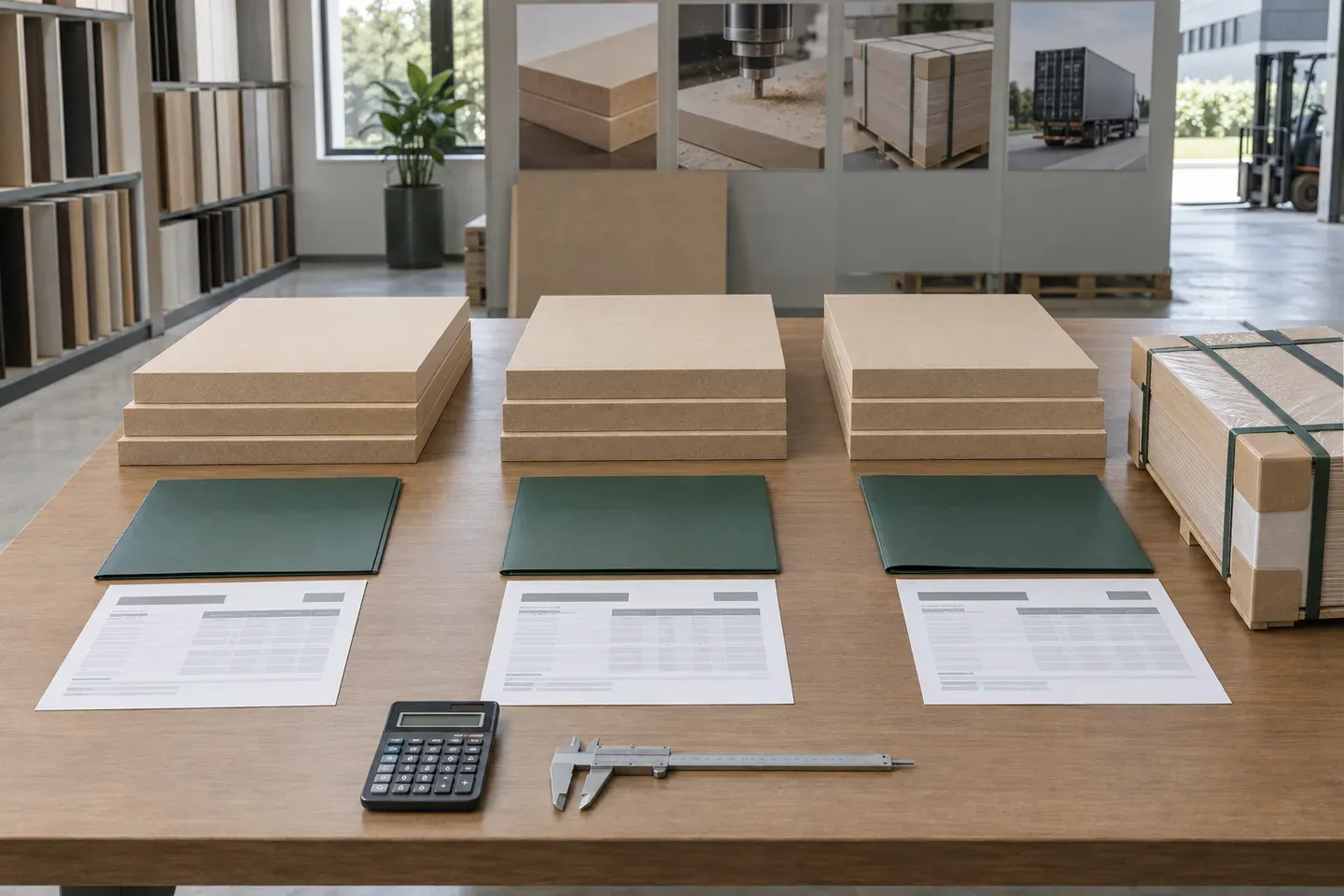
A useful MDF quotation comparison converts every offer to the same board construction, dimensions, quantity, processing scope, packaging, delivery point and commercial basis. This guide shows how to move from headline price to comparable sheet cost, landed order cost and supplier-selection value.
Build the comparison around one purchasing requirement
Create the comparison sheet from the approved requirement, then place each supplier in a separate column. The first rows should describe the material being purchased; price follows after the technical scope.
| Comparison block | Information to align |
|---|---|
| Product | Raw MDF, MR MDF, HMR MDF, Fire Rated MDF, HDF, hardboard or a faced construction |
| Dimensions | Thickness, length, width, tolerance and finished size |
| Performance | Density range, emission class, moisture or fire-performance requirement and test method |
| Surface | Face, reverse, colour, texture, veneer, laminate and approved reference |
| Processing | Cutting, routing, drilling, sanding, edge work, labelling and kit packing |
| Supply | Quantity, bundle plan, delivery basis, named place, lead time and payment terms |
This structure makes the quotation answer the approved purchase specification and gives every supplier the same comparison basis.
Convert price per m³ into price per sheet
Panel quotations often use US$/m³ while the buyer consumes sheets. Use the exact quoted thickness and board format:
**Sheet volume (m³) = thickness (m) × width (m) × length (m)** **Sheets per m³ = 1 ÷ sheet volume** **Panel value per sheet = price per m³ × sheet volume**
For an illustrative 18 mm 1220 × 2440 mm sheet:
- Sheet volume: 0.018 × 1.220 × 2.440 = **0.0535824 m³**
- Theoretical sheets per m³: 1 ÷ 0.0535824 = **18.66 sheets**
- At an illustrative US$200/m³: 200 × 0.0535824 = **US$10.72 per sheet**
Use the MDF weight and CBM calculator to repeat the calculation for each thickness and format. The result is a conversion method; the supplier quotation remains the source of the current price.
Compare the same MDF construction
A matching size can still represent a different product. Record the offered density by thickness, raw-material or product category, emission grade and its referenced test method. For MR, HMR or Fire Rated MDF, include the performance classification, test basis and document applying to the offered product.
For melamine, veneer, acrylic, PVC or laminate-faced MDF, compare the complete construction: MDF core, face material, reverse or balancing layer, colour or species, texture, surface reference, finished thickness and supplied edge condition. The comparison becomes valid when each column describes the same finished construction.
Create a supplier compliance and deviation table
Ask each supplier to respond to the same numbered specification schedule. Copy the offered value into the comparison sheet and record its status beside the requirement. This separates a compliant offer from a proposed alternative while preserving useful supplier recommendations.
| Status | Meaning | Purchasing action |
|---|---|---|
| Complies | The offer matches the stated requirement | Link the quotation line and supporting document |
| Proposed alternative | The supplier offers a different construction or value | Record the technical and commercial effect for review |
| Subject to sample | Appearance or processing requires physical approval | Identify the sample, revision and approval milestone |
| Subject to document | A certificate, report or scope confirmation is pending | List the exact document and due date |
| Open clarification | The supplier response is incomplete or ambiguous | Return one focused question against the numbered row |
The table keeps alternatives visible and lets technical, commercial and logistics reviewers reach a shared decision from the same record.
Translate processing into a finished-part cost
For cut-to-size or machined MDF, add a line for every operation attached to the released drawing revision. Typical rows include nesting or cutting, CNC routing, drilling, grooves, sanding, surface pressing, edge banding, coating, part labels and cabinet-set packing.
Use three cost levels where relevant:
1. **Raw board value** — the panel before secondary work. 2. **Processed component value** — board allocation plus machining and finishing. 3. **Delivered usable component value** — processed component plus protective packing and allocated logistics.
The third level is often the most useful purchasing comparison because it follows the part that reaches assembly.
Compare usable yield and accepted quantity
A sheet price becomes meaningful when it is connected to the quantity that production can use. For full-board orders, record the ordered, shipped, received and accepted sheet quantities. For cut-to-size or machined components, add nesting yield, parts per sheet, setup allowance, replacement basis and the acceptance criteria for visible or dimensional defects.
| Yield input | Comparison entry |
|---|---|
| Full-board supply | Accepted sheets ÷ received sheets |
| Cut-to-size supply | Accepted finished parts ÷ total supplied parts |
| Nesting plan | Approved parts per sheet and expected offcut basis |
| Replacement basis | Credit, remake or replacement freight responsibility |
| Receiving result | Accepted quantity recorded against the order and inspection report |
**Cost per accepted sheet or part = total comparable cost ÷ accepted usable quantity.** This gives purchasing and production one measure for price, yield and receiving quality.
Compare packaging as part of the product
Record sheets or parts per bundle, support layout, top and bottom covers, side protection, corner protection, moisture barrier, strapping, labels and pack dimensions. For finished components, identify face-to-face protection, separator material and the component sequence inside each pack.
Packaging affects gross weight, container use, forklift access, unloading time and the condition received by the factory. Quote comparison therefore gives packaging its own specification, cost and acceptance point.
Put every quotation on one delivery basis
Write the Incoterm® rule, named place and version beside each price. A comparison-ready entry identifies the complete delivery point, for example FOB Lianyungang or CIF the buyer’s named destination port, subject to the supplier’s offer. The named place establishes which origin, main-transport and destination cost rows belong to each party.
Build landed order cost from separate rows:
| Cost layer | Typical items |
|---|---|
| Goods | Board or finished-component value |
| Export preparation | Packing, labels, inspection or agreed documents |
| Origin logistics | Inland haulage, loading and origin charges according to the quoted term |
| Main transport | Ocean freight and insurance where included |
| Destination | Port, clearance, inland delivery and local handling from the buyer’s current estimates |
**Landed cost per usable sheet or part = total comparable order cost ÷ accepted usable quantity.** Use current quotations and the agreed responsibility split for the final calculation.
Validate loading assumptions and freight basis
Compare the proposed sheet count with net product weight, packaging weight, bundle dimensions, container payload, loading method and route limits. Large-format boards and mixed-thickness orders can reach a dimensional, handling or weight constraint at different points.
Ask each supplier to state the planned bundles, sheets per bundle, total sheets, net weight, estimated gross weight and loading method. The container loading data guide explains the information required before booking. For large-volume orders, compare container and breakbulk routes using the actual pack and port handling plan.
Convert payment and timing into comparable terms
Price and cash exposure belong in the same decision record. List deposit percentage, balance amount, payment trigger, inspection point, quotation validity, production start event, cargo-ready definition and the treatment of specification changes.
| Commercial term | Comparison question |
|---|---|
| Deposit | How much cash is committed before production? |
| Balance | Which inspection, document or shipment milestone triggers payment? |
| Lead time | Which confirmed event starts the stated number of days? |
| Validity | Until which date or market condition does the price apply? |
| Sample and setup | Which costs are credited to the production order? |
This view combines price, cash commitment and schedule certainty in one commercial comparison.
Classify quotation gaps before negotiation
Mark every comparison row as **confirmed**, **conditional** or **open**. A confirmed row matches the requirement in writing. A conditional row depends on a sample, document, final drawing or quantity. An open row identifies the supplier response still required.
Then explain each price difference with a named cause: MDF grade, density, surface construction, machining scope, pack, order quantity, testing, logistics, payment or schedule. Send the open rows back as a short clarification schedule. This produces a revised offer that purchasing, technical and logistics teams can review together.
Use a weighted award score for the final shortlist
A weighted score keeps price in proportion to order risk. The example below suits a specification-led order and can be adjusted for the buyer’s priorities.
| Award factor | Illustrative weight |
|---|---|
| Technical specification match | 30% |
| Approved sample and appearance match | 15% |
| Comparable landed cost | 25% |
| Packaging and logistics plan | 10% |
| Lead time and production plan | 10% |
| Documents, communication and revision control | 10% |
Score each factor against recorded information and keep conditions visible beside the total. A preferred supplier then represents the strongest combined fit for material, execution, delivery and commercial terms.
Record the award recommendation and revision basis
Summarize the recommended supplier in one approval record that identifies the selected quotation revision, comparison date, exchange-rate basis where used, technical deviations accepted, samples or documents still conditional, landed-cost estimate and delivery assumptions.
When a supplier revises price, construction, quantity, route or timing, update the affected rows and issue a new comparison revision. This preserves the reason for the award and gives later cost or specification changes a clear baseline.
Release the purchase basis with the selected quotation
Attach the final technical schedule, drawings, approved sample references, quantity schedule, pack specification, document list, delivery term, named place, price validity and payment milestones to the selected quotation or purchase order. Record all accepted clarifications in the same revision. Purchasing, production, inspection, shipment and receiving teams can then work from one approved order basis.
Buyer review checklist
A quotation is ready for final comparison when the following answers appear in the offer or its referenced schedules:
- exact MDF product and complete face/reverse construction;
- thickness, format, tolerance, density range and emission requirement;
- sheet, m³, bundle or finished-part quantity with visible conversion arithmetic;
- included processing, sample, testing, inspection and documentation scope;
- pack materials, bundle count, net weight, estimated gross weight and loading method;
- Incoterm® rule, named place, validity, lead-time start event and payment milestones;
- list of confirmed, conditional and open items;
- total comparable order cost and cost per usable sheet or component.
Keep the selected comparison sheet with the approved quotation so later changes can be priced and reviewed against the same baseline.
Request an MDF quotation
For a new sourcing request, begin with the international MDF RFQ guide. Share the product, construction, dimensions, quantity, processing, packing and destination through the CUZI MDF specification review for an order-specific quotation.