
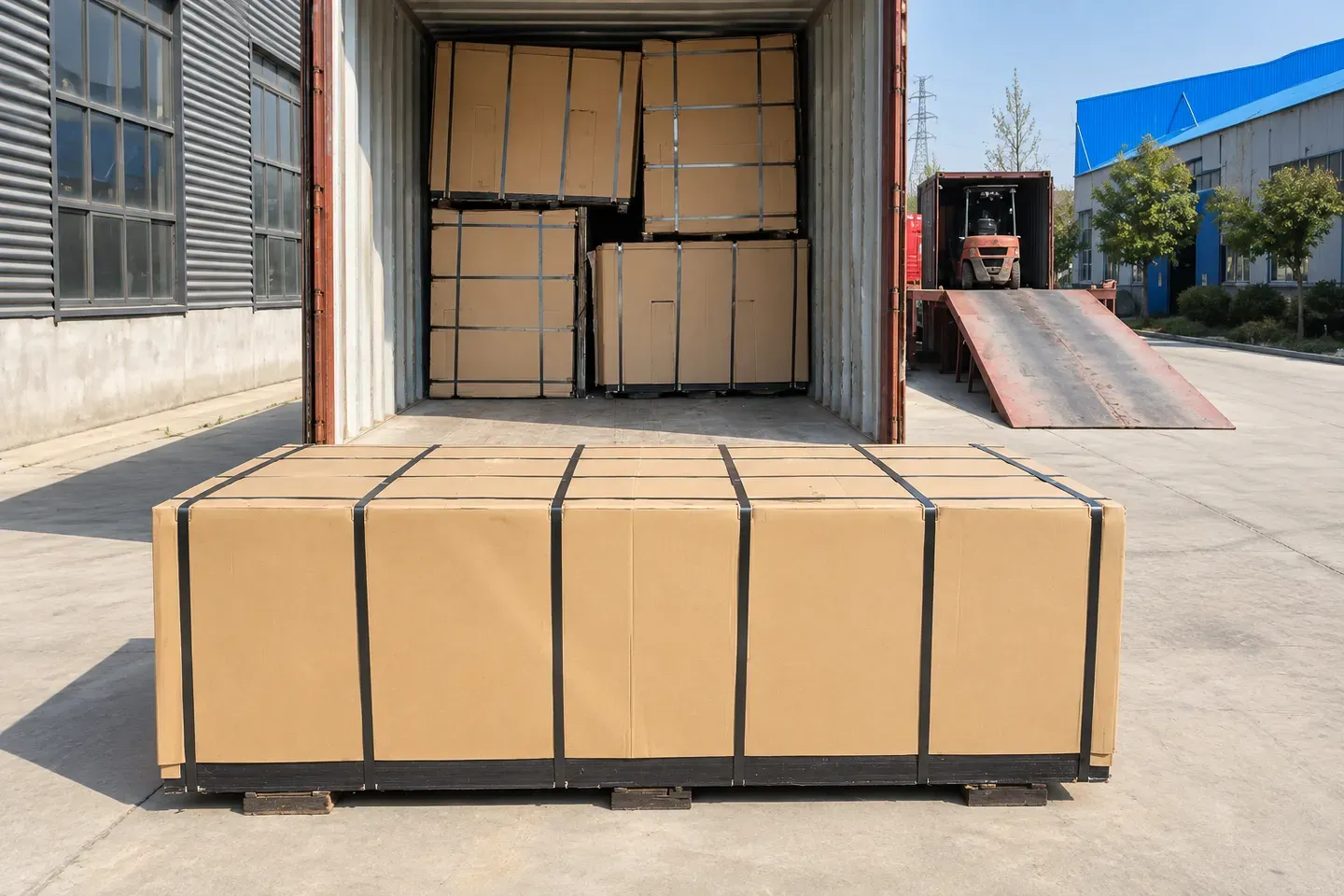
Container planning begins with the exact product mix, packed bundle dimensions, confirmed net and gross weights, loading method, equipment limits, route and receiving conditions. A theoretical sheet calculation is one input to the final loading plan.
Separate calculation from confirmed cargo
Calculate theoretical board volume and weight from thickness, dimensions, density and sheet count. Then record actual sheets per bundle, bundle count, pallet or support material, covers, straps and measured pack weight. Keep calculated, production-confirmed and logistics-confirmed values in separate fields.
Calculate product volume and planning weight
Calculate every specification separately, then total the order. Use metres and kilograms consistently:
**Board volume (m³) = thickness (m) × width (m) × length (m) × sheet quantity** **Theoretical net board mass (kg) = board volume (m³) × specified planning density (kg/m³)** **Planned gross cargo mass = confirmed net product mass + packaging and support mass** **Packed volume (m³) = packed bundle length × width × height × bundle quantity**
The density used for planning should match the offered product and thickness. The final loading record uses production-confirmed quantities and pack weights. The MDF sheet weight and CBM calculator supports the initial calculation.
Build the cargo schedule
Use one row for every product and bundle type.
| Cargo field | Required information |
|---|---|
| Product | MDF type, thickness, format and surface |
| Quantity | Sheets per bundle, number of bundles and total sheets |
| Packed dimensions | Length × width × height including supports and protection |
| Weight | Net product, packaging and gross cargo weight |
| Handling | Forklift entry, lifting direction and stacking restriction |
| Identification | Bundle ID linked to packing list and order line |
Reconcile the quantity and weight records
Connect the commercial quantity, production quantity, packing list and loading plan through one reconciliation table.
| Record | Quantity and weight to capture |
|---|---|
| Purchase order | Sheets or parts by product specification |
| Production completion | Finished and accepted quantity by order line |
| Bundle schedule | Sheets or parts per bundle and number of bundles |
| Packing list | Net weight, packaging weight and gross weight by bundle or shipment |
| Loading plan | Bundle ID, position and planned loading sequence |
| Final dispatch record | Loaded bundle count, seal reference and released gross cargo data |
The totals should follow the same units and identified bundle references. This provides a direct path from ordered sheets to the cargo loaded for shipment.
Confirm equipment and route limits
Ask the forwarder or carrier to confirm container type, payload, internal dimensions, door opening, floor loading and route-specific weight restrictions for the actual booking. Confirm road, terminal and destination limits as separate logistics checks.
Compare cargo dimensions with the booked container
Place the cargo data beside the booking-specific container data. The door opening controls entry, while internal length, width and height control placement and clearance.
| Fit check | Cargo input | Booking input |
|---|---|---|
| Door entry | Packed bundle length, width and height in loading orientation | Confirmed door width and height |
| Internal placement | Bundle footprint, support and handling clearance | Confirmed internal dimensions |
| Payload | Total planned gross cargo mass | Booking-specific allowable payload |
| Floor and handling | Bundle point loads, supports and forklift method | Equipment and container-floor limits |
| Route | Cargo and container gross weights | Road, terminal, port and destination limits |
Record the source and date of the container data because equipment series, carrier conditions and route restrictions can vary.
Review size before weight
Check whether the packed length, width and height pass through the door and allow safe forklift movement, blocking and unloading. Large-format panels may reach space or handling limits before payload. The pack drawing should show orientation and clearances.
Plan mixed products as separate bundle families
For mixed thicknesses, formats, surfaces or finished components, give each bundle family its own code. Record sheets per bundle, pack height, gross weight, forklift entry and placement requirement for each family.
Place early-unload or installation-sequence bundles where the receiving plan can access them. Separate decorative faces and machined components through suitable protection and stack pressure. The loading drawing should show how different bundle heights and footprints share the container floor while maintaining stable support.
Review weight distribution
Map bundle weights and positions along the container floor. Keep the loading plan within the confirmed payload and axle or route requirements. Use stable supports and blocking suited to the actual bundles and handling method.
Issue a bundle-position and loading-sequence drawing
Number every bundle and show its position from the container front to the doors. Add loading orientation, forklift entry, support direction, restraint points and the sequence used to place each bundle.
Use plan and elevation views when bundles stack or when clearances are tight. Link every drawing revision to the bundle schedule and booking. Loading teams can then follow one current plan and record any approved change against the affected bundle position.
Choose packaging for the shipment
Coordinate face protection, waterproof covering, corner boards, straps, pallets or skids and labels with product surface, bundle dimensions, route and unloading equipment. Decorative or machined components may require separators and lower stack pressure.
Coordinate support, restraint and moisture protection
Define the physical interfaces that keep the bundle stable and protected through loading, ocean transport and unloading:
- skids or supports aligned with the planned forklift entry;
- top, bottom, side and corner protection suited to the panel surface;
- strapping positions and edge protection matched to pack height;
- blocking, bracing or restraint selected for the actual bundle layout;
- moisture barrier and covering arranged around the pack construction;
- labels visible from the intended receiving side.
The loading and packaging teams should review the same bundle drawing because support and restraint positions affect both pack integrity and container placement.
Plan loading and receiving together
State whether loading uses forklift, platform, manual assistance or another approved method. Confirm container access, loading sequence and final restraint. Give the receiving team bundle weights, fork-entry direction, unloading space and storage requirements.
Create the final loading records set
Record the completed shipment through a compact record set linked to the packing list:
1. container identity and condition at loading; 2. bundle IDs and visible pack condition; 3. key loading stages and bundle positions; 4. installed supports, protection and restraint; 5. completed load at the doors; 6. final seal reference and dispatch release.
The photographs support identity and visible-condition records. Quantities, weights and technical values remain tied to the applicable production, packing and logistics documents.
Use recorded cases correctly
The 18 mm 1220 × 2440 mm E1 MDF loading case records 768 sheets in 16 bundles for one confirmed 40' high-cube case. Apply its method to new orders while recalculating the actual product, density, packaging and booking limits.
Release the booking data in one revision
Before loading, issue one current data pack containing:
- purchase-order and product-mix reference;
- bundle schedule and packing-list revision;
- confirmed net, packaging and gross weights;
- packed dimensions and total bundle count;
- container type and booking-specific limits;
- bundle-position and loading-sequence drawing;
- packaging, support and restraint instructions;
- destination unloading and storage requirements;
- final loading records and release responsibilities.
Record revisions when product mix, bundle construction, container equipment or route changes so supplier, forwarder, loading team and buyer use the same plan.
Prepare a loading-plan request
Send product mix, dimensions, density, quantities, bundle proposal, confirmed weights, packaging, destination, loading and unloading methods. Use the MDF sheet weight and CBM calculator for planning and request an order-specific loading review.
Buyer review checklist
Before relying on this guidance, record the finished component, service environment, MDF product or unresolved product requirement, thickness, dimensions, supplied surface, visible edges, machining, hardware, quantity and destination. Identify which values need current technical documents and test reports and which appearance decisions need a physical sample.
For international supply, also confirm drawing and sample revisions, packaging construction, part or bundle labels, handling limits, required documents and the party responsible for finished-product design and destination compliance. Ask the supplier to list unresolved items and exclusions in the quotation, and keep every missing value visible for confirmation.
Compare quotations only after these inputs have been normalized. Check whether the offered price covers a full board, a faced construction, a machined part or a finished component, and whether samples, secondary work, protective materials and documentation are included. Record every change after approval so purchasing, production, inspection and receiving teams use the same revision.
Typical lead time is 7–15 days after requirements are confirmed. Final timing depends on specification, quantity, production scheduling and destination. This planning range covers production; arrival timing also depends on the confirmed logistics route.
Request an MDF quotation
Share the application, specification, quantity, packaging and destination with CUZI MDF for an order-specific review.