
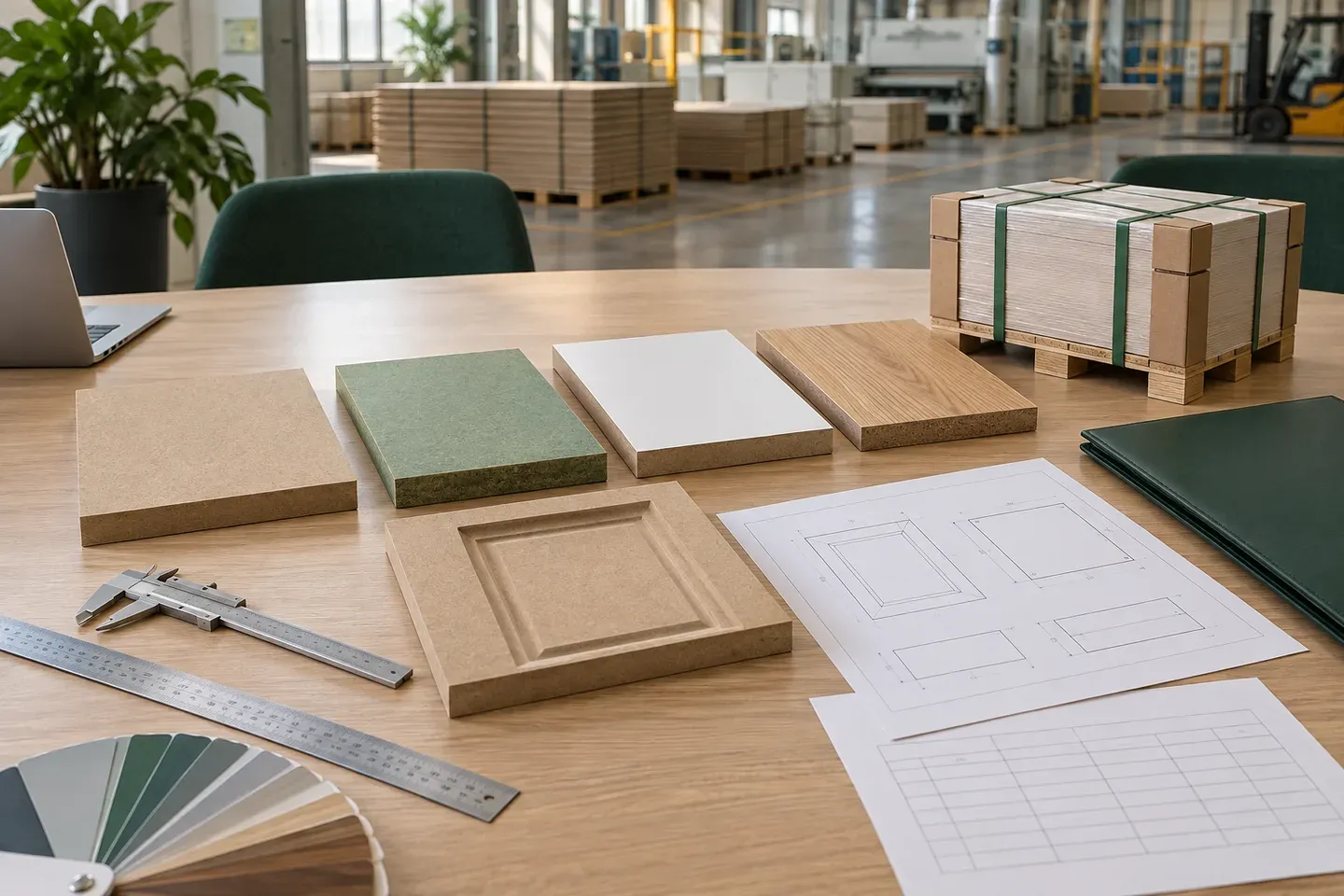
A production-ready MDF RFQ gives every supplier the same commercial and technical basis: finished application, product construction, dimensions, performance requirement, surface, processing, quantity, approval process, required documents, packaging, delivery point and timing. Suppliers can then price the same scope and return a quotation that moves directly into sample approval and order review.
Start the RFQ with the buying decision
State what the buyer needs to purchase: full MDF sheets, faced panels, cut-to-size blanks, CNC-machined parts or finished furniture components. Add the application, service environment, annual or project demand, destination and intended order date. This opening paragraph helps the supplier arrangement the enquiry to the correct product and production team.
Describe the finished application
Name the furniture or interior component and its protected-interior conditions. Record visible faces, support, hardware, machining, finish, cleaning, humidity and any relevant project requirement. When the MDF product remains open, describe the finished result and exposure so the supplier can propose a clearly identified construction for review.
Use one specification row for each product
Create a schedule that separates every thickness, format, surface or component construction.
| RFQ field | Information to provide |
|---|---|
| Product | Raw MDF, MR MDF, HMR MDF, Fire Rated MDF, HDF, hardboard or faced construction |
| Thickness | Nominal thickness and required tolerance |
| Dimensions | Full board size or finished component size |
| Density or performance | Required range, classification or product-specific target |
| Emission class | E0, E0.5, E1 or destination-specific requirement |
| Surface | Raw, sanded, melamine, veneer, laminate, PVC, acrylic, paint-ready or finished |
| Quantity | Sheets, m³, bundles or finished parts |
| Reference | Drawing, physical sample, colour code or approved product reference |
The quotation should repeat these fields beside the offered product so differences remain visible.
Define face, reverse, edge and finish
Describe the complete construction. Record front surface, reverse or balancing layer, colour, decor, texture, gloss, veneer species and cut, grain direction, edge treatment and protective film. Appearance-sensitive orders should identify the physical sample, approval date and acceptable variation.
Describe processing by delivered stage
State the exact form of supply: full sheets, rectangular blanks, nested parts, routed components, drilled panels, sanded profiles, pressed panels, edge-banded parts, paint-ready parts or finished components. Use one line for every included operation so machining and finishing costs can be compared on the same basis.
| Processing item | RFQ detail |
|---|---|
| Cutting | Finished dimensions, squareness, quantity and part ID |
| CNC routing | File revision, datum, profile, depth, radius and remaining material |
| Drilling | Hole type, diameter, depth, coordinates and hardware reference |
| Sanding | Face, edge and routed-profile preparation stage |
| Pressing or facing | Face material, reverse balance, reference and finished thickness |
| Edge work | Edge band, paint, veneer, wrap, bevel or profile by side |
| Labelling | Project, cabinet, room, part, orientation and pack sequence |
Attach controlled drawings and files
List every attachment in an RFQ register. Give each drawing, cut list, CAD or CNC file, colour schedule and pack plan a filename and revision. State units, named datums, tolerances and critical dimensions. A supplier response should identify the exact revision used for pricing.
Separate dimensional tolerance from performance requirements
State thickness, length, width, squareness and finished-part tolerances where they matter. List density, moisture, emission, fire or other performance requirements in their own fields with the relevant standard or test method. This separation connects each requirement to the correct production and inspection record.
Build a document schedule
Create one row for each required certificate, test report, declaration or traceability document.
| Requirement | RFQ instruction |
|---|---|
| Emission | Class, method, destination and offered-product identity |
| Moisture performance | Product, test method, required result and application scope |
| Fire performance | Classification, method, product or system scope and destination |
| FSC or sourcing | Claim type, chain-of-custody scope and order-document requirement |
| Quality records | Inspection stage, measured item and required report timing |
Ask the supplier to identify the supporting document and its scope beside the offered product. The buyer can then review product identity, test basis, dates and destination relevance before order release.
Define sample and first-article approval
State which decision each sample supports: board identity, colour, texture, gloss, veneer range, profile, edge, hardware fit, complete component or packaging. Include sample quantity, size, reference ID, approval deadline and shipping destination. For machined or finished components, define the first article and the records required before repeat production.
State quantity on a consistent basis
List production quantity for every specification in sheets, cubic metres, bundles or finished parts. Show sample quantity, first articles, production quantity and agreed spares separately. For mixed orders, identify which specifications share a container or shipment and whether the supplier may propose an optimized bundle split.
Specify packaging and identification
Describe face protection, separators, top and bottom covers, edge and corner protection, wrapping, straps, pallets or supports, labels and pack sequence. Add receiving equipment, forklift direction, storage conditions and any bundle-weight preference. Finished components can be grouped by cabinet, room, installation stage or production line.
Give the loading and transport context
Provide destination country, port or named delivery point; preferred transport mode; unloading method; and any size or weight constraint. MDF is a heavy cargo, so the final plan should use confirmed product mix, packed dimensions, net weight, packaging weight and gross cargo weight. Large-volume orders can include a comparison between container and breakbulk routes based on the actual shipment.
Name the trade term and delivery point
Write the Incoterm® rule, named place and applicable version requested for quotation. Entries such as FOB Lianyungang, FOB Qingdao or a named destination basis define a clear scope. Ask the supplier to list which origin, freight, insurance or destination costs are included in the offered price.
Define the production timeline from clear events
Use milestone dates and triggers:
1. RFQ issued and questions returned; 2. quotation and sample offer received; 3. specification, drawings and samples approved; 4. deposit or agreed production-release condition completed; 5. production started; 6. inspection-ready date; 7. cargo-ready date; 8. shipment handover and estimated transport schedule.
CUZI MDF’s normal production lead-time planning range is 7–15 days after order requirements are confirmed. Final timing follows product construction, quantity, production schedule, packaging and destination.
Request commercial terms in separate fields
Ask for price unit, currency, quantity basis, price validity, sample and setup cost, payment milestones, production lead time, packaging cost, delivery basis and quotation validity. Keep optional processing and alternative constructions on separate lines. This structure makes the commercial response easier to normalize.
Ask suppliers to return a compliance table
Include three response columns beside every important RFQ line: **offered as requested**, **offered alternative**, and **supplier comment or document reference**. The supplier can then identify the exact offered construction, proposed alternative, included work and open decision. Purchasing teams receive a response that supports technical review before price comparison.
Use a final RFQ attachment checklist
Before issuing the enquiry, confirm that the package contains:
- RFQ cover with buyer, project, destination and requested quotation date;
- product and quantity schedule;
- performance and supporting documents schedule;
- surface, colour or veneer references;
- drawings, cut lists and file register;
- sample and first-article requirements;
- inspection and acceptance points;
- packaging, labels and loading information;
- requested trade term, named place and commercial response format.
Record the RFQ revision so every supplier prices the same issue.
Send the RFQ to CUZI MDF
CUZI MDF’s normal MOQ is 1 × 20'GP for each individual specification. Send the application, product schedule, drawings or samples, quantity, required documents, packaging and destination through the MDF quotation form. After supplier replies arrive, use the MDF quotation comparison guide to compare the same construction, delivery scope and landed order basis.