
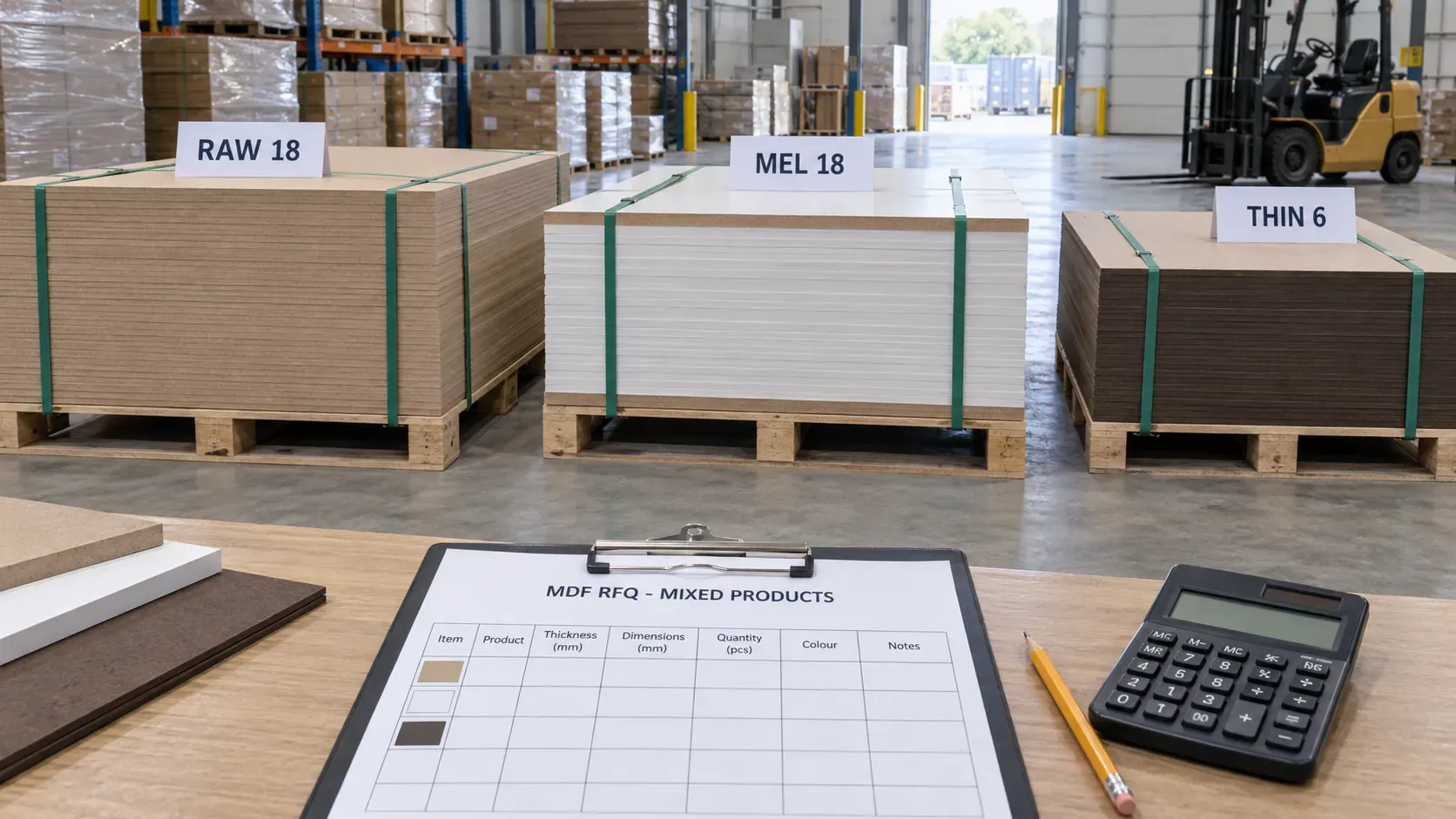
This Procurement Scenario is an educational decision model for a common sourcing situation. It presents a reusable workflow independent of any named CUZI MDF customer project, completed delivery or claimed commercial result.
A mixed-product distributor inquiry may combine raw MDF, thin board, melamine-faced MDF and selected decorative products in several thicknesses and formats. Reliable quotation and loading depend on treating every construction as a separate commercial line, then consolidating the accepted lines through one inventory, packaging and logistics plan.
Start with the target assortment and market role
List each proposed product and explain its intended customer group, application and stock role. Mark core stock, project-specific demand, launch stock, sample stock and optional lines separately. Record the destination market, preferred delivery window, local handling limits and expected reorder pattern. This gives the supplier a commercial reason for each line and helps the distributor evaluate minimum quantities against likely turnover.
Build one RFQ row for every construction
Create a line-level matrix with item code, product name, MDF type, thickness, board format, density expectation, surface construction, face and reverse, colour or sample reference, quantity, bundle preference, destination requirement and priority. A change in thickness, size, substrate, decor or surface creates a new line. Use one RFQ revision and keep line codes stable through quotation, samples, packing and receiving.
Define the complete product identity
State raw MDF, moisture-resistant MDF, melamine MDF, thin MDF, HDF, decorative MDF or another confirmed product as applicable. Add nominal thickness, agreed tolerance, dimensions, density range, sanded or faced condition and the E0/E0.5/E1 destination requirement for the selected product. For faced panels, include the substrate, face, reverse, texture, gloss, direction and finished thickness as one construction.
Separate fixed requirements from approved alternatives
Mark every field as fixed, supplier-proposed or alternative-permitted. A fixed line follows the exact product, construction and reference supplied by the buyer. A supplier-proposed field invites a documented recommendation. An alternative-permitted line should state which attributes may change and which remain fixed. Keep the original and alternative as separate quotation rows so price, MOQ, documents and lead time remain visible.
Connect each line to its physical sample approval sequence
Identify whether the line requires a small material sample, decorative reference, constructed corner, machined sample or complete component. State which attributes each sample will control and the approval timing. Product and appearance samples should carry the same line code as the RFQ. Retained samples then support batch review, receiving and future replenishment.
Build a product-specific document matrix
List the destination requirement, requested document type, applicable product, thickness or construction, issuer, status and responsible approval party for every line. Match emission, moisture, fire or other technical documents and test reports to the offered item and its current scope. Keep product data, declarations, certificates and test reports in distinct columns so the buyer can review applicability before commercial release.
Review MOQ by specification and product family
Ask for minimum quantity, production increment and permitted quantity variation by exact line. Record whether an MOQ applies to one thickness, one size, one decor or a combined compatible run. Compare each small line with its expected stock turnover and customer demand. The distributor can then increase, postpone, replace or remove a line through a documented assortment decision.
Convert quantities into comparable units
State sheets, square metres and cubic metres where each measure helps purchasing. Keep component quantities separate from full-board quantities. Record the calculation basis and rounding rule. Quotations should return the same units plus net product quantity, packaging quantity and any production variation so total volume and delivered cost can be compared accurately.
Calculate weight from confirmed order data
Use the offered thickness, dimensions, sheet quantity and density for a preliminary net-weight calculation. Add confirmed packaging, bases, cover boards and protection for the gross estimate. Compare the result with applicable container, road and destination limits. Recalculate whenever a line, density, quantity or pack design changes and identify the revision used for booking.
Plan bundles before container consolidation
Define bundle size, sheet count, base construction, support positions, cover protection, strapping and label requirements for each product and format. Review whether small quantities can form a stable dedicated bundle and how mixed bundle proposals remain traceable. Use confirmed bundle dimensions and weights to plan container position, axle distribution, unloading sequence and warehouse placement.
Align packaging with product risk
Raw panels need dry handling, flat support and protected edges. Decorative faces need clean separators and surface protection. Thin panels need continuous support and controlled strap pressure. Large-format panels need a handling route matched to loading and unloading equipment. Record the packaging construction by line or compatible group and carry the same code into the packing list.
Label for warehouse receiving and resale
Specify purchase order, RFQ revision, product code, description, thickness, dimensions, surface reference, quantity, bundle number, gross and net weight where confirmed, and destination group. Add the distributor's resale or warehouse code when required. Position labels so they remain visible during unloading and storage and link them to the detailed packing list.
Model inventory and slow-moving exposure
Estimate months of stock, customer concentration, substitution potential and reorder frequency for every line. Separate proven fast-moving specifications from launch or special-order items. Review the cash tied up in MOQ, residual quantities, samples and replacement stock. This allows the buyer to compare a broad assortment with a focused assortment on the same inventory assumptions.
Compare lead time by line and consolidated order
Ask for sample timing, production lead time, pack completion and shipment readiness by product line. Identify the line that controls the combined order date and the conditions that trigger a revised schedule. A split-shipment option can be quoted separately when the distributor wants core stock earlier and slower special lines later.
Normalize quotation price and exclusions
Require line-level unit price, pricing unit, quantity, included processing, documents, samples, packaging, labels, delivery basis, validity and payment terms. Record tooling, setup, film, edge work, machining, inspection and special packing as visible items. State currency and Incoterm with the named place so each offer reaches the same quoted supply scope.
Compare landed cost and operational fit
Combine product price with sampling, setup, packaging, inland transport, port costs, ocean freight, insurance, destination charges, duty or tax assumptions, unloading and warehouse handling as applicable. Compare both total landed cost and the cost per accepted line, sheet, cubic metre or saleable unit. Add inventory exposure, document completeness and receiving complexity to the purchasing decision.
Request an MDF quotation
Send the current assortment matrix, line priorities, exact product constructions, quantities, sample and document schedules, MOQ questions, packaging and label requirements, destination, unloading method and required dates. Use the MDF quotation comparison guide for commercial normalization, the container loading guide for booking inputs, and request a mixed-product RFQ review with the complete matrix.