
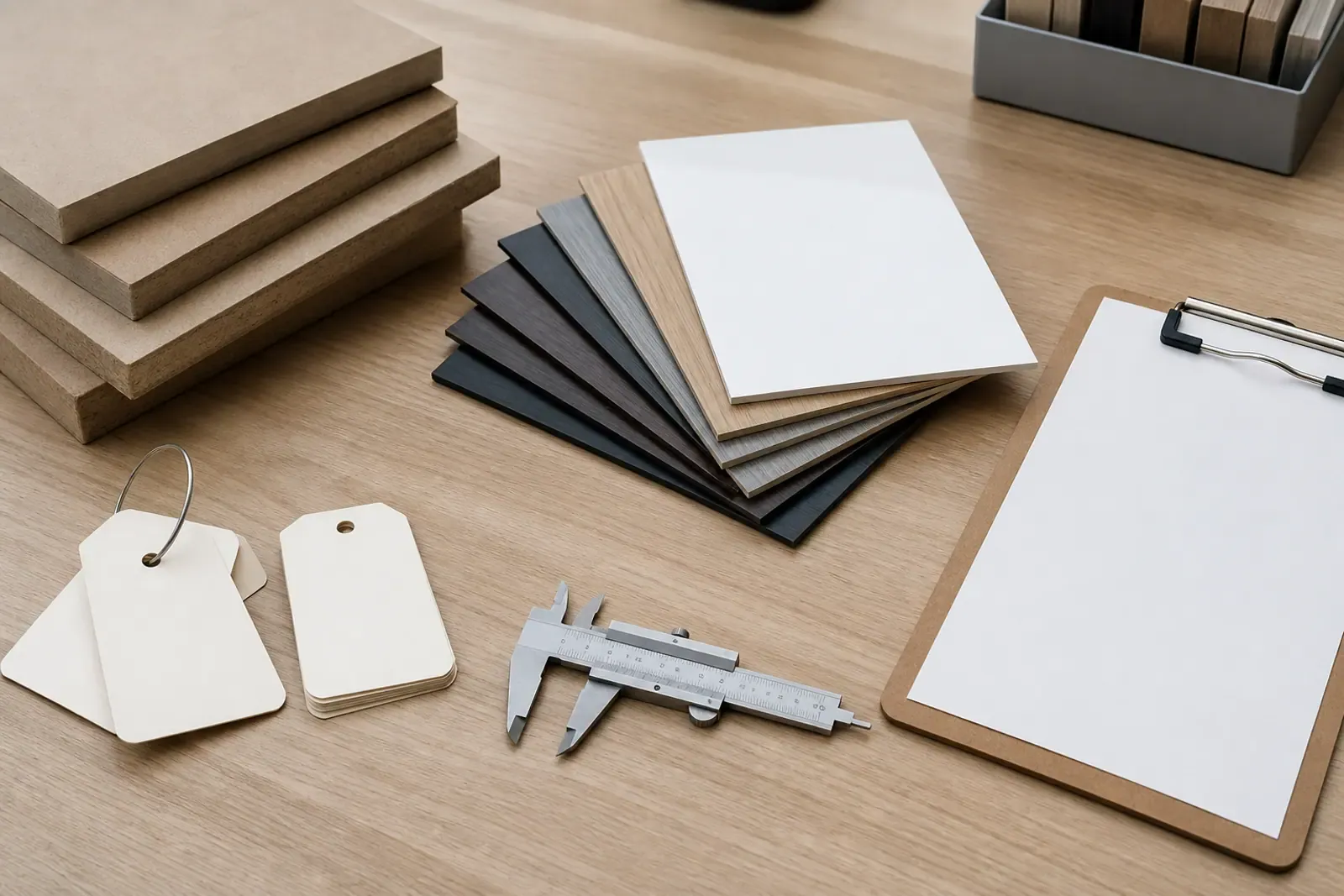
An MDF order becomes comparable and production-ready when every supplier prices the same product construction, dimensions, surface, processing, required documents, quantity and delivery scope. This checklist turns the buyer's application into one controlled specification schedule before quotation and order release.
Define the finished application first
Name the finished component and its service environment. A cabinet carcass, routed door, wardrobe panel, shopfitting module and interior wall panel can use different MDF constructions within the same project. Record visible faces, support, hardware, humidity, cleaning, expected handling and any destination-specific requirement that affects product selection.
Identify the exact form of supply
State the stage CUZI MDF is being asked to supply.
| Form of supply | Specification focus |
|---|---|
| Full raw sheets | MDF product, thickness, format, density, surface and downstream process |
| Faced full sheets | MDF core, principal face, reverse or balancing layer, finished thickness and decor direction |
| Cut-to-size blanks | Complete panel construction, finished dimensions, quantity, orientation, edges and labels |
| CNC-machined parts | Controlled drawing, units, revision, datums, machining depths, holes and remaining material |
| Finished components | Complete construction, surface system, hardware interfaces, sample, inspection and protection |
The quotation should repeat this supply stage beside every price so material and processing scope remain comparable.
Create one specification row for each product
Separate raw MDF, MR MDF, HMR MDF, HDF, Hardboard and each decorative construction into individual schedule rows. Give every row a product name, internal item code or buyer reference, finished application and quantity. Mixed thicknesses, sizes, colours, surfaces or emission classes remain visible as separate specifications for MOQ, production, packing and inspection review.
Confirm thickness, tolerance and board format
CUZI MDF reference MDF thicknesses cover 2–35 mm. Reference board formats are 1220 × 2440 mm, 2100 × 2800 mm, 1830 × 2440 mm, 1830 × 3660 mm, 2440 × 3660 mm and 1830 × 4200 mm. Confirm the selected product, thickness and format combination in the quotation.
The nominal thickness tolerance is ±0.1 mm, subject to the agreed measuring positions, equipment, conditioning and acceptance method. For processed components, record input-board format separately from finished part dimensions.
Specify density by product and thickness
Density belongs to the exact product and thickness being purchased. State the required range or ask CUZI MDF to identify the offered product-specific range in the quotation. Use density together with thickness and dimensions to calculate theoretical sheet weight, then use confirmed production and packed weights for shipment planning.
Density supports product identity, weight and machining review. Moisture resistance, emission class, fire classification and finished-component suitability follow their applicable verification methods.
Define face, reverse, edge and direction
Describe the supplied construction on every surface that matters to the finished component.
| Surface field | Information to record |
|---|---|
| Principal face | Raw, sanded, melamine, veneer, laminate, PVC, acrylic, paint preparation or other confirmed surface |
| Reverse face | Matching face, balancing layer, backing construction or other confirmed finish |
| Direction | Grain, printed pattern, texture, gloss orientation, top and visible face |
| Edges | Raw, sanded, sealed, painted, banded, wrapped or machined profile |
| Finished thickness | Core plus the complete face and reverse construction |
Use a physical sample reference for colour, veneer, texture, gloss and natural variation. A finished corner or representative component records the relationship between face, reverse and edge.
Attach processing drawings and cut lists
State cutting, routing, grooving, drilling, profiling, sanding, coating, pressing, edge work and supplied finishing stage. Drawings should carry part ID, units, revision, finished dimensions, datums, face orientation, pattern direction, machining depths, internal radii, remaining material and hardware coordinates. The cut list should use the same part IDs, revision and quantity basis.
Separate performance requirements and supporting documents
List every requested property beside the order line that uses it.
| Requirement | Document review focus |
|---|---|
| Formaldehyde emission | E0, E0.5 or E1 requirement, applicable method, product identity and destination scope |
| Moisture performance | Proposed MR or HMR product, thickness, test method, result and supported application scope |
| Fire performance | Product and construction identity, thickness, test method, classification and field of application |
| Management or chain of custody | Current certificate, holder, scope, site and applicable transaction records |
| Mechanical or system performance | Relevant product or complete-assembly method, result and design responsibility |
Request authentic, complete and current documents. Match issuer, dates, product, thickness or construction, method, result and scope to the proposed order before release.
Define the sample and approval process
Record what each sample is intended to approve. A substrate sample supports face and edge review; a decor sample supports colour, texture and gloss; a finished corner supports layer and edge construction; a machined component supports geometry and finish; a first article supports the complete production result. Give every accepted reference an ID, date, orientation and revision.
State quantity, MOQ and permitted variation
List production quantity for every specification in sheets, cubic metres, bundles or finished parts. CUZI MDF's normal MOQ is 1 × 20'GP for each individual specification. A mixed-specification proposal receives an order-specific feasibility review. Record sample quantities, production quantities, agreed spares and any quantity tolerance as separate fields.
Match packaging to the actual goods
Define pack grouping, separators, top and bottom protection, corner and edge protection, wrapping, supports, strap positions, bundle labels, fork-entry direction and unloading method. Decorative faces, thin sheets, large formats and machined components use protection matched to their surface and geometry. Record packed dimensions, bundle count and confirmed gross weights in the shipping file.
Confirm commercial and delivery scope
Ask the quotation to state currency, price unit, included processing, sample cost, packaging, inland transport, trade term, named delivery point, payment terms and validity. Typical production lead time is 7–15 days after requirements are confirmed. Record the production-release date, cargo-ready date and logistics milestones separately.
Build the inspection and release checklist
Connect inspection to the purchase order, specification schedule, controlled drawings and approved samples. Define sampling, product identity, quantity, thickness, dimensions, faces, edges, machining, finish, labels, packaging and required documents. Record results and agreed disposition against each order line before shipment release.
Send a complete specification schedule
Provide the application, form of supply, product rows, dimensions, density, face/reverse/edge construction, E0/E0.5/E1 requirement, processing drawings, samples, required documents, quantity, packaging, destination and requested dates. Use the international MDF RFQ guide to package these decisions into a supplier request, then request a specification review with the controlled files.