
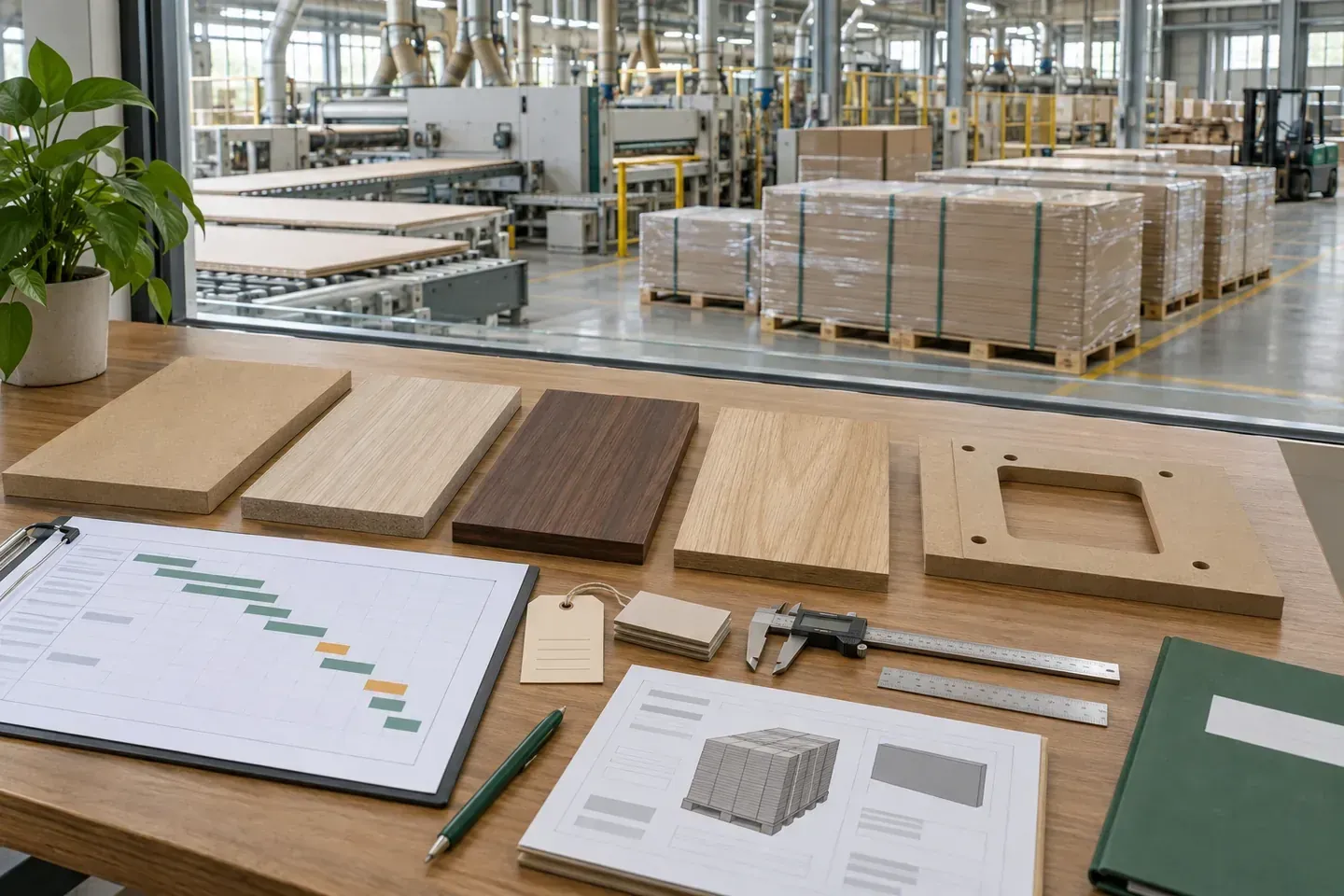
The normal CUZI MDF production lead time is 7–15 days after the specification and commercial requirements are confirmed. A reliable order schedule defines the approval checkpoint, product option, responsible owner and completion record for approval, production, inspection, packing, cargo readiness and shipment.
Set the production clock from a written approval checkpoint
The 7–15 day range is the normal production lead time after the order requirements are confirmed. The quotation or order record should name the event that starts this clock: the accepted commercial order plus the approved material, quantity, surface references, drawings, sample decision, packing scope and delivery term. Product selection, sample development and drawing revision sit in the pre-release plan. Carrier schedules, transit, customs and inland delivery sit in the logistics plan. This separation gives the buyer one traceable production start and prevents a requested arrival date from being treated as a factory completion date.
Use one milestone schedule
Give every date one clear meaning, owner and completion record.
| Milestone | Completion meaning | Owner and record |
|---|---|---|
| Requirements released | Every order line has an approved specification and commercial status | Buyer and supplier release register |
| Materials ready | MDF, decorative faces, veneer or processing inputs are assigned to the order | Supplier material-readiness record |
| Production started | Released order enters the confirmed manufacturing sequence | Supplier production plan |
| Inspection-ready | The agreed lot or sample quantity is accessible for the stated checks | Supplier notice and inspection plan |
| Packing complete | Accepted goods have the agreed protection, labels, pack count and dimensions | Packing list and pack records |
| Cargo-ready | Packed goods and shipment data are released for the named handover | Supplier cargo-ready notice |
| Dispatch or port delivery | Cargo reaches the agreed handover point | Forwarder or carrier record |
| Estimated departure and arrival | Booked route supplies the current transport dates | Forwarder or carrier confirmation |
| Final delivery | Cargo reaches the buyer’s receiving location | Buyer’s receiving plan |
Close the production-release checklist
Production scheduling becomes dependable when every affected order line contains:
- MDF product and required performance or emission class;
- thickness, board format or finished component dimensions;
- density, tolerance and supplied surface requirements;
- face, reverse, edge, colour, texture or veneer references;
- current drawing, cut-list and machining revisions;
- quantity by specification or part number;
- sample or first-article decision;
- inspection scope and acceptance method;
- packaging, labels, destination and handling method;
- payment and commercial release conditions.
Give each item a status of approved, open, superseded or outside the production scope. Record the current reference, owner and due date beside every open item. The release decision then comes from one controlled checklist shared by purchasing, production, inspection and logistics.
Plan by the actual order type
Different MDF orders follow different approval and production schedules even when their production range falls within the same normal 7–15 day window.
| Order type | Schedule inputs to confirm |
|---|---|
| Raw MDF sheets | Product, thickness, format, density requirement, quantity and pack construction |
| Melamine or decorative MDF | Substrate plus physical decor, texture, direction, face/reverse construction and edge requirements |
| Veneered MDF | Species, cut, matching, balancing layer, grain direction, sample set and finishing responsibility |
| CNC or cut components | Released files, units, revision, tolerances, first-part check, part labels and nesting inputs |
| Mixed specification order | Separate release and completion status for every thickness, surface, size and component family |
The quotation should state which option applies and which approval gates belong to it.
Match material and surface readiness to the schedule
Raw MDF, melamine surfaces, natural veneer and processed components use different readiness checks. Raw-sheet planning focuses on the released product, thickness, format and quantity. Decorative orders add a physical colour, texture, direction and face/reverse approval. Veneer orders add species, cut, matching, balancing layer and accepted natural variation. Machined orders add controlled files, units, revision, tooling access and first-part status. Record the readiness date for each input beside its order line so the production sequence reflects the actual construction.
Build the critical path and parallel workstreams
Place dependent tasks in the order created by the selected product. Physical decor or veneer approval normally precedes production release; released machining files precede repeat cutting; inspection follows completion of the agreed inspection quantity; packing follows checks that require accessible faces or bundles. Freight enquiries, document preparation and label review can advance in parallel. Final booking uses the current cargo-ready date, packed dimensions, gross weight and loading method. The longest dependent sequence is the critical path, while parallel tasks reduce avoidable waiting around it.
Assign responsibility at every handoff
A schedule becomes actionable when every milestone has one party responsible for the next release.
| Handoff | Primary owner | Confirmation to retain |
|---|---|---|
| Specification and order release | Buyer and supplier commercial teams | Approved order and release checklist |
| Material and production status | Supplier planning and production teams | Line-level readiness and progress update |
| Sample or first-article decision | Named buyer approver and supplier technical contact | Identified approval record |
| Inspection release | Supplier quality team and appointed inspector | Inspection result and disposition |
| Packing and cargo data | Supplier packing and logistics teams | Pack list, dimensions, weights and labels |
| Booking and transport dates | Buyer, forwarder or carrier according to the trade term | Booking and handover confirmation |
The status report should name the responsible contact and next due date for every open handoff.
Track production through measurable checkpoints
Use checkpoints that describe completed work for the actual order.
| Checkpoint | Useful progress record |
|---|---|
| Order released | Approved lines, quantities and references in the release register |
| Inputs assigned | Product, surface and processing materials linked to the order |
| Production active | Current process stage and quantity completed by order line |
| First article accepted | Identified sample or component disposition recorded |
| Order quantity complete | Completed quantity reconciled with the purchase order |
| Inspection released | Accepted quantity and actions recorded |
| Packing complete | Bundle count, labels, dimensions, weights and protection confirmed |
| Cargo-ready | Final shipment data issued for handover |
Percent-complete figures gain value when they are tied to one of these defined checkpoints and the affected order lines.
Work backward from the required delivery milestone
Start with the buyer’s required milestone and label it precisely as factory dispatch, port handover, destination-port arrival or delivery to the receiving site. Obtain the relevant sailing, cut-off, transit and inland-delivery information from the forwarder or carrier. Then reserve time for cargo release, packing, inspection, production and approvals in reverse order. Add project contingency that reflects service frequency, document timing, seasonal congestion and the buyer’s installation program. This calculation produces the required order-release date and preserves separate production and logistics commitments.
Coordinate inspection, packing and booking
Set the inspection point according to what the buyer needs to see. Surface and quantity checks may require accessible sheets or components; packing checks require completed bundles; loading checks follow the selected container or breakbulk plan. Record which packs may close before inspection and which remain accessible. Freight enquiries can use forecast data, while the final booking and loading plan should use confirmed cargo-ready timing, bundle dimensions, gross weights and handling method. This coordination protects the inspection scope and keeps logistics planning current.
Control mixed orders and partial releases
Track approval, input readiness, production, inspection and packing by order line when one shipment combines thicknesses, sizes, colours or machined parts. A completed raw-board line and a decorative line still in surface approval will have different readiness dates. Agree whether the order ships as one complete lot or permits a documented partial release. A partial shipment record should preserve purchase-order lines, part IDs, released quantities, packing-list references and the remaining balance so production, freight and receiving teams reconcile the same order status.
Record the schedule effect of every approved change
Treat each approved change as a new scheduling input. Record the previous and current size, quantity, surface, drawing, inspection or packing requirement; identify material and work already completed; assign the new action owner; and issue the revised production and cargo-ready dates in writing. Keep the active revision visible in purchasing, production, quality and packing records. The change register then explains the schedule movement and protects every team from using an earlier reference.
Evaluate priority-order feasibility
A priority request should be reviewed against the released product, input readiness, production sequence, processing method, inspection scope, packing plan and freight cut-off. The supplier can then identify which tasks are fixed dependencies, which can run in parallel and which milestone can be advanced. Record the approved priority plan as an order-specific schedule with its current assumptions. This produces a realistic accelerated route and a clear date for the next decision.
Connect cargo readiness to the transport plan
Cargo-ready status should include accepted goods, final pack count, packed dimensions, net and gross weights, labels and the agreed document set. Container and breakbulk plans use different handling and booking inputs, while both depend on accurate packed-cargo data. Review the route, loading method, destination and handover responsibility with the forwarder. The MDF container loading guide and Packaging & Shipping page cover these handover details.
Issue one current schedule revision
A concise progress report should show:
- purchase order and current schedule revision;
- production-release date and normal production range;
- status by product or component family;
- completed milestone and supporting record;
- next milestone, owner and due date;
- approved changes and their date effect;
- inspection-ready, packing-complete and cargo-ready forecasts;
- booking, dispatch and arrival dates with their source;
- open action requiring a buyer, supplier, inspector or forwarder decision.
Issue the current revision after every material schedule change and identify superseded versions. Purchasing and logistics teams can then plan from the same dates.
Prepare a schedule-ready RFQ
State the requested cargo-ready date and required delivery milestone separately. Attach the complete specification, quantities, approval references, drawing revisions, inspection request, packing requirements, destination, trade term and preferred shipment plan. Ask the quotation to identify the approval checkpoint, normal production range, order-specific milestones, planning assumptions and validity. Use the MDF RFQ guide to prepare the technical inquiry and the sample approval guide for the pre-production reference. Request a specification review with the order lines and required dates.
Buyer review checklist
Before relying on this guidance, record the finished component, service environment, MDF product or unresolved product requirement, thickness, dimensions, supplied surface, visible edges, machining, hardware, quantity and destination. Identify which values need current technical documents and test reports and which appearance decisions need a physical sample.
For international supply, also confirm drawing and sample revisions, packaging construction, part or bundle labels, handling limits, required documents and the party responsible for finished-product design and destination compliance. Ask the supplier to list unresolved items and exclusions in the quotation, and keep every missing value visible for confirmation.
Compare quotations only after these inputs have been normalized. Check whether the offered price covers a full board, a faced construction, a machined part or a finished component, and whether samples, secondary work, protective materials and documentation are included. Record every change after approval so purchasing, production, inspection and receiving teams use the same revision.
Typical lead time is 7–15 days after requirements are confirmed. Final timing depends on specification, quantity, production scheduling and destination. This planning range covers production; arrival timing also depends on the confirmed logistics route.
Request an MDF quotation
Share the application, specification, quantity, packaging and destination with CUZI MDF for an order-specific review.