
This guide brings those decisions together for your purchasing and receiving teams.
Choose the MDF construction and supplied stage
The most useful starting point is what your factory will make with the shipment. A distributor ordering full sheets needs a clear stock specification and replenishment plan. A furniture manufacturer may need a particular decor, cut sizes or drilled parts ready for the next operation. An interior project can add matching elevations, installation details and destination documents. Give each product its own order line so those needs remain visible from quotation to receiving.
CUZI MDF manufactures and supplies boards and machined components from our factory in Shuyang, Jiangsu, China. You can discuss the material, surface, processing and packing with the team supplying your order. Our product catalogue helps you choose the construction, while our global supply information covers the commercial and shipping arrangements for international buyers.
| Supply requirement | Details to put on the order line | What your receiving team should identify |
|---|---|---|
| Raw MDF, MR or HMR MDF | Selected grade, thickness, dimensions, density requirement, tolerances and intended interior use | Grade and specification reference, supplied dimensions and batch |
| Melamine MDF | Core, finished panel thickness, face/reverse decor, texture, gloss and pattern direction | Selected decor/sample reference and face orientation |
| HPL MDF | Core, 0.5–1.2 mm nominal HPL selection, bonding, reverse construction, finish and edges | Complete faced construction and approved HPL reference |
| Veneered MDF | Species, veneer construction, matching, sequence, reverse and supplied sanding/coating stage | Sample and elevation/sequence references for related parts |
| Cut-to-size MDF or CNC MDF components | Part IDs, drawing revisions, dimensions, features, completed operations and remaining work | Pieces by part ID and the relevant drawing revision |
| Fire Rated MDF, HDF or Hardboard | Product-specific thickness, density or performance requirement, supplied surface and relevant documents | Actual product identity and the document scope agreed for that construction |
Use separate lines when thickness, grade, surface or supplied work changes. An 18 mm core and an 18 mm completed faced panel describe different requirements. For example, HPL face thickness, bonding and reverse layers contribute to the completed section. A cut board and a banded, drilled component also arrive at different stages of your production. We identify that stage in the quotation so your team can cost and schedule the work that remains.
For a moisture-sensitive interior, describe the room, humidity, cleaning and incidental water exposure before selecting Moisture Resistant MDF. For a specified fire performance, connect the required classification and test method with the actual Fire Rated MDF construction. The MDF specifications checklist develops the material details; this export guide connects the accepted product with the shipment your team will receive.
Still choosing a sourcing location? Compare MDF manufacturers by region. For a Chinese factory order, follow the China MDF sourcing guide through supplier checks, samples and first-order planning.
Carry samples and drawings into the accepted order
A physical sample makes the surface decision easier. A drawing makes the component decision repeatable. Give both a reference that appears in the accepted quotation or order schedule, and describe what has been approved: colour and texture, the complete face/reverse construction, machining geometry, or the finished assembly. A small colour swatch and a complete component each answer a different purchasing question.
Use these six checks when turning a trial into an export order:
- Identify each sample by product, finish and sample ID, with the agreed version or date.
- Record the actual face, reverse, edges, texture, gloss and pattern direction your order will repeat.
- Name the supplied stage, including machining, edge treatment, sanding or coating completed by our factory.
- Link part IDs and drawing revisions to dimensions, datums, holes, profiles and any assembly sequence.
- Agree appearance variation and measurable acceptance requirements for the selected product and sample.
- Carry accepted changes into the order schedule, quotation, production information and inspection plan together.
This approach helps a furniture factory keep matching parts together and helps a distributor reorder the same stock construction. If a decor changes between quotation and ordering, confirm the new physical reference and its price, availability and timing. For a drawing revision, identify the affected parts and quantities. A written change record lets both teams understand which reference the next shipment follows.
Our product samples are free and usually available from stock. You pay the courier charge, which can be credited against the formal order amount. We confirm the requested sample, availability, preparation and estimated transit time before dispatch. For a machined or finished trial, we agree its supplied processing stage and preparation schedule with you. The sample approval guide explains how to move from a surface reference to a first component.
Keep the sample decision connected to its purpose. A representative sample can show appearance, edge preparation and machining response. Product certification and destination requirements use the applicable documents and identification for the offered construction. Your production team can trial the sample with its own tooling, finish and hardware while your purchasing team reviews the commercial and document requirements.
Agree FOB or CIF scope and payment terms
CUZI MDF offers FOB supply, with T/T or L/C payment as agreed for the order. Our usual shipment ports are Lianyungang and Qingdao. Write the chosen term, named port and agreed Incoterms version into the quotation and order. Under FOB, the named port is the shipment port; under CIF, it is the destination port to which freight and insurance are arranged.
| Commercial point | What to agree for your MDF order | How it helps the buyer |
|---|---|---|
| FOB named shipment port | Exact port, product price, export-side scope and buyer's onward shipping arrangements | Connects the factory order with your freight booking |
| CIF named destination port | Exact destination port, quoted freight and insurance scope, validity and shipment assumptions | Gives a defined ocean-transport cost basis for comparison |
| Risk and insurance | Delivery/risk-transfer point, insured interest, cover and claim information | Connects cargo protection with the agreed transport responsibilities |
| Destination costs | Applicable terminal charges, clearance, duties/taxes, inland delivery and unloading arrangements | Completes the buyer's landed-cost calculation |
| T/T or L/C payment | Agreed payment stages or credit terms, amounts, currency and required documents | Aligns the commercial schedule with workable shipment documents |
| Quote validity and changes | Validity period, quantity basis, freight assumptions and the process for agreed changes | Shows what the written offer covers when the order is placed |
FOB and CIF allocate delivery obligations, costs and transport responsibilities. Under Incoterms 2020, their delivery and risk-transfer point is on board the vessel at the shipment port; a CIF destination port identifies the destination of the arranged carriage. Payment, ownership and remedies are agreed in the sales contract. Review these distinctions with your shipping team when choosing the order term. ICC's Incoterms guidance explains the relationship between the named place, delivery, risk and commercial contract.
For an L/C order, review the proposed credit with us before issuance, including description, shipment dates, document wording and presentation requirements. For T/T, record the agreed stages and the corresponding order or shipment milestone. Payment proportions and detailed credit conditions are confirmed for the actual transaction. A clear document schedule makes the arrangement easier for your purchasing, finance and shipping teams to follow.
Compare returned quotations at the same product, supplied stage and unit. A price per sheet, m³ or finished piece needs its corresponding dimensions and construction. Add the agreed packing, processing, transport and destination costs to your comparison. The MDF quotation and landed-cost guide provides the detailed comparison workflow.
Match destination requirements with the supplied product
Tell us the destination country and intended use at the inquiry stage. An order for furniture components, a construction lining and a distributor's panel stock can need different information. List the required document, product identity, method or classification and scope so we can connect your request with the proposed supply before the order is released.
| Document or requirement | Information to match | Where it belongs in the order |
|---|---|---|
| Product specification and test report | Manufacturer/product identity, construction, thickness, method, measured property, result and relevant date | Technical schedule for the selected order line |
| US regulated composite-wood requirements | Applicable TSCA Title VI certification/identification, labels, records and importer requirements | Selected product documentation and the buyer/importer's entry arrangements |
| EU destination and end-use requirements | Country, intended use, applicable emissions method/limit and requested wood-source or transaction information | Product and destination-specific document schedule |
| Specified fire performance | Required classification, test method, board/facing/installation construction and report scope | The exact product or system being ordered for the project |
| Certified-source or transaction claim | Requested claim, covered product and the documents relevant to that transaction | Accepted order and invoice/document instructions |
| Wood packaging material | Actual solid-wood or processed-wood components and applicable treatment/marking requirements | Packing specification and shipping checks |
For US-bound regulated composite wood, product certification/identification, labels and records need to match the supplied goods. The importer also has the applicable TSCA Section 13 import-certification responsibility. EPA's composite-wood guidance explains those requirements. Our TSCA Title VI MDF checklist develops the product and document questions to send with your request. Identify the complete construction for faced or veneered goods so the review covers what you are purchasing.
For EU orders, give the destination country, intended use and purchasing requirement. Compare an emissions result with its named method and units, and request the wood-source or transaction information needed for your import process. The EU MDF import-document guide develops that review. E0, E0.5 and E1 describe order requirements alongside the applicable method and product information; the buyer's destination specification establishes the actual document set.
Review the packaging separately from the MDF product. Solid-wood bearers, pallets or dunnage can bring wood-packaging requirements into the shipment. ISPM 15 distinguishes regulated wood packaging from exempt processed-wood packaging made wholly using glue, heat or pressure, and other specified exemptions. Match the actual packing materials to the destination's requirements, including relevant treatment and marks. See IPPC's ISPM 15 standard for the scope.
Use the MDF certificate and test-report review guide to check identity, issuer, dates, methods and scope. We confirm the offered product and requested documentation together. Your importer, broker and project team can then complete the destination-specific review using the agreed supply information.
Reconcile order quantities, pack IDs and shipping documents
The order schedule identifies what you buy. The packing list identifies where it is packed. The invoice records the commercial supply, and the carrier document identifies the consignment under its transport description. Connecting these records makes a mixed export shipment easier to inspect, clear and receive.
The following example uses illustrative references and quantities for two product lines. It represents a document check, separate from a real stock quantity, bundle recommendation or container-loading plan. Both panels use the same nominal sheet format for the example, while their product constructions remain separately identified.
| Example order line | Product and accepted reference | Example pack allocation | Line total |
|---|---|---|---|
| EX-L01 | Raw MDF, 18 × 1220 × 2440 mm, specification EX-R01 | EX-P01: 48 sheets; EX-P02: 48 sheets | 96 sheets in 2 packs |
| EX-L02 | Melamine MDF, 18 mm core, 1220 × 2440 mm format, sample EX-S01 | EX-P03: 40 sheets; EX-P04: 40 sheets | 80 sheets in 2 packs |
| Example consignment | Keep the two constructions and references on their own lines | EX-P01–EX-P04 | 176 sheets in 4 packs |
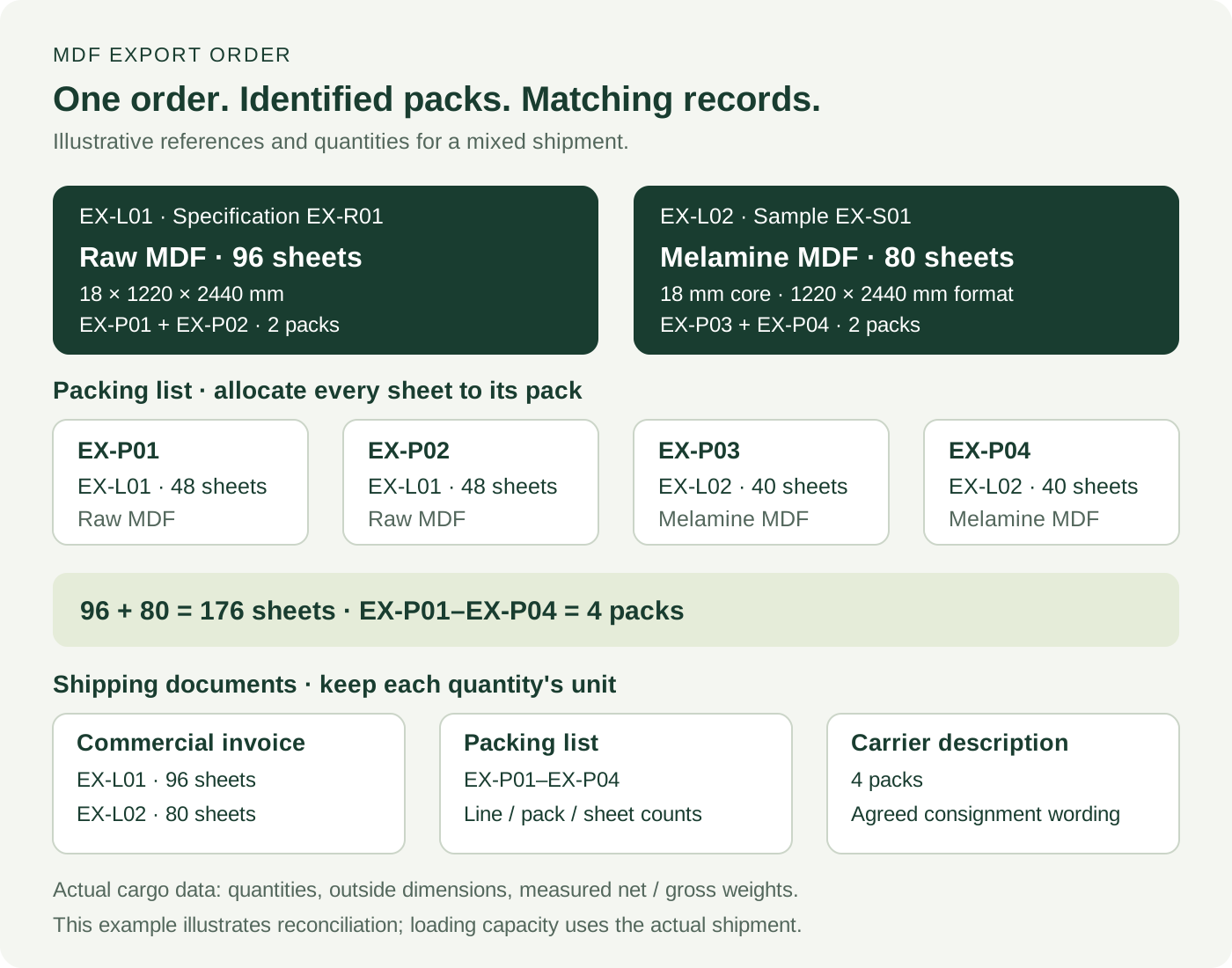
For this example, EX-L01 totals 48 + 48 = 96 sheets and EX-L02 totals 40 + 40 = 80 sheets. Together they give 176 sheets in four identified packs. The invoice retains the two commercial line quantities; the packing list carries the pack allocation; the carrier description can state four packs according to its agreed wording. Each document uses the unit appropriate to its purpose. A carrier's pack count and the invoice's sheet count can agree through the packing list.
Keep measurements and weights on their stated bases too. Nominal board-material volume uses the actual product dimensions and quantity. Outer packed volume uses the pack's complete outside dimensions. Bare-board weight estimates use material volume and density; net and gross shipment weights need the actual supplied condition and measured cargo data. Faces, packing, supports and protective materials all affect the shipment. Record the unit next to every quantity your freight team receives.
Before document issuance, agree the buyer/importer and consignee details, notify party, product descriptions, order/invoice references, ports, quantities and shipping marks. Check the proposed carrier document against the booking and packing records, including container/seal information where relevant. The final invoice and packing list should reflect the actual shipped quantities and agreed commercial treatment of any authorized changes.
Our container-loading information guide develops the measurements needed before booking. The recorded 18 mm MDF loading case is a separate shipment example with its own specification. Confirm your loading quantity from your product dimensions, density, actual packs and approved transport limits.
Prepare packs for the finish and unloading method
A useful export pack protects the selected board and works with the equipment at both ends of the journey. Tell us how the goods will be unloaded, moved and stored, especially for long panels, thin sheets, high-gloss faces, sequenced veneer parts or machined furniture components. The receiving team benefits from knowing the pack size and weight before the shipment arrives.
| Packing decision | Information to agree | Receiving or production benefit |
|---|---|---|
| Support and pack size | Sheet/part dimensions, aligned supports, stack arrangement and outside dimensions | Lets the handling team plan suitable equipment and supported storage |
| Face protection | Finish sensitivity, clean contact layers, separators and protective-film condition where supplied | Protects the surface your finishing or assembly team expects |
| Edges and corners | Edge condition, completed bands/profiles and chosen corner/contact protection | Preserves fit and the appearance of finished details |
| Strapping and restraint | Suitable strap contact protection, pack stability and loading restraint arrangement | Keeps the selected construction supported through handling |
| Labels and pack allocation | Order line, product/part ID, batch, quantity, pack ID and sequence where relevant | Connects physical goods with the packing list and assembly needs |
| Wood materials and destination handling | Actual bearer/dunnage materials, required marks, lifting access and receiving limits | Supports the import review and practical unloading plan |
Our packaging and loading photographs show our supplied MDF packing and shipment arrangements. They can help the discussion, while the accepted order identifies the pack construction for your product. A photo of one bundle shows that bundle's presentation; your order's quantities, outside dimensions and gross weights establish its shipping data.
For mixed decorative products, group parts so the receiving team can identify the finish and sequence. Keep a label connected to its pack and order line. For thin sheets, support and handling matter across the full footprint. For machined components, separate and protect projecting profiles, finished edges and vulnerable corners according to their geometry. The decorative-panel packaging scenario connects finished-part protection with an order schedule.
Choose the transport and loading arrangement from the actual cargo. Confirm container type, payload and route limits with the freight team, along with pack accessibility and restraint. The MDF packaging and shipment-planning guide develops bundle protection and transport planning. At destination, arrange a covered, supported storage area and the handling equipment needed for the confirmed pack dimensions and weights.
Plan production, inspection and transport milestones
Normal production lead time is 3–10 days after technical and commercial requirements are confirmed. This range concerns production. Sample preparation, specification decisions, inspection appointments, freight booking, ocean transit, clearance and inland delivery each have their own timing. Put those milestones into your purchasing schedule so the date your factory needs material can be discussed against the complete journey.
| Milestone | What establishes it | Information your team receives or confirms |
|---|---|---|
| Requirements confirmed | Accepted specification, references, quantity, documents and commercial terms | Order schedule and production timing |
| Production and processing | Selected construction, quantity and agreed operations | Product/part identities and the relevant order revisions |
| Inspection-ready | Agreed inspection lot, accessible goods and inspection appointment | Sampling/checking plan and required reference set |
| Cargo-ready | Released goods, packing completion and actual cargo data | Pack allocation, quantities, outside dimensions and weights |
| Booking and shipment | Cargo readiness, carrier arrangements and port/cut-off information | Booking, vessel/departure information and shipping documents |
| Arrival and receiving | Updated transport information, importer clearance and unloading arrangements | Expected arrival, receiving plan and condition/quantity records |
For repeat factory supply, connect the requested cargo-ready date with your production consumption and stock needs. Keep a separate destination-required date, and allow the shipping team to plan its transport milestones. If a sample or drawing changes, update the relevant order and timing together. A revision can affect processing or pack allocation as well as the product description.
For a distributor, give the quantities by specification, the required replenishment sequence and any planned split shipments. Normal MOQ is 1 × 20'GP per specification; confirm the accepted product mix and shipment arrangement in your quotation. A mixed inquiry is useful for planning, while the formal offer records the agreed quantities and supply arrangement for each line.
Use the MDF lead-time and production-planning guide for scheduling detail. Keep expected and confirmed transport dates identifiable, and share updated booking or arrival information with your broker and receiving team. That makes a changed vessel or clearance milestone easier to manage while preserving the accepted product requirement.
Check the shipment before release and at receiving
We support third-party inspection against the agreed order and inspection plan. Agree the lot, sample selection, measuring methods, required documents and acceptance criteria before the appointment. Connect findings with the selected order line, batch, part or pack ID so a result can be traced to the goods involved.
These six checks bring the product and shipment together:
- Match product identity, specification and supplied stage with the accepted order and relevant sample/drawing references.
- Check the agreed dimensions, thickness, tolerances, appearance, machining and finished interfaces using the defined methods.
- Reconcile quantities by order line or part ID with the physical goods and pack allocation.
- Check support, face/edge protection, labels, pack condition and any required wood-packaging treatment/marks.
- Review the requested product documents and the actual cargo information used for invoice, packing list and booking.
- Record findings, agreed corrective decisions, rechecks where needed and the shipment-release decision before dispatch.
Inspection scope should suit the product. Raw-board dimensions and condition, a decor comparison, a drilled component and a fire-performance document each need their appropriate reference and method. The MDF pre-shipment inspection checklist develops the inspection plan and reporting workflow. Keep the accepted sample and drawing available to the inspector when those references govern the order.
At loading, connect the pack record with container/seal details and the agreed loading observations. At receiving, record the arrival condition and quantity against the packing list. Photographs, pack IDs and the affected product quantities make a handling or cargo concern easier to investigate. Follow the agreed notification procedure and relevant carrier/insurance requirements so the right parties have the necessary information promptly.
After unloading, keep boards flat and supported in a suitable covered area. Inspect protective layers and finished faces through the agreed receiving checks, and condition the material for your workshop where required. The MDF storage and conditioning guide explains the connection between receiving climate and the next machining or finishing operation.
Send your export-order request to our factory
Give us the product requirement and the destination you are planning for. You can identify the open decisions as questions alongside the fixed specifications. We can then prepare a response covering the board or component, sample, documents, packing and commercial scope your purchasing team needs.
- Product and intended use: grade or construction, finished application and relevant service conditions.
- Dimensions and supplied stage: core/finished thickness, sheet or part sizes, density/tolerance requirements and completed operations.
- Quantity schedule: order lines or part IDs, units, quantities, product mix and any required shipment sequence.
- Surface and technical references: decor/texture/gloss, face/reverse, edge detail, sample IDs and drawing revisions.
- Destination and documents: country, end use, requested methods/classifications and importer or project document instructions.
- Packing and handling: finish protection, labels, receiving equipment, pack limits and storage/unloading needs.
- Commercial and timing: FOB shipment port or CIF destination port, T/T or L/C request, cargo-ready target and destination-required date.
- Contact and receiving information: your company/contact, destination or consignee details and questions for our response.
We reply to inquiries within 12 hours. Your written quotation includes the product specification, quantity, price and currency, packaging, FOB named port, production lead time, T/T or L/C payment terms and validity. The accepted order connects those details with the relevant samples, drawings and requested documents. Freight and destination information are confirmed for the actual shipment arrangement.
Product samples are free and usually available from stock. You pay the courier charge, which can be credited against the formal order amount. We confirm availability, preparation and estimated transit time before dispatch. For custom machined or finished trial parts, we agree the supplied stage and preparation timing with you.
Request an MDF export quotation, request product samples or request destination product documents. Your request can begin with the board, quantity and destination, then develop into the complete order schedule with our factory team.
Questions about importing MDF from CUZI MDF
Can I buy MDF directly from CUZI MDF's factory?
Yes. CUZI MDF manufactures and supplies MDF boards and machined components from our factory in Shuyang, China. Send your construction, dimensions, quantities and destination so we can confirm samples, processing, packing and a written export quotation for your order.
What is the minimum order quantity?
Normal MOQ is 1 × 20'GP per specification. List quantities for each grade, thickness, decor or component requirement. We confirm the accepted product mix, quantities and shipment arrangement in the formal quotation, including any proposed replenishment or split-shipment plan.
Which ports and payment methods are available?
Our usual shipment ports are Lianyungang and Qingdao. We offer FOB terms with the appropriate named port, and T/T or L/C payment as agreed. Record the exact commercial scope, payment conditions and applicable document requirements for the transaction.
Does CIF include delivery to my factory?
CIF uses a named destination port for the arranged carriage and insurance. Your inland delivery, import clearance, destination charges and unloading need their agreed arrangements. Write those costs and responsibilities into your landed-cost and receiving plan, with the delivery/risk-transfer point identified under the chosen Incoterms version.
Is the 3–10 day lead time the arrival time?
The normal 3–10 day range covers production after technical and commercial confirmation. Arrival planning adds the actual packing/release, booking, transport, clearance and inland-delivery milestones. Give us both your requested cargo-ready date and the date your receiving team needs the material.
Can I request samples before placing the export order?
Yes. Product samples are free and usually available from stock. You pay the courier charge, which can be credited against the formal order amount. We confirm availability, preparation and estimated transit time before dispatch; custom machined or finished trials follow the agreed supplied stage and preparation schedule.
Which documents should I request for a US or EU order?
Start with the selected construction, destination country and intended use. Request the applicable product identification, reports/certification, labels and wood-source or transaction information for that requirement. Your importer or broker completes the entry review using the agreed product and shipment records. The US and EU document guides above develop the respective questions.
How many MDF sheets fit in a container?
Loading quantity depends on the product dimensions, density, actual pack sizes and weights, container/route limits and loading arrangement. Give us the quantities by specification and your destination. We confirm the cargo data for booking, with sheet counts, material quantities and outside packed volume identified separately.
Can my inspector check the goods before shipment?
Yes. Third-party inspection can be arranged against the accepted order and inspection plan. Agree the accessible lot, sampling, methods, references and required checks before the appointment, then link the findings and release decision with the inspected order lines and packs.
What should my receiving team have before arrival?
Share the packing list, pack IDs, quantities, outside dimensions and gross weights, relevant shipping documents and agreed handling/storage information. Arrange the import-clearance and unloading steps with your broker and logistics team. At arrival, record pack condition and quantities so the goods can be matched with the order and prepared for your next production operation.