
A clear request makes quotations easier to compare and gives your importing team time to review the files before shipment. CUZI MDF manufactures and supplies boards from Shuyang, China. Send your specification, EU destination and document checklist to our factory; we will help you choose the board and prepare the documents for your purchase.
Start with the intended use and MDF specification
Describe what you are buying and what you will make from it. A raw board for cabinet production, a melamine furniture component and a panel offered for incorporation into a building require different purchasing reviews. Include the MDF grade, core and finished thicknesses, dimensions, face, reverse, adhesive where relevant, and processing drawings.
BSI's EN 622-5 overview identifies the standard as requirements for dry-process boards, or MDF. Its product-property values serve a different purpose from characteristic values used in design calculations. When requesting EN 622-5 MDF, specify the grade, thickness range, intended service conditions and properties your purchase needs.
For Raw MDF, begin with the substrate and planned finish. For Melamine MDF, add the face and reverse references. For Moisture Resistant MDF, describe the expected humidity, edge treatment and installed component. Those details connect the offered board to the reports and checks that matter for your project.
| Intended purchase | Describe in the inquiry | Documents to review |
|---|---|---|
| Furniture-production boards | MDF grade, thickness, facing and planned furniture use | Product properties, applicable emissions and chemical information |
| Machined furniture components | Source board, finished construction, part IDs and drawing revision | Relevant product reports plus the link to the supplied components |
| Interior construction panels | Product identity, intended building use and installed construction | Applicable declaration, assessment, marking and performance documents |
| An order with a requested FSC claim | Exact product lines, quantities and claim requirement | Current certificate coverage and the claim on sales and delivery records |
Our Quality Control page introduces destination-specific document requests. This guide turns the EU questions into an order file your purchasing, technical and logistics teams can share.
Request the applicable formaldehyde emissions assessment
Commission Regulation (EU) 2023/1464 introduced REACH Annex XVII entry 77. From 6 August 2026, furniture and wood-based articles within its scope have a formaldehyde release limit of 0.062 mg/m³ under the specified chamber conditions. The provisions include exemptions; establish applicability from the actual article and foreseeable use.
Write the destination requirement and test basis into the request. An E1 MDF board description, or an E0 or E0.5 label, is useful only alongside the named method, specimen and result relevant to the purchase. A grade description and the current REACH assessment answer different questions. Read both with your technical team.
For a faced panel, identify the core, face, adhesive and reverse layer. For furniture, include the complete assembled article in the assessment plan. Review the whole-complex-product approach in the restriction and ECHA's measurement guidelines. A panel result contributes information about that panel; your finished construction has its own assessment context.
If a buyer or project specification asks for an additional national method or a lower contractual limit, include that requirement at quotation stage. Ask our factory to confirm the reports available for the offered construction and any additional testing needed, with the cost and timing included in the order discussion.
Choose the CUZI MDF reports for your product
Start your product file with the reports available on this page. Each document keeps its product description, report date and original results together. Choose the board you plan to buy, then send our factory the EU destination, intended use and required assessment so we can prepare the document request around your order.
| CUZI MDF document | Product information in the file | Next step for your purchase |
|---|---|---|
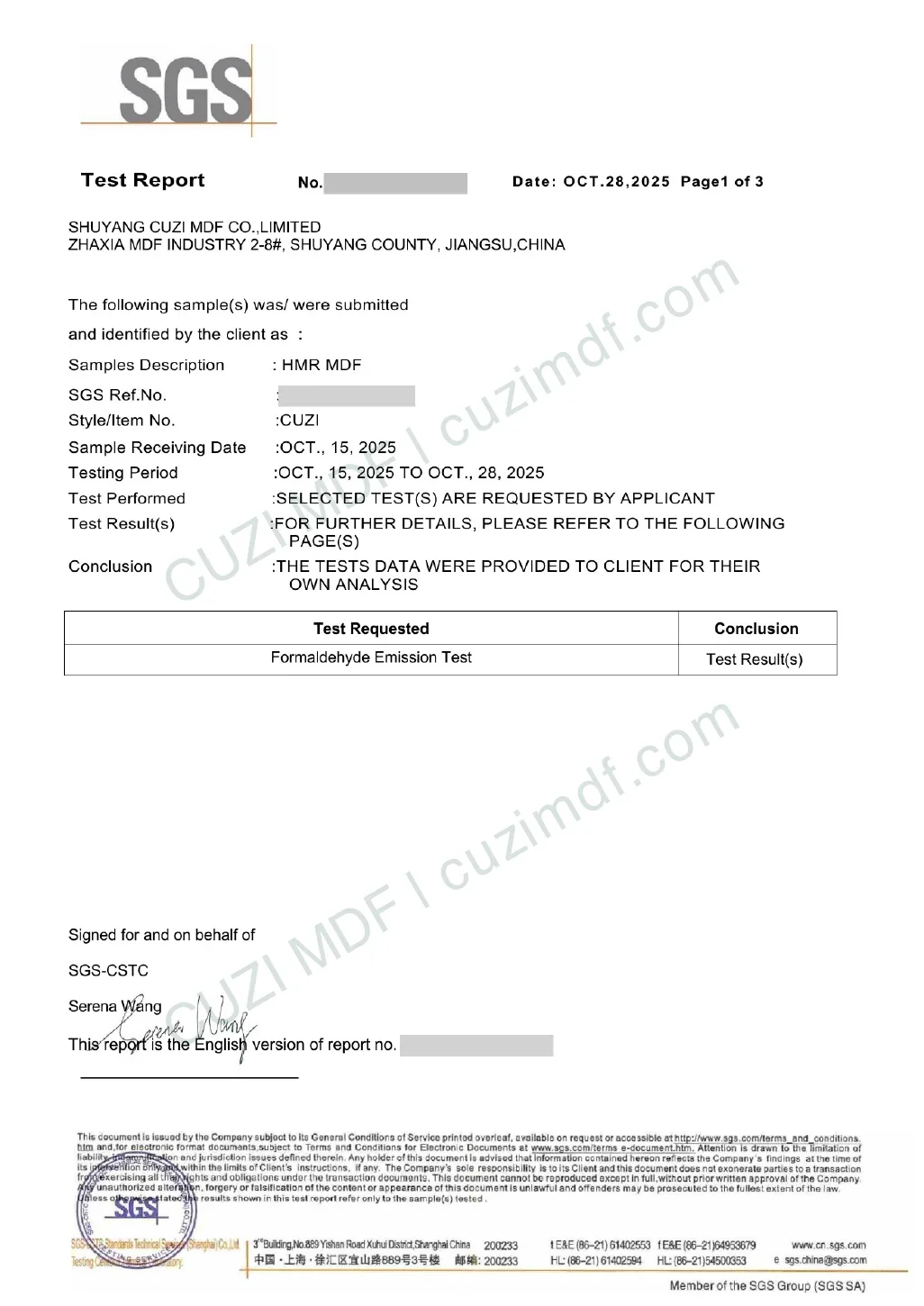
| HMR MDF Formaldehyde Test Report | Three-page report dated 28 October 2025, with the sample description, emission method and result | View HMR MDF and request the product and emissions information for your selected thickness and use |
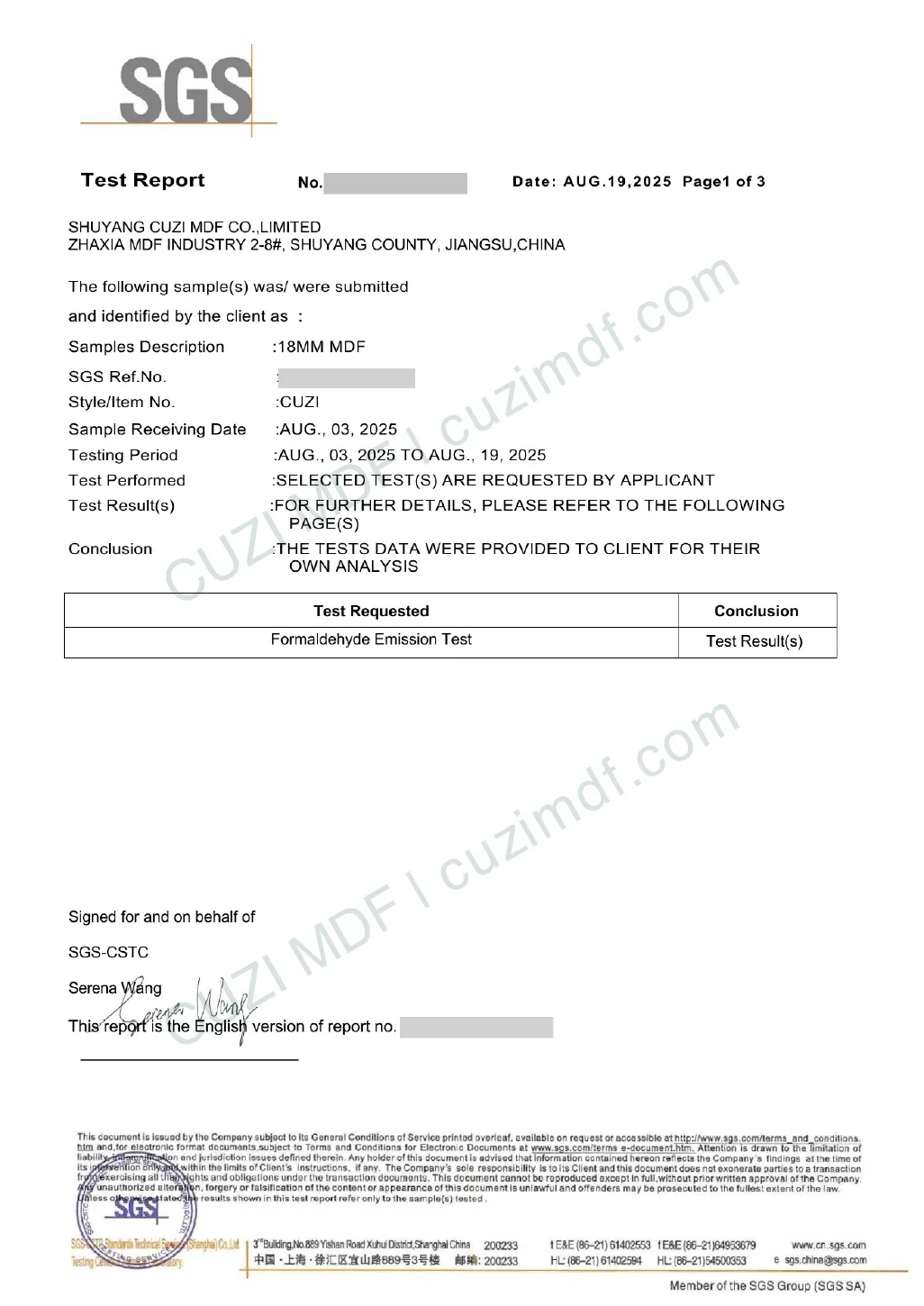
| 18 mm White-Faced MDF Formaldehyde Test Report | Three-page report dated 19 August 2025 for the stated white-faced panel | View Decorative MDF and identify the face, reverse, adhesive and finished construction in your request |
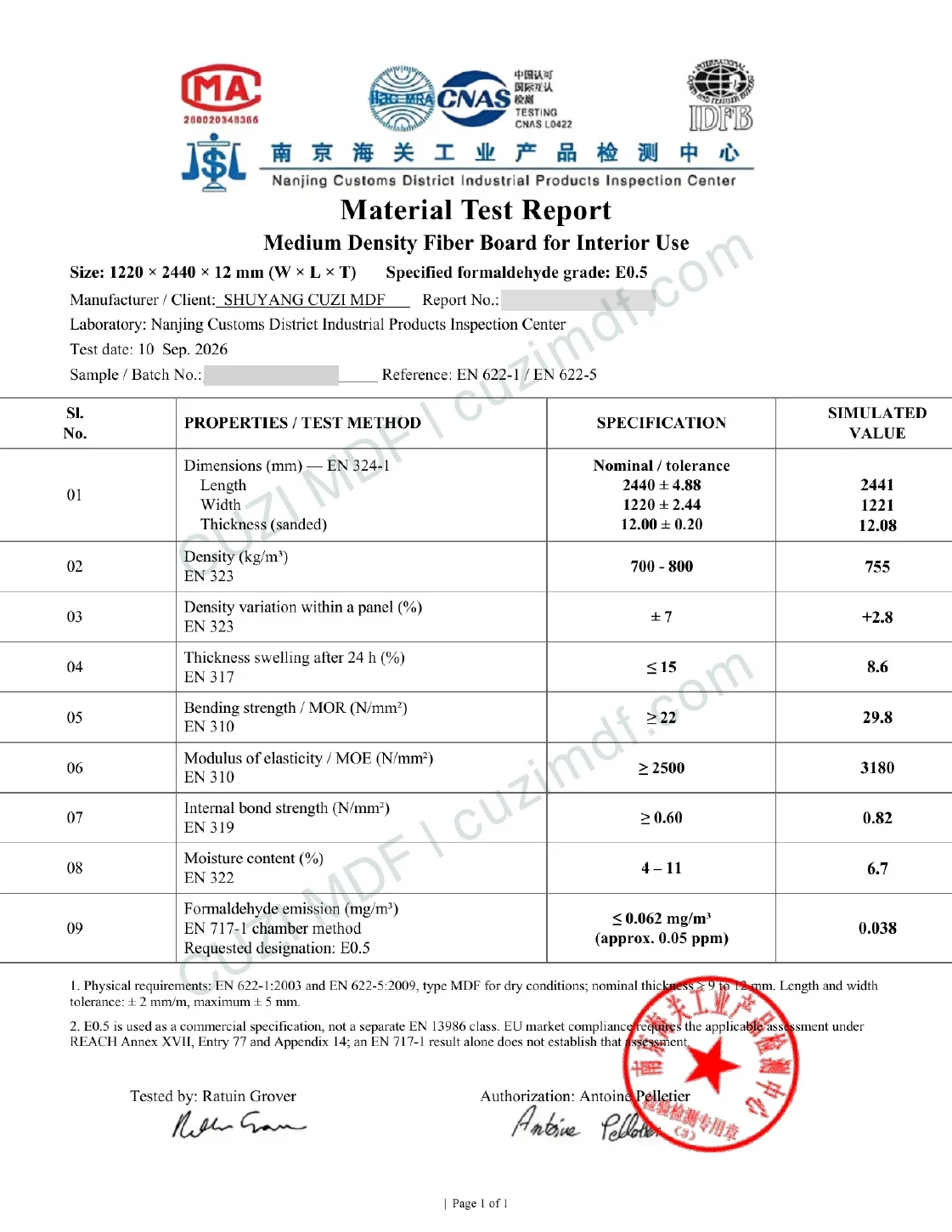
| 12 mm MDF Material Report | One-page document dated 10 September 2026 with board dimensions and material properties | View Raw MDF and add the planned finish, EU destination and required product properties |
The HMR and white-faced reports state EN 717-1:2004 as their formaldehyde test method. Read their sample descriptions, results and units with that method. For an EU assessment under REACH entry 77, include the Appendix 14 reference conditions and any supporting correlation required by the assessment method. For furniture, identify the complete article being placed on the market. This keeps the panel information connected to the construction your buyer will use.
View or download the MDF reports, read how to review MDF certificates and test reports, or request EU purchasing documents for your specification.
Read the report with its specimen and test conditions
Start with the sample description. Compare its grade, thickness, facing and adhesive information with the quoted product. Record the laboratory, report date, method, units and result, then review conditioning, exposed surfaces, edge treatment and chamber setup. Ask how the tested sample represents the proposed product range.
ECHA's published measurement guidelines address measurement against the restriction's reference conditions. Use the named assessment basis when comparing reports. A result from a different test setup needs the laboratory's explanation of how it relates to the requirement you are applying.
Keep the numerical result in its original unit and context. Where the file uses a conversion or correlation, retain the supporting explanation. For a decorative board, ask whether the report covers the supplied construction or the underlying MDF alone. For a change of resin, finish, reverse or thickness, review the stated coverage before carrying the file forward to a repeat order.
The certificate and test-report guide covers issuer, scope and specimen checks in more detail. Keep the original report with the quotation and its matching specification so each team can read the same information.
Match construction use to its declaration and CE information
First establish whether the item is being placed on the market as a construction product and which harmonised specification or assessment applies. The Commission's CPR overview explains that the obligations depend on the applicable cited standard or European assessment document. A furniture-board purchase follows its own product and finished-furniture requirements.
For an applicable construction panel, request its intended use, declaration of performance or performance and conformity as applicable, relevant technical specification, assessment system and supporting reports. Read the product code and manufacturer identity with the marking information. Match declared properties, including reaction to fire where relevant, to the offered construction and the installation your project requires.
The CPR 2024 transition guidance explains that the main part of the revised regulation applies from 8 January 2026, while product families move individually to the new framework. Products covered by standards cited under CPR-2011 generally continue under that framework until their transition. Ask which framework and cited specification govern the offered product.
For interior wall panels, send the intended use, fixing, substrate and finish together. A document for another material or application provides information about its stated scope. The construction declaration you request should identify the MDF product and intended use in your order.
Include chemical information for faces, adhesives and components
List the supplied surface and bonding materials in the chemical-information request. Melamine paper, HPL, veneer, film, acrylic and edge materials each form part of a particular construction. Ask for information addressing the applicable REACH restrictions and Candidate List substances for that supplied article.
ECHA's supply-chain guidance explains the Article 33 communication duty when a Candidate List substance is present above 0.1% by weight in an article. Your EU importer or downstream supplier should also check applicable notification and information obligations for its role and products.
A useful response names the product, construction, substances or requirements assessed, date and supporting basis. Where the response relies on component declarations, connect those declarations to the face, reverse and adhesive actually offered. Safety data sheets for production chemicals can support that material review; the supplied board or component needs information appropriate to its article status.
Keep appearance approval in the same specification folder. Matching a colour or texture sample and matching chemical information are separate checks, both needed when a decorative surface becomes part of a repeat furniture programme.
Build the wood-origin file with the EU operator
The Commission's EUDR implementation page gives the current application dates: 30 December 2026 for large and medium operators and micro or small operators already covered by EUTR; 30 June 2027 for other micro or small operators. Establish the applicable product scope, operator role and date with your EU importing team. Check the current Annex I and customs classification for the exact goods.
For an MDF order, distinguish the country where the board was manufactured from the country or countries where its wood was produced. Agree the wood-species information, source-country records, applicable harvest-plot geolocation, production dates and legality information needed to connect the material to the shipment.
The Commission's 2026 EUDR guidance addresses reconstituted products such as fibreboard and particleboard. Processing several sources into a board still calls for the applicable species, origin and location information. The operator checks any permitted simplification against the current rules and its actual role.
Ask for the required data format early, especially where several species, source countries or material inputs are involved. Give your operator time to review completeness, risk assessment and any follow-up before booking. The operator responsible under the regulation performs the applicable due-diligence steps and submission; our factory confirms the source information available for the proposed supply.
Keep the FSC claim connected to the purchased products
When searching for FSC MDF suppliers for Europe, start with current certificate status and product coverage, then specify the claim required on the order lines. Our Quality page describes the company's Chain of Custody documentation. We confirm the applicable coverage and sales-document claim for the offered MDF order.
Read the certificate holder and scope with the product description, invoice and delivery records. Where only some items in a mixed order carry an FSC claim, identify those items and quantities clearly. Keep the claim wording and document reference together so your receiving and downstream teams can follow the same product identity.
FSC's EUDR guidance explains that certification can support due diligence while the operator's EUDR obligations remain. Organise the FSC purchase claim and the applicable timber-source dataset as related parts of the file, each serving its stated purpose. A source review can use relevant certification information alongside the other records required for the order.
Prepare the wood-source worksheet before booking
The Commission's EUDR Information System validation reference is a public document your importing team can inspect. It describes timber entries with common and scientific species names, commodity descriptions, production places and geolocation information. Use it with the current regulation and guidance when agreeing how the actual source data will be supplied.
The worksheet below organises those fields for a purchasing review. Enter the species, source references and shipment identifiers from the original records for the offered board. Keep any laboratory results and certification numbers in their own matching product files.
| Source-data field | Request from the proposed supply | Check with the EU operator |
|---|---|---|
| Wood species | Common and full scientific names for the applicable inputs | Names and material coverage correspond to the MDF construction |
| Wood-production origin | Source country or countries and the relevant source records | Wood origin is distinguished from the board-manufacturing address |
| Production place and period | Applicable plot information, geolocation and production dates | Dataset follows the rules and format applicable to the operator |
| Legality and traceability | Records connecting wood inputs, production and the proposed order | Review supports the operator's due-diligence process |
| Product and shipment identity | Specification, order lines, lot and pack references | Dataset can be connected to the invoice and physical goods |
For an order containing both raw and melamine MDF, identify each product line separately. Send the intended use and emission requirement, then agree the wood-source dataset your operator needs. For the melamine item, include its core, face, reverse and finished thickness. Connect the reports and source records to their matching order lines.
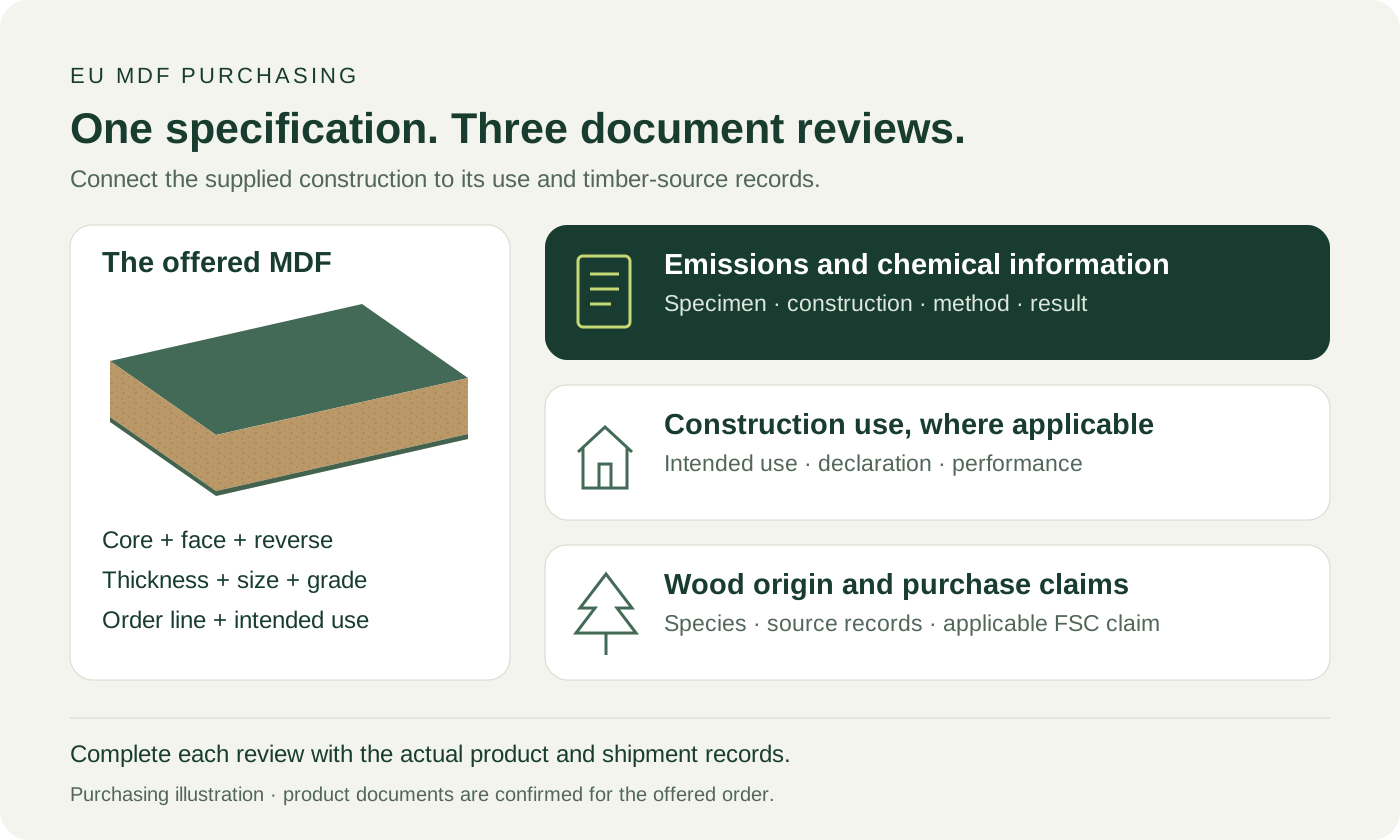
View the EU MDF purchasing diagram to see the three reviews together: supplied construction, product/use documents and timber-source records. The diagram is a purchasing aid. The actual document values are provided for the offered product and order.
Put the document request into the RFQ and shipment plan
Send the board grade, thickness, dimensions, quantity, finish, intended use and EU member state. Add the required formaldehyde assessment and your importing team's wood-source checklist. Ask us to include any agreed testing, document preparation, cost and timing in the quotation, alongside your required delivery date.
For a construction-product request, add the intended building use and required declaration and performance information. For a decorative or machined order, attach the face and reverse references, component drawings and final construction. That makes the written quotation specific enough for your technical team to review before production.
| File to collect | At quotation and approval | Before shipment or receiving |
|---|---|---|
| Product specification | Grade, thickness, size, facing and intended use | Confirmed revision and identifiable product lines |
| Emission and chemical information | Relevant reports, scope and any further assessment needed | Records for the approved supplied construction |
| Construction-product information, where applicable | Declaration, cited specification, intended use and performance | Applicable marking and product identity |
| FSC claim and timber-source records | Requested claim, coverage and operator data checklist | Applicable claim, source dataset and order/lot connections |
| Commercial and packing documents | Quoted terms, quantities and document handoff dates | Invoice, packing list, pack references and transport records |
Our MDF Export Guide and Global Supply page cover the wider purchase and shipment plan. We offer FOB, T/T or L/C and third-party inspection arrangements. Shipments use Lianyungang or Qingdao; confirm the named place or port and which party supplies each document under the agreed terms.
Agree the document review date with your importer and customs broker, including any origin documents they require. Give technical, logistics and receiving teams a single approved specification and file list. A complete handoff helps them resolve a question while the goods are still being prepared and keeps the references usable on repeat orders.
Assemble the commercial and transport documents
Give our factory the consignee, destination port and document instructions before loading. Your customs broker confirms the customs classification and destination requirements for the exact board or component. Product reports travel with the order file; commercial and transport documents identify the goods, shipment and agreed transaction.
| Document | Details to agree before loading | How it helps your importing team |
|---|---|---|
| Commercial invoice | Seller and buyer, product descriptions, dimensions, quantities, price and currency, delivery terms and named port or place | Connects the shipment to the approved order and customs entry |
| Packing list | Product lines, sheets or parts per pack, pack IDs, quantities, weights and dimensions | Connects the invoice to the physical packs and receiving count |
| Bill of lading or agreed transport document | Shipper, consignee, notify party, ports, cargo description and release instructions | Provides the transport reference and cargo-release information |
| Origin documentation, where requested | Document type and destination requirements confirmed with the customs broker | Supplies the origin information required for the entry |
| Insurance document for CIF supply | Agreed cover, insured shipment and claims contact | Keeps the shipment's insurance information accessible to the buyer |
| Wood-packaging information, where applicable | Type of pallet or supporting timber and required treatment or marking | Helps the broker check the packaging requirements for the supplied packs |
Confirm document wording and handoff timing before dispatch, especially for an L/C order. The invoice, packing list and transport record should use consistent product descriptions, quantities and shipment references. Keep your report files and any applicable declarations or wood-source records linked to that same order.
Buyer review checklist
- Name the EU destination, supplied construction and intended furniture or building use.
- Match the MDF grade, thickness, dimensions and facing to the quotation and reports.
- Establish the applicable formaldehyde requirement and assessment conditions.
- Review the specimen, method, result and coverage for the panel or complete article.
- For construction use, identify the applicable declaration, specification and performance.
- Collect chemical information for the supplied board, surfaces and components.
- Agree the FSC claim and wood-source dataset required for the exact order.
- Confirm the EU operator's responsibilities and document review before shipment.
- Connect the approved files to product lines, lots, packs and commercial records.
- Agree invoice, packing, transport, origin and insurance instructions with the importing team.
Frequently asked questions
Which documents should I request for MDF imported from China to Europe?
For an EU purchase, start with the actual MDF specification and intended use. Request the applicable emissions and chemical information, add construction-product documents where required, and agree FSC claims and timber-source information with the importing operator. Keep shipment and commercial records connected to those product lines.
Does an E1 MDF board description answer the current EU emissions requirement?
Read the E1 description with its named test method and result, then assess the applicable REACH requirement for the supplied article. Confirm the specimen, construction and reference conditions with your technical team. A complete furniture item has its own assessment context.
What should an EN 622-5 MDF request include?
State the required grade, thickness range, dimensions, service conditions and product properties. Ask which reports cover the offered board. Keep design-performance requirements and any construction-product declaration with the intended application.
Does every MDF furniture order require a construction-product CE declaration?
Establish whether the supplied item is being marketed as a construction product under an applicable specification or assessment. Request the declaration and marking documents for that use where required. Furniture-production boards are reviewed with the requirements for their supplied construction and finished furniture.
Which report should I request for melamine MDF?
Describe the core, face, adhesive and reverse construction and the intended use. Ask whether the report covers the supplied faced panel or the substrate alone, and how that coverage addresses your requirement. Keep the approved decorative references with the same specification.
What changes when several wood sources are used in MDF?
Ask for the applicable species, source-country and production-place information for the material inputs, linked to the board and shipment. Your operator reviews the dataset under the current rules, including any permitted simplification for its role.
How should I request FSC MDF for Europe?
Identify the product lines and claim requirement in the inquiry. Confirm current certificate coverage and the applicable claim on the sales and delivery records for the offered order. Keep the separate timber-source information needed for the importing operator's review.
Who completes EUDR due diligence and submits the required information?
The responsible operator carries out the applicable regulatory steps. Agree its role, data format and handoff timing before placing the order. Our factory confirms the product and source information available for the proposed supply.
Can I request samples and EU documents together?
Yes. Send the board or component, thickness, face and reverse, intended use and EU destination in one request. Samples support appearance, processing and fit checks; the applicable reports and source records support the separate document review.
Which CUZI MDF reports can I view and download here?
You can view the HMR MDF formaldehyde report, the 18 mm white-faced MDF formaldehyde report and the 12 mm MDF material report. Each card provides the PDF, report date, relevant product and a document-request link. Send the required thickness, finish and EU destination with your request so our factory can help prepare the product file for your purchase.
How do the EN 717-1 reports fit into my EU purchasing file?
They provide the formaldehyde information for the samples described in those reports. Read the specimen, method, conditions, result and unit together. For the REACH entry 77 assessment, specify the Appendix 14 reference conditions and the supplied panel or complete article. Include the laboratory's supporting correlation where the chosen assessment uses different test conditions.
Which shipment documents should I agree before placing the order?
Agree the commercial invoice, packing list and transport-document instructions, plus origin documents requested by your customs broker. For CIF, include the shipment insurance information. Add any applicable product declarations, wood-source records and wood-packaging requirements to the file list, with a handoff date before loading.
Discuss your order with our factory
Send the MDF product, specification, intended use, EU destination, quantity and document checklist. We reply within 12 hours to help with your board choice, documents and quotation. Your written quotation includes specification, quantity, price and currency, packing, delivery terms and place, lead time, payment terms and validity.
Samples across our range are free and normally available from stock. Buyers pay the courier charge, which can be credited against the formal order amount. We confirm any custom preparation, dispatch and estimated transit timing for your request. Typical production lead time is 3–10 days after requirements are confirmed; agree document preparation and transport timing in the order plan.
Request EU purchasing documents, request a product sample, or request an MDF quotation.
Requirements reviewed on 10 October 2026. Use the current official sources linked above with your importing and technical teams. The offered specification and original product, source and shipment records establish the document coverage for your order.