
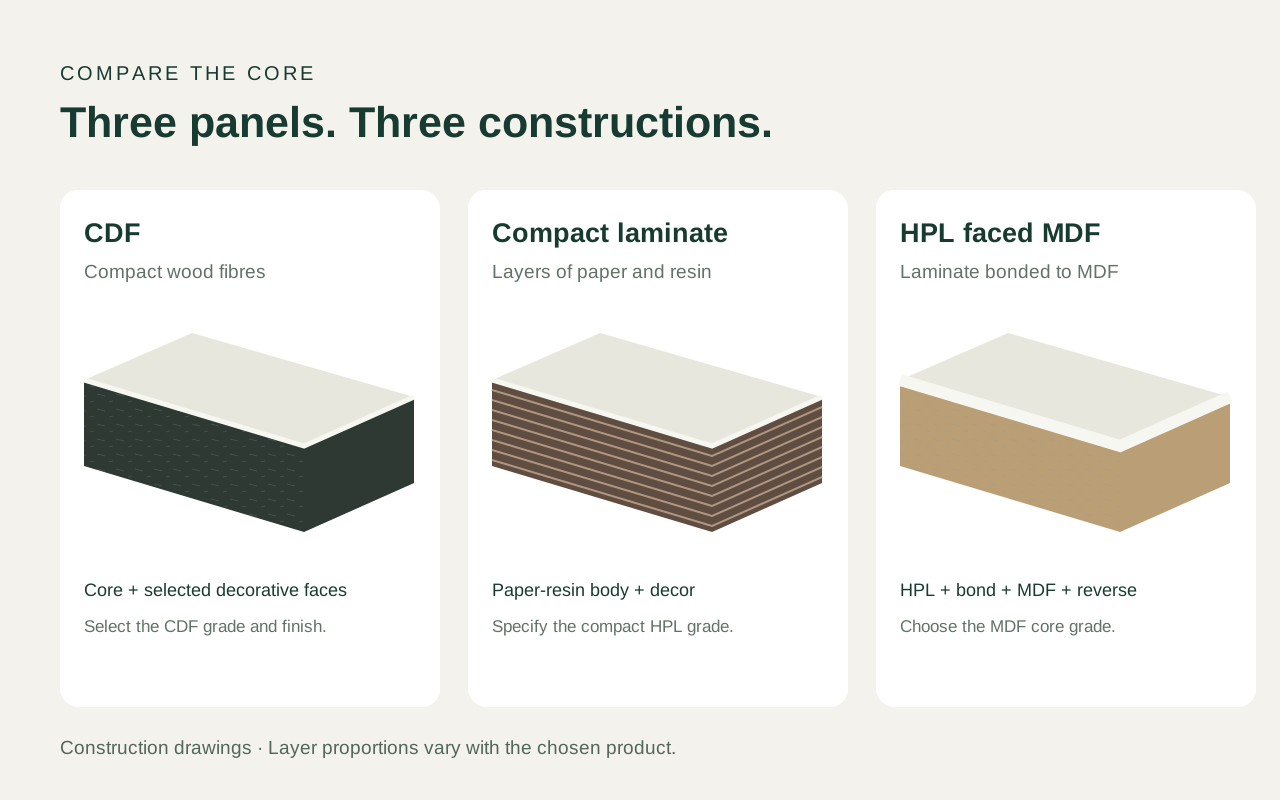
These panels can have similar decorative faces while using different materials inside. The core affects the way you specify thickness, cut edges, fixings, finishing and service conditions. Start with the component you are making, then choose the construction that suits it.
Three panel constructions at a glance
| Panel | Core construction | Surface and edge choice | What to send for selection |
|---|---|---|---|
| CDF | Compact wood fibres bonded with resin | Raw or decorative-faced board; often a black core for visible edges | Required density, dimensions, finish, machining and service conditions |
| Compact laminate / compact HPL | Multiple layers of resin-impregnated paper | Decorative faces over a compact paper-resin body | Intended use, panel grade, thickness, supports and fixing details |
| HPL faced MDF | MDF with a separately made HPL sheet bonded to it | Selected laminate face, balancing reverse and finished edges | MDF grade, HPL reference, complete thickness and edge treatment |
CDF: compact density fibreboard
Compact Density Fibreboard (CDF) uses a densely pressed wood-fibre core. Compact Density Fiberboard is the American spelling. Black-core and decorative-faced constructions allow furniture makers to coordinate the face, cut edge and machined details.
Consider CDF for furniture components, interior panels and retail fixtures where a compact fibreboard core fits the design. Specify the actual grade and thickness, then review the cut edge, holes and profiles on a sample. For a humid location, include the moisture requirement and planned edge protection in the selection.
SWISS KRONO's CDF range illustrates this material family. Its published dimensions and performance apply to its own products; use the offered CDF specification when ordering from a supplier.
Compact laminate: a paper-resin panel
Compact laminate, also called compact HPL or phenolic compact laminate, is built from layers of resin-impregnated paper pressed into a panel with decorative faces. Formica's explanation of phenolic panels describes that construction.
This material is commonly considered for washroom partitions, lockers, wall linings and furniture in frequently used interiors. Select the product grade for the exposure and cleaning routine. Thickness, supports, fixing distances and installation details follow the particular panel system and design.
When matching an existing compact laminate panel, send the grade or supplier reference with a cross-section photo and dimensions. That helps keep the paper-resin construction clear in the inquiry.
HPL MDF: a laminate face over an MDF core
HPL MDF combines a separately manufactured high-pressure laminate sheet with an MDF substrate. Choose it for desks, counters, cabinet fronts, retail fixtures and other furniture where the decorative surface and machinable core fit the component.
Our HPL MDF range includes 0.5–1.2 mm face sheets, with the decor, texture and gloss selected for the order. The core, adhesive, face and reverse contribute to the finished thickness. Include matching edges, exposed holes and any further machining in the panel specification.
Choose an MR core for suitable humid-interior applications, and specify the complete finished construction where fire performance is required. The HPL MDF vs melamine MDF guide explains another common surface choice for furniture production.
What is second-generation compact board?
Some Chinese suppliers use second-generation compact board for a wood-fibre alternative to traditional paper-based compact laminate. This is a trade description, so an export quotation should also name the actual fibreboard construction, density, thickness and surface. Zhongtian's material comparison describes the two manufacturing routes.
For a compact fibreboard requirement, ask about CDF. A sample or close photograph of the cut edge helps distinguish the fibre core from layered paper and from a thin HPL facing bonded onto MDF. Keep that construction in the written specification for repeat orders.
How do HDF and Black MDF relate to CDF?
HDF is high density fibreboard supplied in a range of thicknesses and grades. Black MDF is selected for colour through the fibreboard, including its cut and routed edges. CDF adds a compact fibreboard choice to the comparison. Use the actual density, face construction and performance for each proposed board when deciding between them.
Choose around the component
For furniture panels, compare the thickness, weight, supported span, hardware fit and finished edge. For retail counters, add surface wear, cleaning and impact at corners. For decorative walls, include panel joints, fixing details and the project's fire specification. For humid rooms, describe splashes, cleaning and ventilation, then select the board and protective details together.
A sample should include more than a flat face if your design has holes or profiles. Ask for a representative cut edge, drilled hole or routed detail, and try the intended hardware and finish. This makes the first production order easier to specify.
Buyer review checklist
- Material: CDF, compact laminate or HPL faced MDF.
- Component, location, exposure and required performance.
- Core and finished thickness, sheet or part sizes and quantities.
- Face and reverse, colour, texture, gloss and visible edges.
- Cutting, holes, profiles, supports and hardware drawing.
- Sample, packing groups, destination and required timing.
Discuss your order with our factory
Request a CDF quote for compact wood-fibre boards or prepared parts. For laminate-faced furniture panels, request an HPL MDF sample. Send the current material reference if you are matching an existing panel.