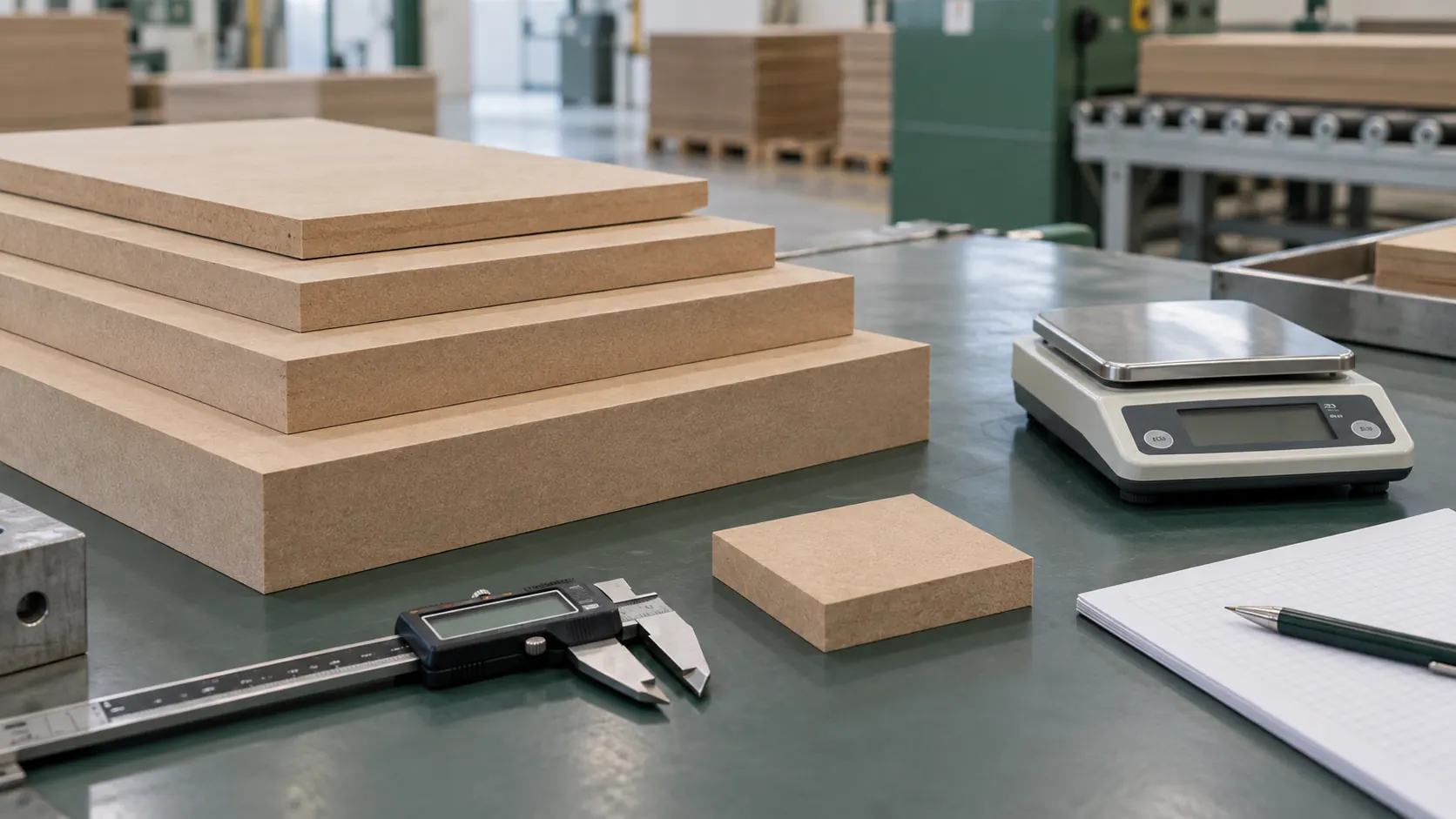
MDF density is the mass of board material in one cubic metre, expressed in kg/m³. For buyers, it supports product identification, like-for-like comparison, calculated sheet weight and handling plans. Finished-component performance is confirmed through the requirements, test reports and product documents that apply to the selected product and assembly.
Direct answer: should a buyer choose 650, 680, 700 or 750 kg/m³ MDF?
Choose density for the exact product, thickness, component, machining, hardware, surface and handling requirements. Then compare current product data at the same thickness and construction. A higher nominal density increases calculated board weight. Screw holding, moisture resistance, emission performance and component suitability each follow their applicable product or assembly test reports and documents.
The four values below are controlled comparison inputs. Order availability is confirmed for the selected product, thickness, quantity and production process.
CUZI MDF standard density ranges by thickness
| Thickness | Standard MDF density |
|---|---|
| 2–4 mm | 800–810 kg/m³ |
| 5–8 mm | 780–800 kg/m³ |
| 9–11 mm | 760–780 kg/m³ |
| 12–18 mm | 680–750 kg/m³ |
| 19–35 mm | 650–680 kg/m³ |
HDF, HMR MDF and Hardboard use their own product-specific schedules. Put the product name, thickness and density requirement on the same quotation line so purchasing, production and receiving teams apply the value to the correct panel.
Keep each fibreboard product on its own density schedule
Density helps identify a proposed panel only when the product family and thickness are stated together.
| Product | Thickness-specific CUZI MDF density schedule |
|---|---|
| Standard MDF | 2–4 mm: 800–810; 5–8 mm: 780–800; 9–11 mm: 760–780; 12–18 mm: 680–750; 19–35 mm: 650–680 kg/m³ |
| HMR MDF | 2–4 mm: 820–860; 5–8 mm: 790–820; 9–11 mm: 760–790; 12–18 mm: 710–750; 19–35 mm: 650–710 kg/m³ |
| HDF | 2–4 mm: 850–930; 5–8 mm: 830–890; 9–11 mm: 780–830; 12–18 mm: 730–780; 19–35 mm: 680–730 kg/m³ |
| Hardboard | 1.5–5 mm: 810–960 kg/m³, with its own face and reverse construction |
MR MDF and every faced or processed product should carry the density schedule of its confirmed MDF core. The order line should identify the exact product name, core thickness, density range, face/reverse construction and finished supply stage.
Weight comparison for one controlled specification
This table keeps thickness, sheet size and quantity fixed so that density is the only changing input: 18 mm × 1220 mm × 2440 mm, 768 sheets.
| Nominal density | Theoretical weight per sheet | Theoretical net board weight | Buyer interpretation |
|---|---|---|---|
| 650 kg/m³ | 34.829 kg | 26.748 t | Lowest calculated weight of these four inputs; confirm the exact product, thickness and required performance. |
| 680 kg/m³ | 36.436 kg | 27.983 t | The nominal density used in the linked recorded loading case. |
| 700 kg/m³ | 37.508 kg | 28.806 t | Adds about 1.823 t of theoretical board weight compared with 650 kg/m³ at 768 sheets. |
| 750 kg/m³ | 40.187 kg | 30.863 t | Highest calculated weight of these four inputs; container quantity and route limits require a new review. |
These are theoretical net board weights. Packaging, bearers, protection and other loading materials must be added separately when planning gross shipment weight.
Calculate bundle and order weight from the same inputs
Extend the sheet calculation into a loading plan:
**Net bundle weight = calculated sheet weight × sheets per bundle**
**Estimated gross bundle weight = net bundle weight + cover boards + bearers + straps + wrap + labels**
**Estimated order gross weight = sum of all gross bundles and loose protection**
Keep each thickness, size and product construction on a separate line. Faced panels should include the mass of decorative layers where it materially affects the handling plan. Confirm actual bundle construction and verified gross weights before transport release because bearer layout, cover boards and protective materials vary by order.
How the calculation works
First calculate the volume of one sheet in metres:
18 mm × 1220 mm × 2440 mm = 0.018 m × 1.220 m × 2.440 m = 0.0535824 m³.
Then multiply sheet volume by nominal density. At 680 kg/m³, one sheet has a theoretical weight of 36.436 kg. Multiply by 768 sheets to obtain 27,982.9 kg, rounded to 27,983 kg.
Use the MDF sheet weight and CBM calculator to repeat the calculation for another thickness, size, density or quantity.
Use a controlled density measurement workflow
A density result comes from mass and measured specimen volume. Record the complete workflow used by the supplier, buyer or laboratory:
1. Identify product, thickness, batch and sampling location. 2. Condition specimens under the method required by the order or test standard. 3. Measure specimen length, width and thickness at the required locations. 4. Measure mass with equipment suitable for the specimen size. 5. Calculate volume in cubic metres and divide mass in kilograms by that volume. 6. Report individual results, average or range as required by the agreed method. 7. Retain equipment identity, date, operator and specimen references.
This workflow distinguishes a formal specimen result from a quick full-sheet weight check used for purchasing or logistics review.
Plan samples across the batch and panel
Define the sampling plan before inspection. State the number of bundles, sheets and specimens, their selection method and the result format required for acceptance. Record where each specimen came from so results remain traceable to the production batch and bundle.
Panel density can vary through the thickness and across a production panel. A method based on identified specimens gives a controlled result for the selected sample locations. Use the test standard or agreed inspection method to establish specimen dimensions, conditioning, measurement points and calculation.
Recorded 680 kg/m³ loading reference
The CUZI MDF loading case records 18 mm 1220 × 2440 mm E1 MDF with a nominal density of 680 kg/m³. It used 48 sheets per bundle, 16 bundles and 768 sheets in a 40-foot High Cube container.
The theoretical net board weight was 27,983 kg. The recorded net weight was 28,000 kg, a difference of about 17 kg. The recorded packaging weight was 500–800 kg and the recorded gross weight was 28,500–28,800 kg.
Read the complete 18mm E1 MDF loading case for the packing data, loading method and photographs. This shipment record applies to its stated product, bundle plan, equipment and route; each new booking uses its confirmed packed-cargo data and transport limits.
Reconcile calculated and measured weight differences
When measured sheet or bundle weight differs from the planning calculation, review the inputs in a fixed order:
| Input to check | Reason it changes the comparison |
|---|---|
| Actual dimensions | Small thickness or size differences change panel volume |
| Product and density band | A different product family or thickness schedule changes expected mass |
| Surface construction | Melamine, veneer, laminate, paint and adhesives add material |
| Moisture and conditioning state | The measured mass reflects the panel condition at weighing |
| Machining and cut-outs | Removed material reduces component mass |
| Packing construction | Bearers, cover sheets, straps and wrap add gross weight |
| Scale and record | Equipment, zeroing, units and transcription affect the reported value |
Update the loading and handling plan from confirmed order data, then keep the calculation and measured record under the same bundle or shipment identity.
What should a cabinet manufacturer specify besides density?
Separate cabinet parts before selecting a board. Doors, routed fronts, carcass panels, shelves, end panels and other components can have different machining, support, surface and hardware conditions.
| Decision area | Information to provide | What to confirm |
|---|---|---|
| Component | Door, carcass, shelf, end panel or other part | Whether one MDF specification can serve every component |
| Thickness and span | Finished thickness, unsupported span and support points | Product availability and component-design responsibility |
| Machining | Cutting, routing, profiling, drilling and edge details | Sample result, edge condition and applicable tolerance |
| Hardware | Fixing type, hole diameter, depth and edge distance | Hardware-system requirements and representative trials |
| Surface | Raw, painted, melamine-faced, veneered or other construction | Substrate, face/reverse face, edge treatment and sample control |
| Environment | Intended interior area, humidity, spills and cleaning exposure | Whether standard, MR or another reviewed construction is required |
| Logistics | Sheet or component quantity, packaging and destination | Bundle weight, gross weight, loading and unloading limits |
The MDF for kitchen cabinets application page helps organize these component and environment questions before quotation.
Connect each requirement to the correct document or test method
Density is one specification value within the complete panel and component review. Each additional requirement should use the document or test method created for that question:
- Screw holding and mechanical values use the applicable product or representative component test with the selected hardware and geometry.
- Standard, MR and HMR MDF identities come from the selected product specification and its applicable moisture-performance test reports.
- E0, E0.5, E1, CARB or EPA TSCA Title VI requirements use the relevant method, result and product scope.
- Fire, acoustic, structural and exterior-use decisions follow the applicable test report and project approval process for the applicable product or complete system.
- Face, cut-edge and routed-profile finishing is approved with the proposed substrate, preparation and coating system on a representative sample.
This structure keeps density focused on product identity, comparison and weight planning while every other requirement receives the document or test method designed to answer it.
How to verify a density value before order
Ask the supplier to identify the exact product and thickness covered by the density information. Record whether the value is nominal, a range, an average or an individual result, together with the measurement method and applicable tolerance.
For a physical check, density is calculated from measured mass divided by measured volume. Agree the sampling plan, conditioning, measuring equipment, number of specimens and acceptance limits when the result will control order acceptance. The order-specific inspection method and acceptance record provide the controlling basis.
Compare cost through the accepted component
Density can change sheet weight, handling and the proposed product option, while commercial value is established by the accepted component. Compare quotations through:
**Panel cost + surface construction + processing + inspection + packing + expected production loss ÷ accepted component quantity**
Use the same component drawing, thickness, dimensions, face/reverse build, machining and acceptance method for each option. This keeps density as a controlled input and preserves the finished-part, yield and supply-scope comparison.
Information to send with an RFQ
- Product or application and component name.
- Thickness, sheet or component dimensions and quantity.
- Requested density or the performance question behind it.
- Surface construction, machining, edge and hardware requirements.
- Required emission or other product documents and test reports.
- Packaging, destination and loading or unloading constraints.
- Sample, drawing and inspection requirements.
If the density is undecided, describe the component and process and request a product review. CUZI MDF can then identify the proposed product and the information still needed before quotation.