
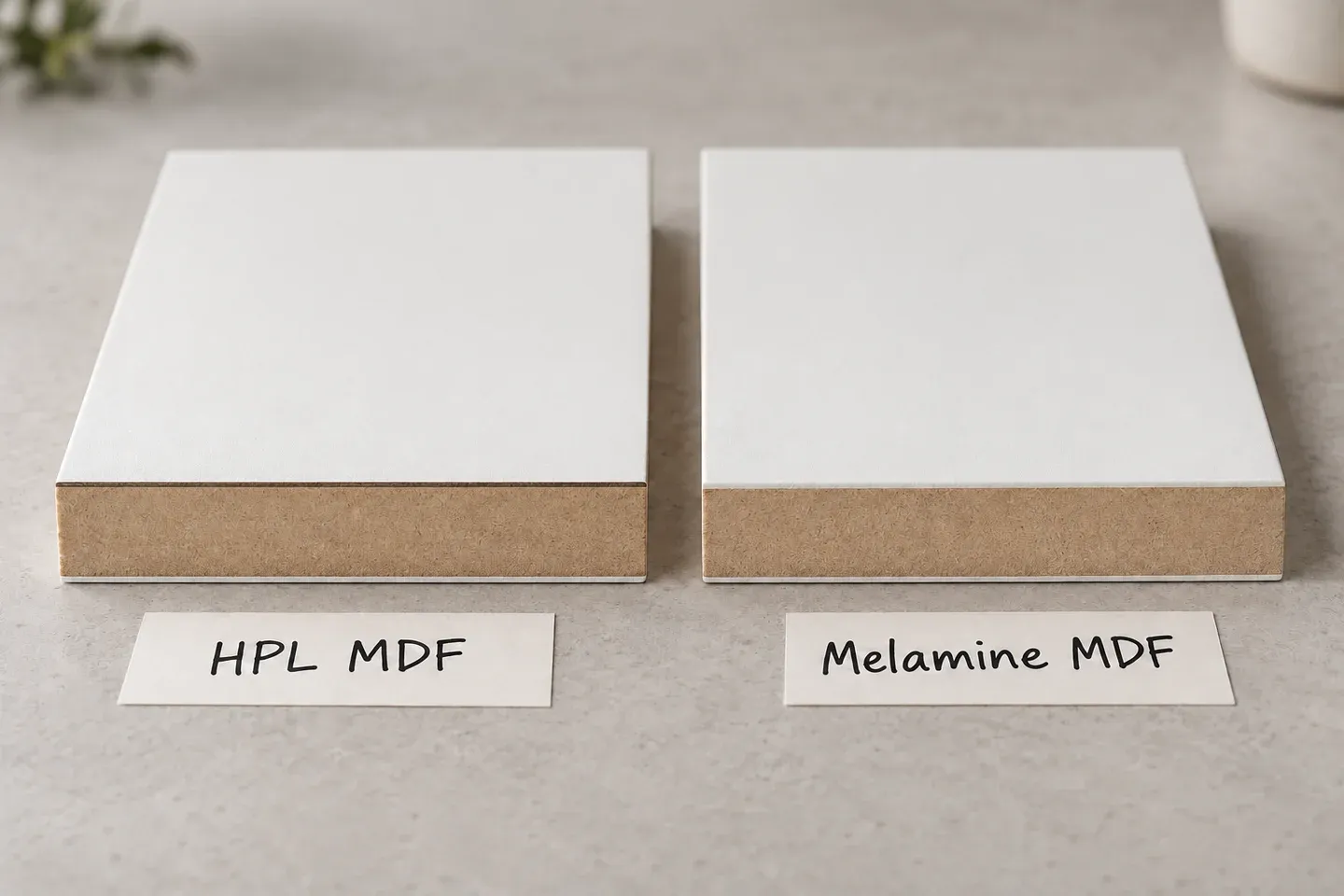
A reception counter, a desk top and a cabinet interior ask different things of a surface. Start with the component and the finish you want, then compare the offered surface grades, MDF core, reverse and finished edges. Our factory supplies both options and can help you specify them for the same furniture range.
The construction difference: separate laminate or direct facing
HPL MDF has a separately manufactured high-pressure laminate sheet bonded to an MDF core. Conventional HPL combines resin-impregnated decorative paper with kraft-paper layers, pressed into a laminate before bonding to a supporting board. Formica's thin-laminate datasheet describes this construction.
Melamine MDF has resin-impregnated decorative paper pressed directly onto MDF under heat and pressure. It is also called melamine-faced MDF or thermally fused laminate, often shortened to TFL. EGGER's faced-MDF description provides a published example of the direct paper-facing construction.
The two boards can look similar in the same white or woodgrain decor. An exposed edge helps distinguish the separate HPL layer from the direct facing; the quotation identifies the construction precisely. Both use an MDF core in this comparison.
HPL MDF and melamine MDF compared
| Buying decision | HPL MDF | Melamine MDF |
|---|---|---|
| Facing construction | A separate multilayer HPL sheet bonded to MDF | Decorative resin-paper facing pressed directly onto MDF |
| Useful starting point | Counters, work surfaces and furniture with specified surface-performance requirements | Cabinet parts, storage, fronts and decorative furniture with an agreed faced-board grade |
| Thickness description | Record HPL, MDF core, reverse and finished panel separately | Record the finished faced-panel thickness and specified facing construction |
| Colour and texture | Select or customize colour, pattern, texture and gloss using a physical HPL reference | Select the decor, texture, gloss and grain direction using a physical faced-board reference |
| Wear comparison | Compare the selected laminate grade and test results | Compare the selected faced-board grade and test results |
| Production planning | Coordinate lamination, balancing, machining and finished edges | Coordinate cutting, drilling, edging and assembly |
For a mixed furniture order, you can use a specified HPL surface on a counter and a coordinated melamine finish on storage components. Approve the adjoining samples together so colour and texture work across the complete design.
What does 0.5–1.2 mm HPL mean?
CUZI MDF supplies HPL facing options with nominal laminate thicknesses from 0.5 to 1.2 mm. This is the thickness of the HPL sheet, including its multilayer laminate construction. Your finished board also includes the MDF core, adhesive and the selected reverse.
Keep these dimensions separate in the RFQ. For example, an 18 mm MDF core with a nominal 0.8 mm HPL sheet on each side has a nominal layer sum of 19.6 mm before accounting for the bond lines and production tolerances. This is a dimensional example; the quotation confirms the supplied finished thickness and tolerance.
For hinge cups, sliding-door tracks, rebates or a flush counter joint, specify the finished dimension that your assembly needs. Choose the HPL grade and surface performance alongside thickness, then check the component with your hardware drawing.
Wear, scratches, stains and cleaning
A specified HPL grade is a practical choice when your brief calls for a hard decorative face and defined abrasion, scratch, stain or heat performance. Describe what the furniture will face: sliding merchandise, regular handling, office use or frequent cleaning. We can then discuss the appropriate HPL series and surface information for that application.
Melamine MDF also provides a hard decorative surface for everyday furniture. Some faced-board series use additional layers for particular performance requirements; EGGER's Eurodekor datasheet includes an example of a high-abrasion variant. Compare the actual series offered for your order.
| Performance question | Ask for this information |
|---|---|
| Abrasion or surface wear | Test method, wear indicator, value or class, and the covered decor and finish |
| Scratch resistance | Scratch-test result and method for the selected surface |
| Stain and cleaning resistance | Tested substances, contact conditions, results and care instructions |
| Heat resistance | Test conditions, result and recommended service use |
| Edge and corner durability | Finished edge sample and the checks relevant to your component |
Abrasion describes wear from repeated rubbing; scratch resistance describes a different type of damage. A comparable quotation identifies both where they matter. Use matching test methods and conditions when comparing results, and keep your own furniture-use trial with the chosen sample.
Read a laminate datasheet before selecting the grade
Published laminate classifications make a request more specific. For example, Formica's collection guide identifies HGS as horizontal, general-purpose, standard grade and HGP as a postforming grade under EN 438-3.
If your design has a flat work surface, ask which horizontal-use grade is proposed. If you want a curved wrapped edge, include the radius and ask for a suitable postforming grade, core detail and fabrication process. A flat HPL-faced panel and a postformed component are distinct supply specifications.
Record the actual laminate series, decor, texture, thickness and test document revision. The published examples above explain how to read product information; the offer for your CUZI MDF order names the actual facing and available documents.
Fire-retardant options for the complete panel
Fire-retardant HPL MDF options are available from our factory. Send the required classification, test standard and intended installation with your inquiry. We confirm the HPL grade, MDF core, adhesive, reverse and applicable report for the proposed panel construction.
The classification needs to describe the construction you will use. Laminate, adhesive and substrate work together in the finished panel; EGGER's classification explanation makes this distinction clear. Check the covered thicknesses, fixing arrangement, substrate and any installation conditions alongside the stated result.
For furniture or a wall-panel project, identify whether the requirement concerns reaction to fire of a surface or a resistance period for a complete assembly. That detail lets us address the correct product and documentation request. Appearance, wear and fire requirements can then be agreed together for the selected construction.
Custom colours, textures and matching edges
For HPL MDF, we can discuss selected or customized colours, woodgrains, stone and material effects, textures and gloss levels. For melamine MDF, our decor catalogue helps shortlist the finish before comparing a physical sample.
Provide the decor reference or your sample, then identify every visible face and edge. Check adjoining panels under the intended lighting, including a front, side and finished corner. A matching name alone may cover different textures or sheen across facing families; the adjoining samples give you a useful visual reference.
Specify an edge band that matches or intentionally contrasts with the face. Include material, thickness, colour, corner treatment and the intended finished dimensions. Keep the accepted sample and drawing revision with the repeat-order specification.
Reverse balance, flatness and machining
Specify the reverse with the face. For HPL MDF, use an agreed reverse HPL or balancing layer with the selected adhesive and pressing construction. For melamine MDF, agree matching or different decorative faces, or the required reverse construction, for the component. This helps your team and our production team plan the panel as a complete build-up.
State the component size, flatness requirement, support and service conditions. A full-size sample or first component can show the effect of the selected construction more clearly than a small decor swatch. Let the panels condition for the intended production environment before checking assembly fit.
For cutting, drilling and CNC work, send the hole schedule, hinge locations, routing details and pattern direction. We review the MDF core and finished facing together. If a routed feature removes the decorative layer, specify how that exposed area will be finished. The laminated MDF guide expands the face, reverse and edge specification.
Compare quotations on a finished-component basis
HPL adds a separately selected sheet and a bonding operation. Melamine MDF arrives with its direct decorative face ready for downstream work. The useful commercial comparison includes the work required to deliver the same finished component, appearance and performance.
Here is a purchasing example for a 1200 × 600 mm retail counter top. The size is an example input; your drawing defines the finished thickness, supports and use requirements.
| RFQ line | Information to give our factory |
|---|---|
| Component and drawing | Counter C01, 1200 × 600 mm, drawing revision and quantity |
| Finished dimensions | Required total thickness, tolerances, supports and hardware details |
| Facing alternatives | Quote the specified HPL MDF and melamine MDF constructions separately |
| Appearance | Physical decor reference, texture, gloss, pattern direction and visible faces |
| Performance | Required wear, scratch, cleaning and fire documents where relevant |
| Reverse and edges | Reverse construction, edge-band reference and finished corner detail |
| Delivery | Pack groups, destination, delivery term and required date |
Ask the quote to identify what is included: facing, MDF grade, lamination, cutting yield, drilling, edge banding, protective materials and packing. Compare the same quantity, currency and delivery basis. Your trial results provide the usable yield and rework inputs for a cost-per-accepted-part comparison.
Buyer review checklist
- Choose the surface around the component, contact level and cleaning routine.
- Record the actual facing series and physical decor reference.
- Separate HPL sheet thickness, MDF core and finished panel dimensions.
- Agree the reverse, edges, machining and adjoining appearance.
- Match performance documents to the offered construction and intended use.
- Keep the selected sample, drawing and quotation together for the order.
Questions buyers ask
Is HPL MDF the same as melamine MDF?
They use different facing constructions. HPL MDF has a separately pressed multilayer laminate bonded to MDF; melamine MDF has decorative resin-paper facing pressed directly onto MDF.
Which should I choose for a desk or counter?
Start with the wear, scratch, cleaning and appearance requirements of the top. A specified horizontal-use HPL grade is a useful option for demanding work surfaces. Compare the offered melamine grade on the same requirements, finish and finished-component cost.
Does thicker HPL mean better wear resistance?
Choose the wear grade and test result for the selected decor and finish. Sheet thickness is a separate construction dimension, so include both in the specification.
Can CUZI MDF customize HPL colour and texture?
Yes. Send your HPL reference or sample and discuss the colour, pattern, texture and gloss with our factory. We confirm the proposed finish and sample for your order.
Can I request fire-retardant HPL MDF?
Yes. Provide the classification, test standard and installation. We confirm the complete panel construction and the applicable report, including its covered thicknesses and conditions.
Can both sides have a decorative finish?
Yes. Specify matching or different finishes on the two sides, or agree the reverse balancing construction for a single decorative face. The quotation records the supplied face and reverse.
Can I compare free samples before ordering?
Yes. Samples across our range are free and generally in stock. The buyer pays courier costs, which can be credited against a formal order. We confirm the sample availability, preparation, dispatch and estimated transit timing for your destination.
Discuss your order with our factory
CUZI MDF manufactures and supplies MDF from Shuyang, Jiangsu, China. Explore HPL MDF, Melamine MDF and our Laminated MDF options, then send the component, finish reference, quantity and destination. We can help you compare a decorative face with the production steps and performance your furniture needs.
Request samples or request a quotation. We reply within 12 hours. Your formal quotation includes the agreed specification, quantity, price and currency, packaging, delivery term and place, production timing, payment conditions and validity.