
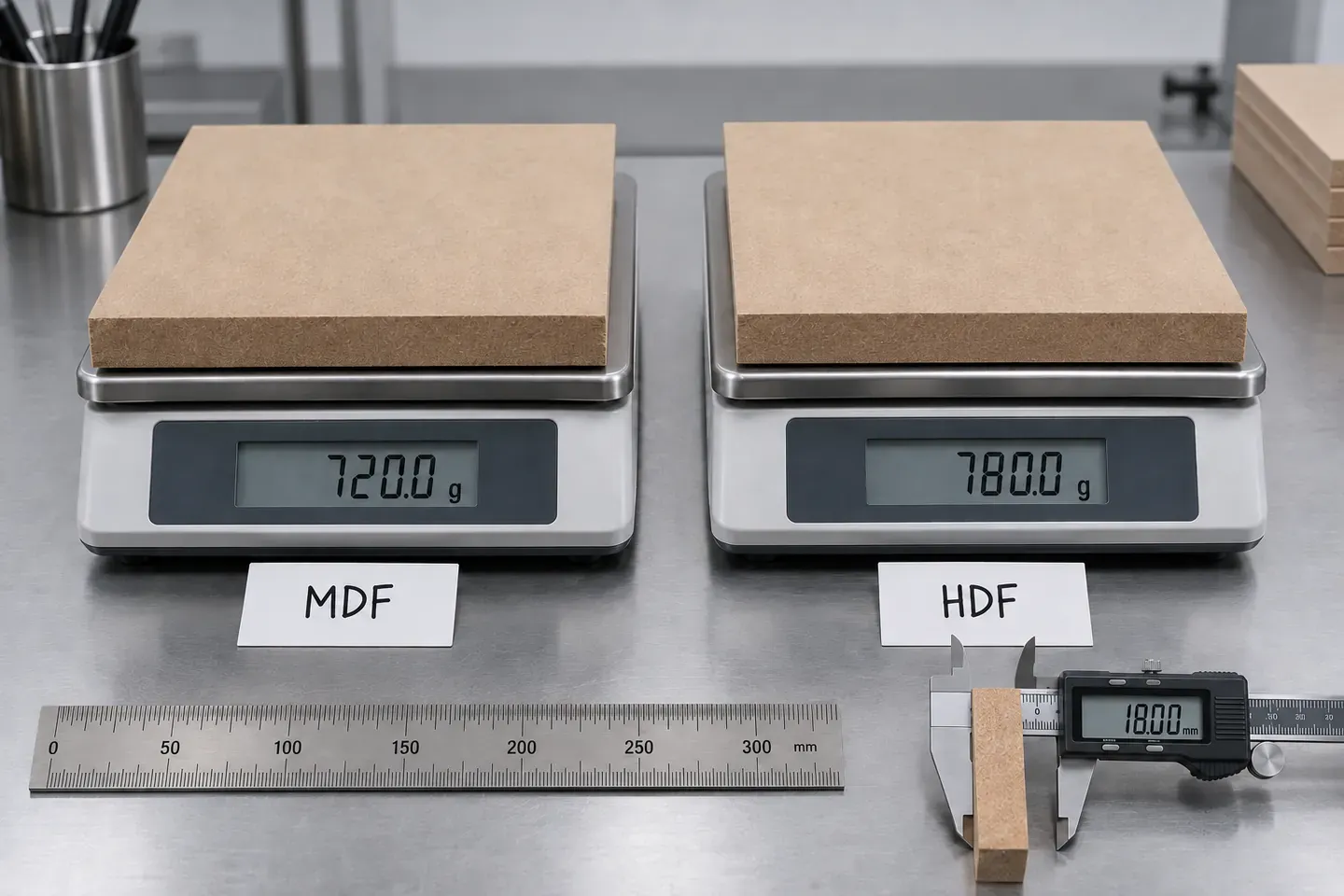
MDF and HDF become comparable when thickness, dimensions, supplied surface and finished component stay the same. HDF follows a higher density schedule, which changes calculated weight and influences machining, hardware, usable yield, support, packaging and delivered-component planning.
Compare the CUZI MDF density schedules
The product name and thickness identify which density range belongs in the comparison.
| Thickness | Standard MDF | HDF |
|---|---|---|
| 2–4 mm | 800–810 kg/m³ | 850–930 kg/m³ |
| 5–8 mm | 780–800 kg/m³ | 830–890 kg/m³ |
| 9–11 mm | 760–780 kg/m³ | 780–830 kg/m³ |
| 12–18 mm | 680–750 kg/m³ | 730–780 kg/m³ |
| 19–35 mm | 650–680 kg/m³ | 680–730 kg/m³ |
These are CUZI MDF product ranges for purchasing review. The quotation should connect the selected product, nominal thickness and density requirement on the same order line. Product data and shipment records then provide the applicable values for the confirmed supply.
Use the finished component to make the first selection
MDF is the broader furniture and interior-component option when the order begins with a smooth, uniform board for cutting, routing, drilling, painting or decorative facing. HDF is the higher-density option when the component specification calls for its denser product schedule and the buyer has reviewed the related weight, processing and handling effects.
| Buyer question | Selection direction |
|---|---|
| Is the component defined mainly by a smooth substrate and standard furniture processing? | Begin with MDF at the required thickness and construction. |
| Does the drawing or approved assembly call for the HDF density schedule? | Review HDF at the same thickness and dimensions. |
| Is the part thin, long or highly machined? | Compare representative MDF and HDF parts with their actual support and process. |
| Will the component carry hardware or repeated drilling? | Test the selected board with the released hardware and drilling geometry. |
| Does the order ship as full sheets or finished parts? | Compare usable yield, accepted quantity, pack design and delivered weight for that supply option. |
This first selection creates a shortlist. Product data, samples and a representative component trial complete the decision.
Calculate weight at the same thickness and size
Panel weight follows volume × density, so the comparison keeps length, width and thickness identical.
| Example panel | Standard MDF calculation | HDF calculation |
|---|---|---|
| 3 mm, 1220 × 2440 mm | 7.14–7.23 kg | 7.59–8.30 kg |
| 18 mm, 1220 × 2440 mm | 36.44–40.19 kg | 39.12–41.79 kg |
The figures are theoretical material weights based on the published density ranges. Facing, coating, machining, moisture variation and packaging add their own weight. Use the ordered density and measured shipment data for lifting, bundle and freight decisions. The MDF sheet weight and CBM calculator supports other confirmed sizes and densities.
Normalize the supplied construction before comparing price
Place MDF and HDF quotations on the same construction basis. A raw panel, a sanded panel, a decorative-faced sheet and a machined component carry different included work.
| Comparison field | Record for both options |
|---|---|
| Product | MDF or HDF with the applicable thickness-specific density range |
| Panel | Length, width, nominal thickness and tolerance |
| Surface | Raw, sanded, painted, veneered, melamine or another confirmed construction |
| Face and reverse | Same or different constructions, direction and balancing requirement |
| Processing | Cutting, routing, drilling, sanding, edge work and part identification |
| Quantity basis | Sheets, m³, finished parts, bundles and accepted usable quantity |
| Supply basis | Packaging, delivery term, destination and production timing |
This table keeps a higher-value finished construction from being compared directly with an unfinished board price.
Choose by component option
Translate the finished part into a product review before comparing quotations.
| Component option | MDF review focus | HDF review focus |
|---|---|---|
| Routed furniture part | Profile depth, radius, remaining section, edge preparation and finish | Dense-board machining result, tool route, remaining section and finished weight |
| Thin supported panel | Thickness, face condition, cutting, flat support and assembly fit | Higher-density thin panel, cutting, fit, support and pack protection |
| Painted component | Face, routed edge, preparation, primer and finish sample | Face and edge preparation with the selected HDF and coating system |
| Faced or laminated component | Core identity, bond construction, face/reverse balance and finished thickness | Same complete-construction review using the selected HDF core |
| Drilled hardware part | Actual hardware, hole geometry, edge distance and first-part check | The same hardware and geometry checked in the proposed HDF part |
This keeps the choice connected to a manufactured component and its verified requirements.
Confirm thickness and format as a product combination
Confirm format availability for each exact MDF or HDF product-and-thickness combination. State the product, thickness, format, tolerance and quantity on one quotation line. For cut components, add the source-panel format, finished dimensions, grain or finish direction and nesting requirement. The supplier can then confirm availability and yield for the exact combination used in the order.
Compare machining on representative parts
Cutting and routing trials should use the proposed product, thickness and supplied face condition. Record edge appearance, profile definition, internal radius, remaining section, dust control and any preparation required before finishing. For repeated CNC work, approve a drawing-linked first part and retain its product identity and program revision. The CNC routing specification guide covers the drawing inputs for a production inquiry.
Establish hardware performance with the real assembly
Hardware performance depends on board construction, thickness, fastener type, pilot hole, diameter, depth, edge distance, insertion method and the load path through the finished component. Test the proposed screw, insert, hinge or connector in a representative part and inspect both installation and service loading. Record the accepted hardware reference and drilling coordinates with the drawing. This gives density a supporting role inside a complete connection design.
Compare usable yield and delivered component cost
Convert each option into the unit the buyer consumes. For full sheets, compare accepted sheets, volume, gross shipment weight and price on the same delivery basis. For cut or machined parts, compare approved parts per source sheet, setup allowance, accepted quantity, processing cost, protective packing and freight allocation.
**Delivered cost per accepted part = comparable order cost ÷ accepted usable parts**
A denser panel can change bundle weight, manual handling and freight planning even when panel dimensions stay the same. A machining trial can also change the accepted yield or finishing work. Recording both effects gives purchasing a complete component-level cost comparison that includes the board-price basis.
Specify surface, edge and finish separately
Record whether the board is supplied raw, sanded, faced or prepared for another process. Define the visible face, reverse face, cut edges and routed profiles. For paint, qualify face and edge preparation with the actual primer and topcoat. For veneer, melamine or laminate, identify the complete face/reverse construction, finished thickness, direction and edge treatment. A representative finished corner shows how the selected MDF or HDF works with the intended surface system.
Keep performance requirements on their own verification method
Density supports product identity, weight calculations and the technical comparison. Emission class, moisture performance, fire classification, mechanical performance and finished-component suitability each follow their applicable product or system test reports. Specify E0, E0.5 or E1 according to the selected product and destination requirement, then request documents that identify the proposed product, construction, thickness or applicable scope, method and date.
Release a representative comparison sample
Ask the supplier to identify each sample by product, thickness, density range, surface condition and date. The sample set should reproduce the buyer’s decision points:
- matched raw panels for face, reverse and edge comparison;
- cut or routed parts using the proposed geometry;
- drilled parts with the selected hardware where relevant;
- a finished corner showing face, reverse and edge construction;
- a representative pack arrangement for thin or appearance-sensitive parts.
Record which attributes the sample approves and which values remain controlled by product documents, drawings or order inspection. Retain the accepted reference and its revision for production and receiving review.
Plan formats, tolerances and packing
CUZI MDF reference board formats are 1220 × 2440 mm, 2100 × 2800 mm, 1830 × 3660 mm, 1830 × 2440 mm, 2440 × 3660 mm and 1830 × 4200 mm. Confirm the selected product, thickness and format combination in the quotation. Nominal thickness tolerance is ±0.1 mm subject to the agreed measuring and acceptance method. Define flat base support, top and bottom protection, separators, protected corners and edges, strap positions, bundle weight, labels, destination and unloading method for the actual order.
Prepare a matched MDF and HDF RFQ
For a useful supplier comparison, send the same information for both alternatives:
- finished component and service environment;
- MDF or HDF product option;
- nominal thickness, tolerance and required density;
- full-sheet format or finished part dimensions;
- face, reverse, edge and finish construction;
- cutting, routing, drilling and hardware details;
- E0, E0.5 or E1 destination requirement;
- sample, first-part and document requirements;
- quantity by product and thickness;
- packing, labels, destination and unloading method.
Use the Raw MDF product page and HDF product page for current supply details. The Hardboard vs MDF vs HDF guide covers the wider three-category decision when furniture backs, drawer bottoms or other supported thin components also place Hardboard on the shortlist. Request a specification review with the component, quantity and destination.
Buyer review checklist
Before relying on this guidance, record the finished component, service environment, MDF product or unresolved product requirement, thickness, dimensions, supplied surface, visible edges, machining, hardware, quantity and destination. Identify which values need current technical documents and test reports and which appearance decisions need a physical sample.
For international supply, also confirm drawing and sample revisions, packaging construction, part or bundle labels, handling limits, required documents and the party responsible for finished-product design and destination compliance. Ask the supplier to list unresolved items and exclusions in the quotation, and keep every missing value visible for confirmation.
Compare quotations only after these inputs have been normalized. Check whether the offered price covers a full board, a faced construction, a machined part or a finished component, and whether samples, secondary work, protective materials and documentation are included. Record every change after approval so purchasing, production, inspection and receiving teams use the same revision.
Typical lead time is 7–15 days after requirements are confirmed. Final timing depends on specification, quantity, production scheduling and destination. This planning range covers production; arrival timing also depends on the confirmed logistics route.
Request an MDF quotation
Share the application, specification, quantity, packaging and destination with CUZI MDF for an order-specific review.