
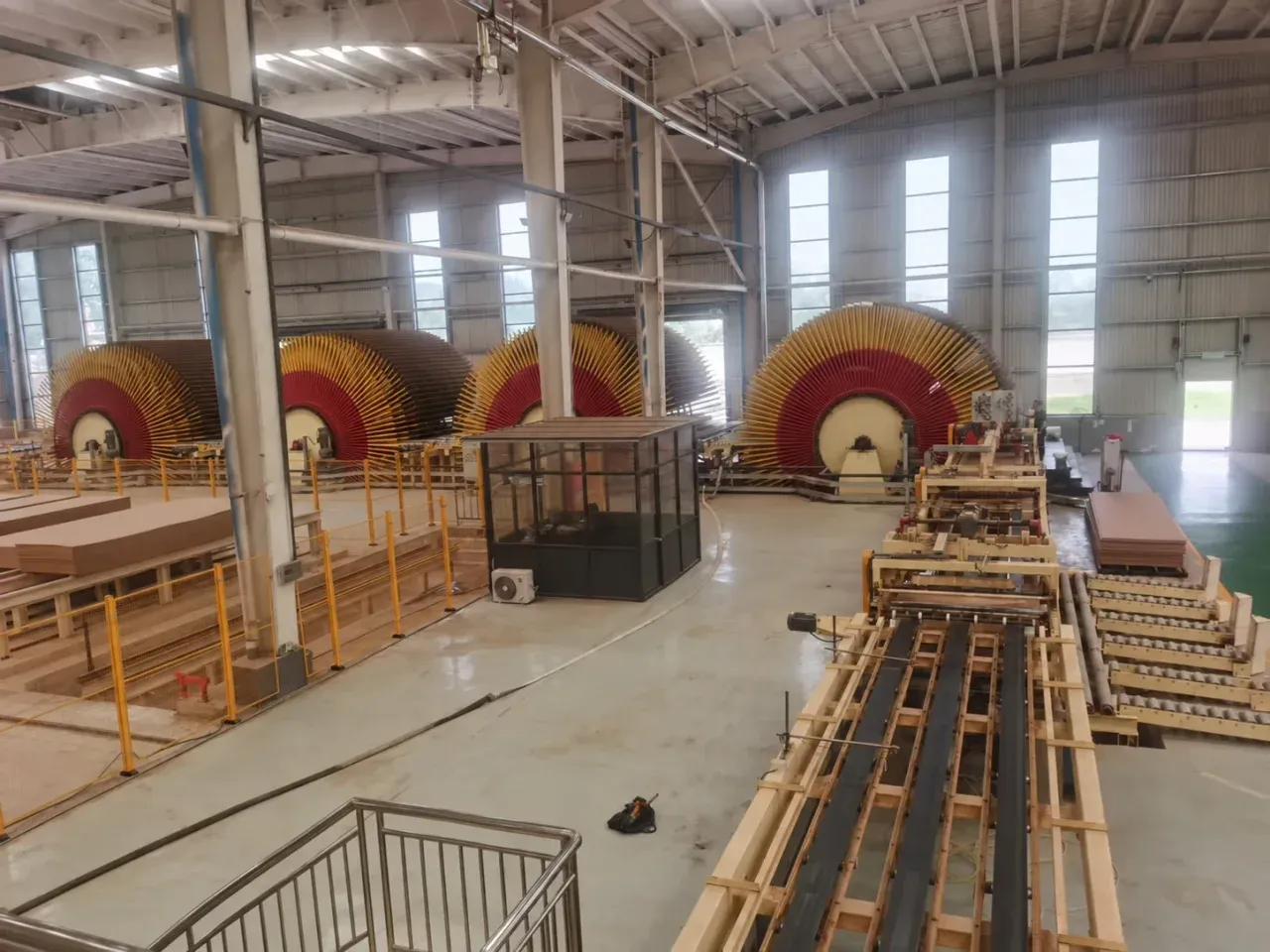
The useful question is whether the panel is ready for the part you will make. A receiving record connects the board grade and shipment condition with your workshop, measurement method and finished-component requirements. That connection helps furniture factories and distributors make a clear decision before releasing a batch into production.
Moisture content, room humidity and MR grade
| Term | What it describes | How to use it when buying MDF |
|---|---|---|
| Board moisture content, or MC | Water in the test piece as a percentage of its oven-dry mass | Agree the method, sample condition and range for the identified panel |
| Relative humidity, or RH | Moisture in the surrounding air relative to saturation at that temperature | Record RH together with room temperature during storage and conditioning |
| Moisture-resistant MDF grade | The selected product's performance for the specified humid-interior conditions | Check the grade and product documents against the component's service environment |
A board's moisture reading is a condition measurement; its moisture-resistant grade is a product specification. Keep both with the order. Our MR MDF vs standard MDF guide explains the grade choice for furniture and protected interiors.
What moisture content should MDF have?
Match the agreed moisture range to the particular board, measurement method and intended use. A useful purchase specification states when the check applies: factory dispatch, receiving, or preparation for machining. This gives your team and our factory a common basis for comparing results.
Published figures can help explain the distinction. The MEDITE PREMIER datasheet lists 5–9% for that manufacturer's product at manufacture. That figure belongs to its named grade and condition. For your CUZI MDF order, the quotation and product information identify the agreed requirement and how it will be checked.
MDF exchanges moisture with its surroundings, and individual exposed panels and the centre of a stack can respond at different rates. The European Panel Federation's moisture guide explains this relationship. Record the conditions at the time of your check so a reading has a clear context.
Choose a measurement method you can repeat
Moisture-meter checks
A handheld meter can help your receiving team compare locations and follow a batch during conditioning. Use the instrument's instructions for MDF, including the appropriate material calibration or correction where provided. The European Panel Federation discusses resistance-meter limitations and MDF-specific calibration in its measurement guidance.
Record the model, electrode or sensor, setting, check location and panel temperature. With pin meters, include the pin type and penetration used; with pinless meters, include the material setting and sensing depth specified by the instrument. A consistent method makes repeat readings more useful.
Delmhorst's instrument guidance explains how electrode type and material temperature affect resistance-meter readings. Its calibration-check instructions also show why the correct check standard and meter settings belong together. A meter check confirms the instrument's electrical response; use the MDF calibration and measurement procedure alongside it.
Laboratory determination
For a contractual moisture-content result, agree the laboratory method and sampling plan in advance. EN 322 covers moisture-content determination in wood-based panels, and ISO 16979 specifies a method for the same panel property. Ask the laboratory to identify the method and record the test-piece mass before drying and its oven-dry mass under that procedure.
The dry-mass calculation is: moisture content (%) = (mass before drying − oven-dry mass) ÷ oven-dry mass × 100.
For a worked calculation, a test piece weighing 107.2 g before drying and 100.0 g at oven-dry mass gives 7.2%. These masses are example inputs. A laboratory report records the actual sample, method, masses and result; the agreed specification supplies the acceptance range.
Make a useful receiving record
Start with the bundle identity and visible condition before opening. Link the photos and inspection sheet to the order, product, thickness, quantity and receiving date. Then use a representative sample plan agreed for the shipment.
| Record field | What your team should capture |
|---|---|
| Shipment identity | Order, bundle or pack ID, grade, thickness and supplied surface |
| Arrival condition | Cover, straps, bearers, visible faces and edges, with labelled photos |
| Sample plan | Selected panels and positions within the sampled packs |
| Room conditions | Date, time, temperature and relative humidity |
| Measurement | Meter or laboratory method, settings, correction and check record |
| Results | Individual readings and locations, plus the agreed range and units |
| Production status | Ready for processing, further conditioning, or joint review of identified panels |
If the sample plan includes different stack positions, retain that identity with every reading. A top-board check and a centre-board check then remain distinguishable. Compare your readings with the dispatch information using the same product and method context.
Our pre-shipment inspection checklist helps connect the inspection scope with bundle identification and shipment records. Discuss any critical receiving checks with us while confirming the order.
Store MDF flat and evenly supported
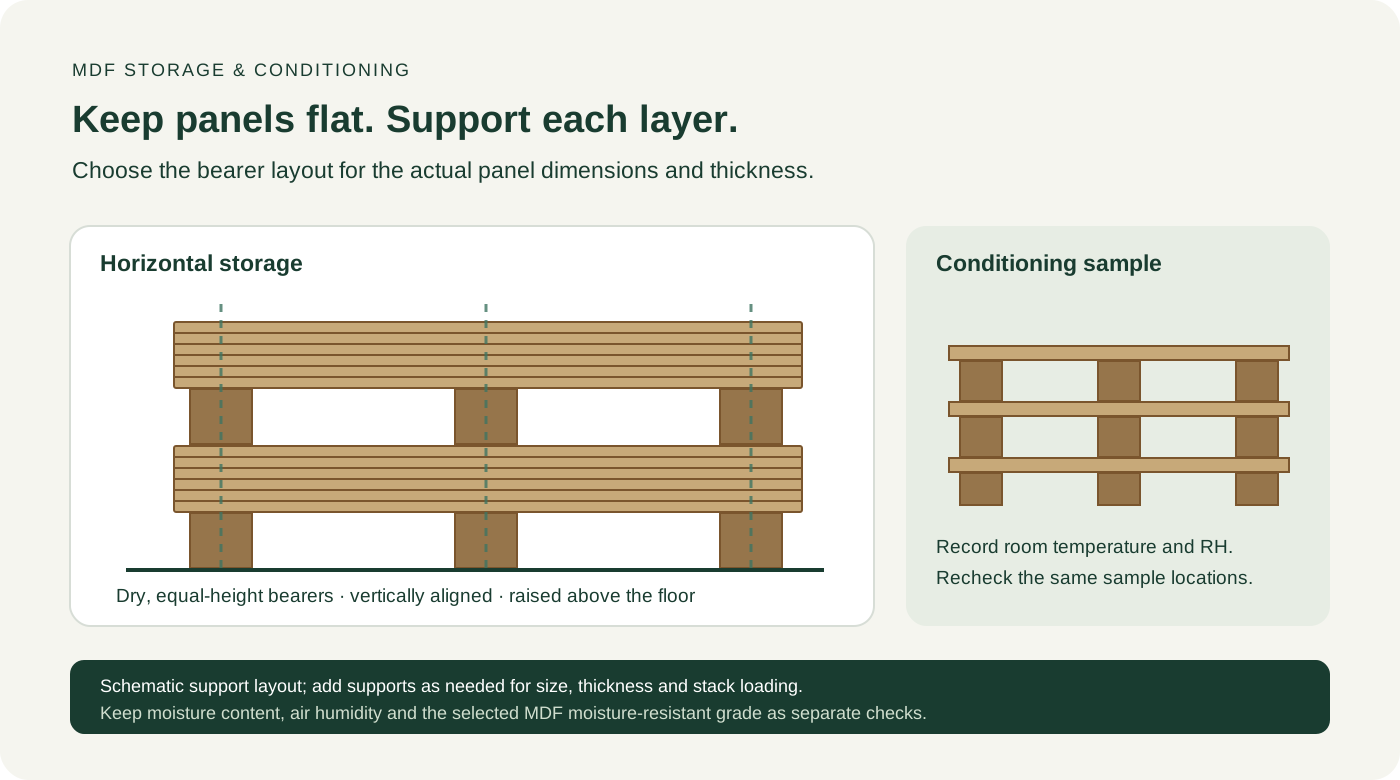
Use a covered, reasonably dry storage area. Keep full-size panels horizontal, raised above the floor on dry supports of equal height. Align supports vertically through stacked packs, keep the edges aligned and select enough support for the board size, thickness and stack loading.
The European Panel Federation's handling guide explains the role of supports in maintaining flatness. Thinner panels and long components need a layout suited to their geometry. Include the support arrangement when discussing bundle and warehouse handling with our factory.
View the storage support and conditioning diagram for a schematic layout of aligned bearers and sample spacers. Set the actual support spacing from your panel dimensions, thickness and loading requirements.
Keep stock identifiable as it moves from receiving to storage and machining. Record the storage location and retain the pack information with the job schedule. For decorative boards, add the face orientation and protective-material instructions to the handling plan.
Condition panels for the production environment
Plan conditioning around the selected product, panel size, supplied face and the difference between arrival and workshop conditions. Log the room temperature and RH, then repeat checks at the identified sample positions using the same procedure. Track dimensions and flatness where they affect your component.
Product instructions may give a starting period. For example, the MEDITE PREMIER datasheet recommends two to three days in the final environment for its product before cutting and fixing. Use the instructions agreed for your chosen board and the conditions of your process to set the schedule.
For a conditioning sample, suitable spacers can provide air access while keeping the panels evenly supported. Agree how the pack is opened and supported with the board and finish requirements. Your production release can then consider the recorded moisture checks, dimensions, flatness and representative component trial together.
Check the panel before cutting, finishing and assembly
Bring the receiving and conditioning records to the job's first-component check. Confirm thickness, dimensions, flatness and face or edge condition using the requirements on the drawing. Fit the actual hardware and inspect the finished part with the intended support.
For painting, veneering or lamination, include the substrate condition required by the coating or adhesive system. Keep the face, reverse and edge preparation coordinated through processing. If finishing or conditioning changes the schedule, update the job record so your team uses the same panel condition for its checks.
For furniture shipped into a different climate, give us the intended service environment as well as the destination. The material grade, dimensional allowances, face and reverse construction and installation detail can then be discussed as part of the complete component specification.
If you find swelling or bowing
Keep the affected panels identifiable while you assess them. Record where the change appears, the dimensions or flatness measurements, sample position, storage supports, room conditions and elapsed time after opening. Add photos of the panel, pack and supporting arrangement.
Compare those records with the receiving condition and agreed specification. Our factory can review the product and shipment information with your team and help determine the appropriate next check. The disposition may involve a representative component trial, additional laboratory assessment or an agreed material decision for the identified quantity.
Keep the action and its results with the same batch record. This makes the first order easier to resolve and gives repeat orders a clearer receiving and production reference.
Buyer review checklist
- Select the MDF grade for the component and intended service environment.
- Agree the moisture-content method, sample condition, check timing and acceptance range.
- Record bundle identity, arrival photos and representative sample locations.
- Store panels flat on dry, equal-height supports suited to their size and thickness.
- Log the conditioning environment and repeat the same sample checks.
- Release the batch using the job's agreed moisture, dimension and component checks.
Questions buyers ask
Is MDF moisture content the same as relative humidity?
They describe different things. Moisture content relates water mass to the oven-dry mass of the test piece; RH describes the surrounding air. Record both, with temperature, when reviewing a batch.
Does moisture-resistant MDF need conditioning?
Plan conditioning for the selected MR product and production environment. The grade choice and the board's condition are separate purchasing checks. Confirm them with the component design, finish and product instructions.
Can a wood moisture meter measure MDF?
A resistance meter can be used with the accuracy limitations and MDF calibration or correction described for the instrument. Record the procedure and settings. Use the agreed laboratory method when a contractual result requires it.
How long should I acclimatise MDF?
Use the instructions for the chosen panel and compare arrival conditions with your workshop. A documented conditioning period, repeated checks and the required component fit give your team a useful release decision.
How should thin MDF be stored?
Keep it flat and evenly supported with a bearer layout appropriate to its thickness and format. Use the product's handling guidance when agreeing support spacing and pack handling.
What information helps review a changed panel?
Send the order and pack IDs, identified panel quantity, arrival and current photos, measurements, meter or laboratory method, environmental records and storage-support details. We can compare them with the agreed product and shipment information.
Can CUZI MDF help specify moisture checks for an order?
Yes. Send the application, board format, finish, quantity and destination, together with your proposed receiving and production checks. Our team can discuss the product information and inspection scope before the order is confirmed.
Discuss your order with our factory
CUZI MDF manufactures and supplies MDF from Shuyang, Jiangsu, China. Explore Raw MDF, Moisture Resistant MDF and High Moisture Resistant MDF, then tell us the component, service conditions and production process you are planning. We can help connect the board specification with inspection, packaging and handling for your order.
Request technical information, request samples or request a quotation. We reply within 12 hours. Samples are free and generally in stock; the buyer pays courier costs, which can be credited against a formal order. Preparation, dispatch and transit timing are confirmed for your request.