
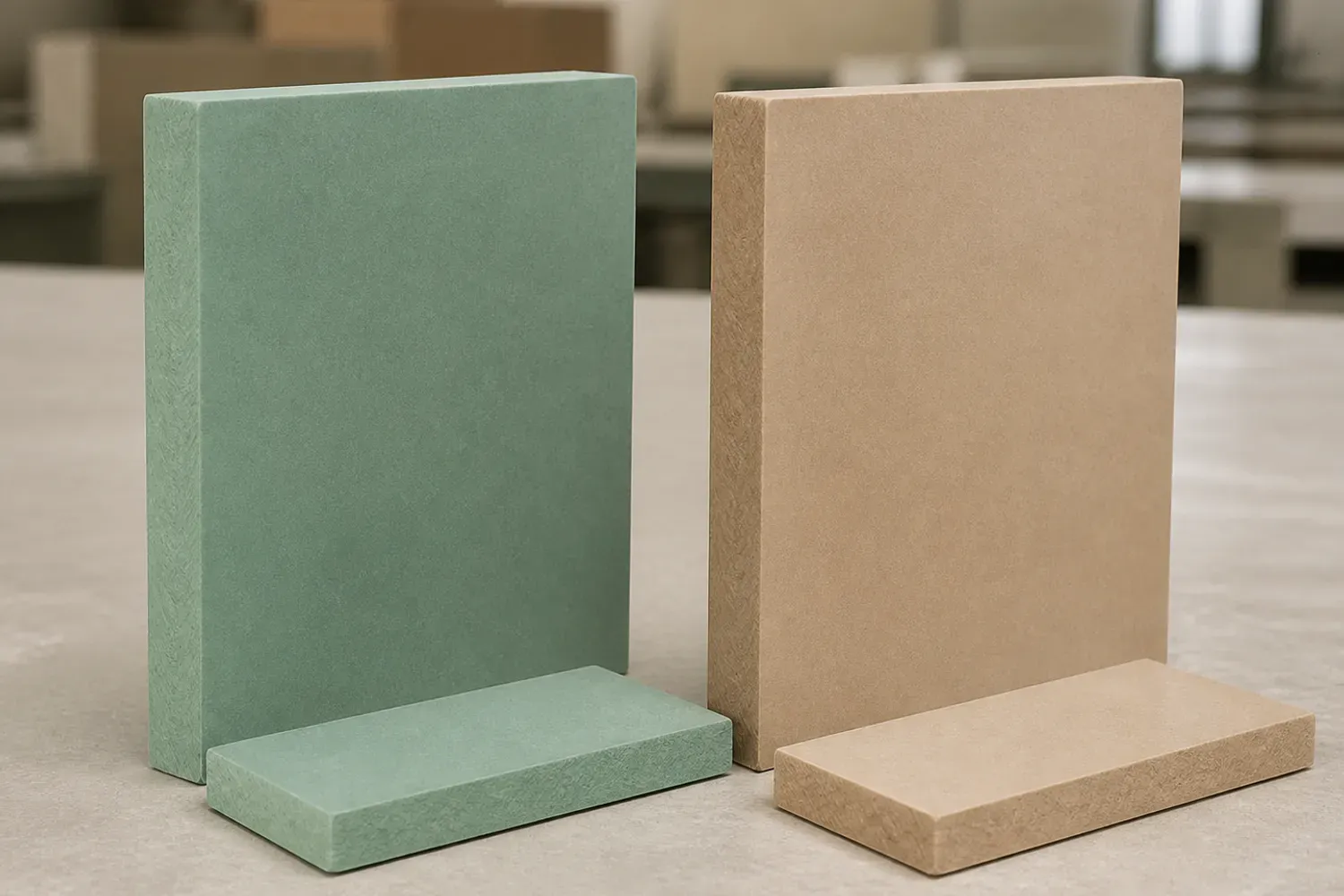
Standard MDF is generally selected for dry, protected interior components. Moisture Resistant MDF (MR MDF) adds improved resistance to humidity and short, intermittent moisture exposure for protected interiors. MR MDF is not waterproof and is not intended for exterior use, standing water or prolonged soaking. The right choice follows the actual component, exposure condition, machining, finish and product-specific test reports and technical documents.
Standard MDF or MR MDF: the direct comparison
The room name provides context, while the component determines the useful specification. A kitchen wall cabinet, sink-base side, routed door and bathroom vanity panel can face very different exposure even when they appear in the same project.
| Buyer decision | Standard MDF | Moisture Resistant MDF |
|---|---|---|
| Typical service condition | Dry, protected interiors with controlled humidity | Protected interiors with higher humidity, condensation risk or brief incidental moisture |
| Common starting applications | Wardrobes, office furniture, dry-area cabinets, decorative panels and general furniture parts | Kitchen and bathroom furniture, laundry-area cabinetry and selected interior panels with defined moisture concerns |
| Moisture performance | Reviewed against standard-grade product data | Improved moisture performance verified for the exact offered product and applicable test method |
| Machined edges and openings | Finished or protected according to the component design | The same controls remain essential at cut edges, routed profiles, hinge cups and service openings |
| Surface system | Paint, melamine, veneer, laminate or another confirmed finish | Face, reverse, edge and joint protection are specified as one complete construction |
| Acceptance basis | Product data, dimensions, machining sample and finish approval | The same controls plus relevant moisture-performance test reports |
Current supply options are shown on the Raw MDF and Moisture Resistant MDF pages. This guide owns the comparison and selection process; the product pages own current specifications, options and quotation review.
Map how moisture reaches each component
Classify the exposure condition before naming a grade. Ambient humidity acts across the complete board. Condensation commonly appears near cold walls, pipes or poorly ventilated enclosures. Splash reaches local faces, joints and openings. Leaks and standing water create a more severe exposure that calls for a different material or assembly review.
Record the conditions for each component:
- room humidity, ventilation and temperature variation;
- distance from sinks, plumbing, wet appliances or exterior openings;
- likely splash, condensation and cleaning frequency;
- duration and frequency of any direct moisture contact;
- exposed faces, reverse sides, cut edges, joints and hardware holes;
- installation details that allow drainage, airflow and maintenance access.
For kitchen components, the kitchen cabinet material guide connects these conditions to doors, carcasses, shelves and sink-base parts. The bathroom furniture application guide covers vanity, basin and plumbing interfaces.
Treat the finished component as the performance unit
An uncut board sample shows color and raw surface quality. A representative finished component shows how the board, machining and protective system work together. Mark the face, reverse, edge, joint and opening requirements on the drawing, then identify the supplier responsible for each operation.
For a routed painted door, approve the profile depth, remaining section, edge preparation, primer and topcoat sequence. For a melamine-faced carcass, confirm both faces, edge banding, hinge drilling and exposed service cut-outs. For a vanity component, include basin openings, pipe penetrations, rear ventilation and the interface with adjoining materials.
This approach gives the buyer an acceptance sample that reflects the real moisture entry points and production process.
Compare product documents and test reports on the same basis
Moisture-performance values become useful when the report identifies the exact product, thickness, construction, test method, conditioning or exposure procedure, measured result and acceptance threshold. Results from different methods or conditions form separate record sets and should be compared within their stated scope.
Use this review sequence:
1. Match the product identity and thickness to the quotation. 2. Confirm the test method and sample conditioning or exposure conditions. 3. Separate the required limit from the measured result. 4. Check the report date, issuing laboratory and pages that define the result. 5. Record the record or document reference in the order specification and inspection plan.
Board color can help with factory identification, while the technical data and test record establish the verified performance. The certificate and test-report guide explains document coverage in more detail.
Keep moisture grade, density and emission class separate
MR designation, density and formaldehyde emission describe different parts of the specification. Select the moisture grade from the service condition and verified moisture performance. Select density and thickness from the component, machining, hardware and structural support requirements. Specify E0, E0.5 or E1 according to the selected product and destination requirement, with the applicable test reports and product documents confirmed for the order.
This separation improves quotation accuracy because two offers can both say “MR MDF” while differing in thickness, density, emission class, surface construction, applicable documents and included processing.
Review machining, sealing and finish together
Machining exposes fresh fibre at cut edges, routed grooves, hinge cups, handle holes and service openings. Define their preparation and protection within the finished construction. The production sample should include the deepest route or most demanding opening, the intended sanding and sealing process, and the actual coating, edge band or laminate system.
The face finish also affects the comparison. Paint requires a controlled surface and edge-finishing sequence. Melamine or laminate protects the covered face while joints and machined openings follow their own protection detail. Veneer projects add face selection, grain direction, balancing construction and coating requirements.
Recognize when the requirement goes beyond MR MDF
A higher protected-interior moisture requirement can lead to a review of High Moisture Resistant MDF. Direct weather, repeated water contact, standing water or immersion points toward a different material or assembly solution. The MDF waterproof guide explains these exposure boundaries.
The decision remains documented: define the exposure and required result, then match the product and complete construction to that requirement.
Compare quotations using one controlled specification
Normalize each offer against the same component schedule. Compare the exact MDF grade, thickness, dimensions, density or performance requirement, E0/E0.5/E1 class, supplied surface, machining, edge work, sample scope, required documents, packaging, quantity unit and delivery basis.
An MR price premium becomes meaningful only after these included items are aligned. A lower offer may represent a different construction, document coverage or processing responsibility. Keep every difference visible as a line item so purchasing, production and inspection teams use the same basis.
MR MDF vs standard MDF RFQ checklist
Send the following information for a component-specific review:
- finished component and protected-interior application;
- humidity, condensation, splash, cleaning and ventilation conditions;
- thickness, board size or finished dimensions and quantity;
- face, reverse, edge, joint and opening construction;
- cutting, drilling, routing and hardware details;
- paint, melamine, laminate, veneer or other finishing process;
- required moisture-performance method or acceptance value, when specified;
- E0, E0.5 or E1 emission requirement and destination;
- sample, drawing and document requirements;
- packaging, handling route, destination and requested timing.
Request an MR or standard MDF specification review. CUZI MDF can identify the proposed product, supporting test report or certificate and open items in the quotation so the comparison uses one controlled requirement.