
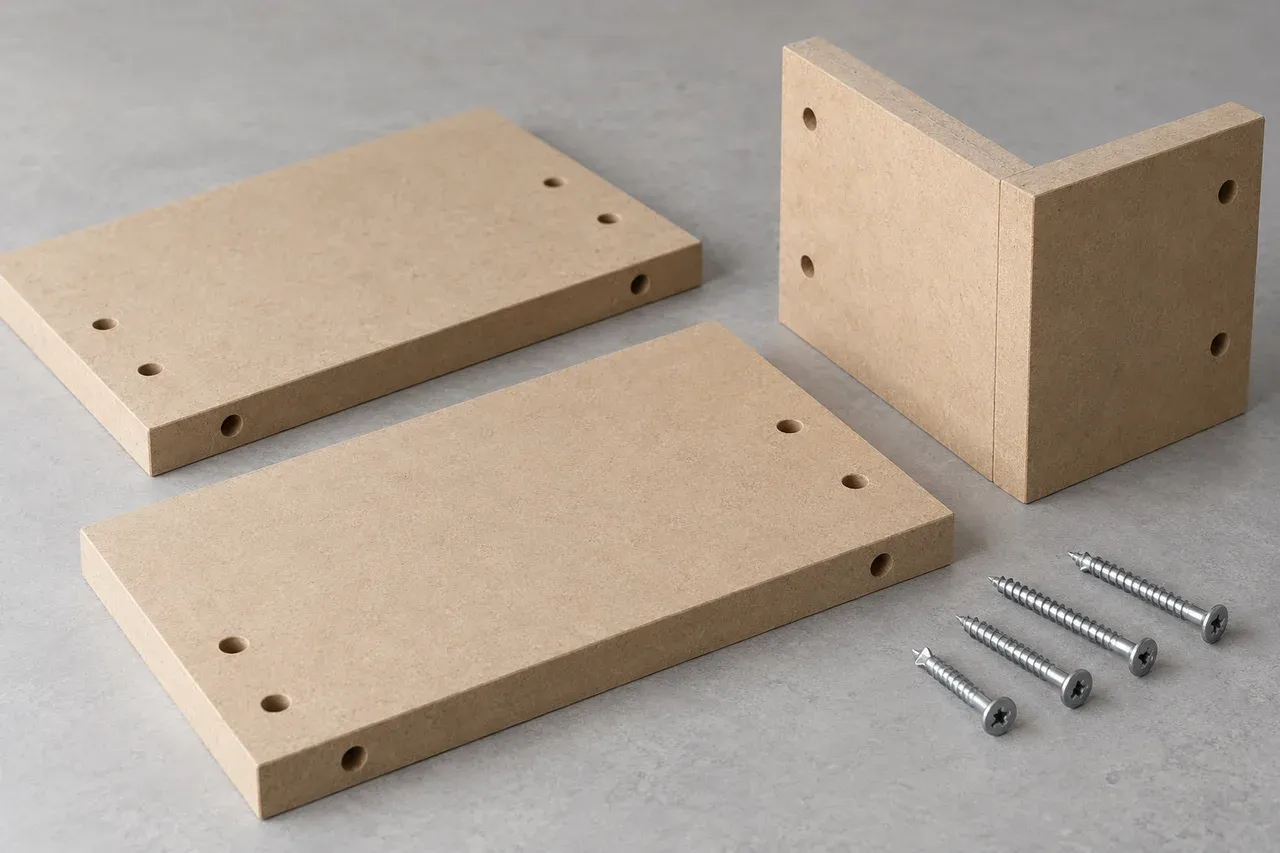
Starting with the part makes the quotation and sample more useful. Your team can compare the proposed boards on the properties that matter, then check the joint or shelf in the finished assembly. CUZI MDF manufactures the boards and machines furniture components, so the material, drawing and supplied condition can be discussed together.
Choose the property that answers your question
An MDF data sheet may place density, internal bond, bending strength and screw holding in the same table. Each describes a different property. Match the row to the component question before comparing its number with another product.
| Property | Common unit | What the result describes | Furniture purchasing question |
|---|---|---|---|
| Density | kg/m³ | Mass per panel volume under the stated measurement conditions | What board weight and material specification are we comparing? |
| Bending strength, often MOR | N/mm² or MPa | Bending stress at failure in the specified test | What bending-strength requirement applies to the proposed panel? |
| Modulus of elasticity, or MOE | N/mm² or MPa | Stiffness derived from the specified bending test | What stiffness input is needed to assess shelf deflection? |
| Internal bond, or IB | N/mm² or MPa | Tensile strength perpendicular to the panel plane | What through-thickness bond requirement applies to this grade? |
| Face screw withdrawal | N | Force to pull a defined screw axially from the broad face | What face-fixing data supports the proposed hardware review? |
| Edge screw withdrawal | N | Force to pull a defined screw axially from the narrow cut edge | What edge-fixing data applies to this thickness and method? |
One MPa equals one N/mm². Newtons measure force; a stress value and a screw-withdrawal force have different units and uses. Keep the property name, method and units beside every result in your comparison.
Keep density and strength as separate specifications
Density helps identify the offered board and plan handling weight. Mechanical properties give you the data needed for a particular design. For two proposed grades, compare density and the relevant mechanical results at the same thickness, supplied construction and test conditions.
Our MDF density guide explains thickness-specific schedules and calculated sheet weights. Use that information alongside the bending, bond and fixing data for the chosen board. The combination is more useful than selecting a material from its density number alone.
For a repeat order, keep the agreed grade, thickness and mechanical requirements with the accepted sample and drawing. A change in core, finish or machining can then be reviewed against the same furniture requirement before the new batch is made.
Read bending strength and stiffness together
EN 310 covers bending strength and modulus of elasticity for wood-based panels. MOR concerns the stress reached at failure in that test; MOE concerns stiffness. Your design uses the relevant values for its own geometry and support arrangement.
A wardrobe shelf makes the distinction practical. Its clear span, depth, thickness, support positions and expected contents all belong in the drawing or design brief. Record whether the load is spread across the shelf or concentrated in one location, and how long it remains there. Specify the acceptable deflection and the checks for the completed unit.
The US Forest Products Laboratory Wood Handbook treats composite-panel mechanical properties and structural analysis as related topics. A useful shelf review combines material stiffness with the actual geometry, supports, load and time in service. Your furniture designer can assess a thicker panel, shorter clear span, centre support or designed reinforcing member for that assembly.
Send those details with your Thick MDF Board inquiry. We can discuss the board and component supply around the design, including cut sizes, holes and the finish you want. Agree the shelf's service checks separately from the panel's material-property table.
Understand what internal bond measures
EN 319 concerns tensile strength perpendicular to the board plane, commonly called internal bond. ISO 16984 covers that property too. The report should identify which method was used, the specimens and their condition.
Internal bond is useful when reviewing the selected panel's through-thickness cohesion. A furniture joint also brings screw geometry, local machining, fitting contact and assembly forces into the picture. Read IB alongside the appropriate fixing data, then use the actual joint to check the component requirement.
Deep pockets, hinge cups and routed details leave a particular thickness of material behind them. Give our machining team the remaining section, hole locations and critical dimensions on the drawing. That makes the sample relevant to the part your factory will assemble.
Separate face and edge screw-withdrawal data
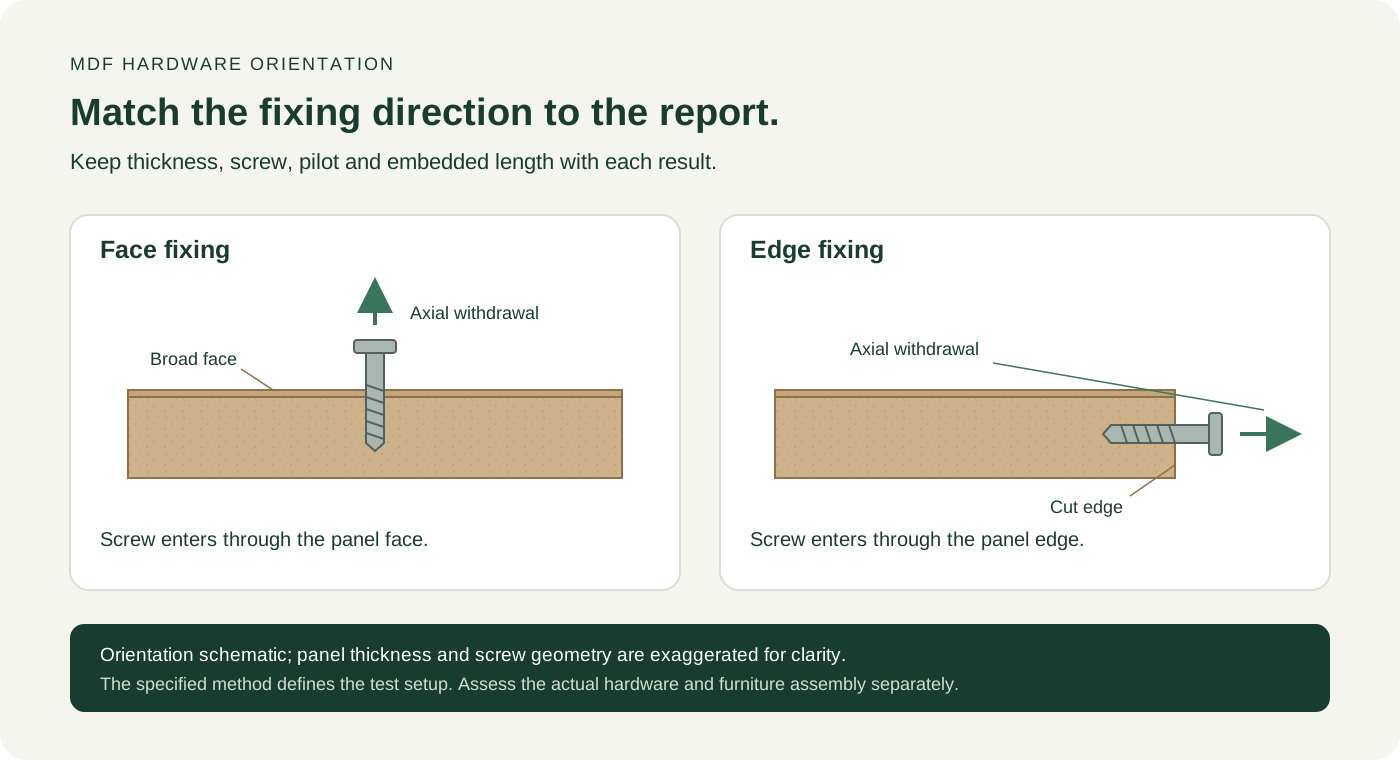
Face fixing enters the broad panel surface; edge fixing enters the narrow cut edge. EN 320 measures resistance to axial withdrawal of a defined screw. DIN Media's method overview states that its edge test applies to panels at least 15 mm thick.
This thickness scope matters when reading a report for thin panels. Ask which method and specimen arrangement supports any quoted edge result. For a comparison, retain the fixing direction, panel thickness, screw specification, pilot hole, embedded length and specimen conditioning with the force value.
View the face and edge fixing diagram to see the two directions. The drawing explains orientation; the actual method defines the test equipment and specimen preparation.
A hinge plate, drawer runner or cabinet connector can place several demands on a joint during use. The component review considers the real fitting, fastener pattern, installation and loads, alongside the material test. A reported withdrawal force is an input to that review; the assembled furniture has its own acceptance checks.
A published data-sheet reading example
The MEDITE PREMIER datasheet, V12-0224 provides a useful public example. An 18 mm panel falls within its column for thickness greater than 12 mm and up to 19 mm, which includes the following minimum specification values:
| Property in that column | Published minimum | Method listed |
|---|---|---|
| Internal bond | 0.45 N/mm² | EN 319 |
| Bending strength, MOR | 18.0 N/mm² | EN 310 |
| Modulus of elasticity, MOE | 1,600 N/mm² | EN 310 |
| Face screw holding | 1,000 N | EN 320 |
| Edge screw holding | 600 N | EN 320 |
These values belong to the named manufacturer's product and thickness band. Read them as the minimum specification values shown in that sheet. An individual laboratory result, a declared product specification and a design value each have their own meaning and conditions.
For a CUZI MDF order, request the information for the offered grade and thickness, with its applicable method and result type. That gives your purchasing team a comparable basis for the board being supplied. The sample and furniture design establish the hardware and assembly checks for your part.
Match pilot holes to the selected screw
The European Panel Federation's screw-fixing guidance recommends matching screw geometry and pilot preparation to MDF. Its general pilot-hole guidance uses 85–95% of the screw's core diameter, with sufficient depth for the intended penetration.
The core is the solid shaft between the thread roots; the overall diameter includes the threads. As a calculation example, a 4.0 mm core gives 3.4–3.8 mm at 85–95%. These are example inputs for reading the guidance. Select the actual drill and depth from the chosen screw manufacturer's instructions and a trial in your board.
Identify the screw or connector model before drilling the sample. Confirm pilot, clearance, counterbore or countersink dimensions as appropriate, along with the intended embedded length and remaining panel material. Use the fitting's installation instructions to set its preparation and assembly process.
Our MDF drilling and cabinet-hardware guide helps turn the hardware drawing into a drilling brief. The drawing should identify the reference face, hole positions and depths so your workshop and our factory prepare the same joint.
Plan the joint around its actual hardware
Use a labelled hardware set when preparing the first component. Include the hinge plate, runner, connector or shelf support and the exact fasteners that will be used in production. Record the fitting contact area, fixing positions and any instructions for torque or assembly equipment.
Choose fixing positions with the panel thickness, screw size, edge and corner distances, nearby holes and routed areas in view. When a design includes inserts, cams, dowels or face-mounted blocks, check the complete connection with the intended machining and assembly sequence.
If the furniture will be dismantled and reassembled, include that use in the trial. Agree the number of assembly cycles and the condition required afterward. For export furniture kits, send the installation sequence and identify which connections arrive assembled and which the buyer completes.
Make the sample representative of production
A useful hardware sample has the same grade, thickness, face construction, holes and cut edges as the supplied part. A faced panel, a deep-routed component and an unfinished board may need different sample details. Label the board and drawing revision so the result stays attached to its material and geometry.
For example, a buyer may choose an 18 mm side-panel coupon for a hinge-plate trial. The thickness is a sample-brief input. The brief still identifies the fitting model, screws, pilot dimensions, locations, finish and intended component. Trial loading and acceptance follow the furniture requirement agreed for that assembly.
Record installation, seating, visible face and edge condition, and the checks relevant to the joint's use. If the trial includes loading or repeated operation, retain the applied load, duration or cycles, observations and result. A changed screw, hole depth or board grade can then be reviewed through the same process.
Our MDF storage and conditioning guide explains how to retain the panel-condition record before machining and assembly. Keep sample preparation and conditioning consistent when comparing proposed materials or repeated batches.
What to request with your MDF quotation
Bring the material data and component drawing into one inquiry. This helps our factory prepare the board, sample and machining information your team needs for a useful comparison.
| Information to include or request | Detail that makes it useful |
|---|---|
| Product identity | Offered grade, core thickness, density specification and supplied faces |
| Mechanical requirement | Required property, units, method and minimum or other agreed acceptance value |
| Product document | Identified grade and thickness band, document date and value type |
| Laboratory result, where required | Sample identity, conditioning, method, individual or summary results and report reference |
| Hardware schedule | Manufacturer and model, screw geometry, pilot and insertion details |
| Drawing | Finished dimensions, hole datums, depths, edge distances and remaining sections |
| Furniture use | Span and supports, loads, service conditions, repeated assembly or operating cycles |
| Order | Quantity, supplied processing stage, protective packing and destination |
Specify whether you need product information, a laboratory test for a defined sample, or a component trial. Each request can then be quoted and scheduled with a clear scope. Use our quality page to review product-document and inspection arrangements.
For repeat supply, retain the agreed material requirements, accepted hardware sample and drawing revision with the purchase order. Ask our team to review any proposed material or machining change against those references before production.
Buyer review checklist
- Identify the furniture part, service conditions and loads.
- Select the mechanical properties needed for its board and connections.
- Compare the same grade, thickness, method, condition and result type.
- Record face and edge fixing as separate orientations.
- Provide the actual hardware, pilot preparation and component drawing.
- Check a representative sample through installation and intended use.
- Keep the material, fitting, drawing and trial record together for repeat orders.
Questions buyers ask
Is higher-density MDF always stronger?
Use density to describe mass per volume and request the mechanical properties needed for the part. Compare the offered grades at the same thickness and test conditions. Your furniture design and sample determine which specification suits the component.
What is the difference between MDF bending strength and stiffness?
Bending strength, often MOR, describes failure stress in the stated test. MOE describes stiffness. A shelf review considers both, together with span, thickness, supports, load and the deflection acceptable for the assembled furniture.
What does MDF internal bond strength tell me?
It describes tensile strength perpendicular to the panel plane under its test method. Use it in the grade review and request the relevant fixing and component data when assessing a hardware joint.
Can I compare face and edge screw-holding numbers?
Read them as separate fixing directions, with the thickness, defined screw and test method attached. Select the result that matches the connection being considered, then check the actual fitting in the component.
Can a screw-withdrawal result be used as a shelf load rating?
The withdrawal result describes a particular axial screw test. A shelf rating comes from the completed design and the relevant assembly assessment, including panel bending, supports, connections and intended loading.
What pilot-hole size should I use for MDF?
Start with the chosen screw or fitting manufacturer's instructions and identify the screw core and overall diameters. Record the pilot diameter and depth with a trial in the actual grade and thickness, then carry the accepted preparation into the drawing.
Can CUZI MDF supply components drilled for my hardware?
Yes. Send the board requirement, fitting model, hole drawing and quantity. Our CNC MDF processing supply can include cutting, routing and drilling to the agreed drawing, with sample and inspection details confirmed for the part.
What should I send to request a useful sample?
Send the component drawing, grade and thickness, hardware model, screw details, finish and delivery address. Add the property or assembly question the sample needs to answer. We can discuss the sample preparation and supporting product information with your request.
Discuss your order with our factory
CUZI MDF manufactures and supplies boards and machined MDF components from Shuyang, Jiangsu, China. Explore Raw MDF, Thick MDF Board or CNC MDF Processing, then send us the drawing, material requirements, hardware, quantity and destination. We will help prepare the supply specification, sample plan and written quotation.
Request technical information, request samples or request a quotation. We reply within 12 hours. Samples across our range are free and generally in stock; you pay courier costs, which can be credited against a formal order. Custom preparation, dispatch and estimated transit timing are confirmed for your request.