
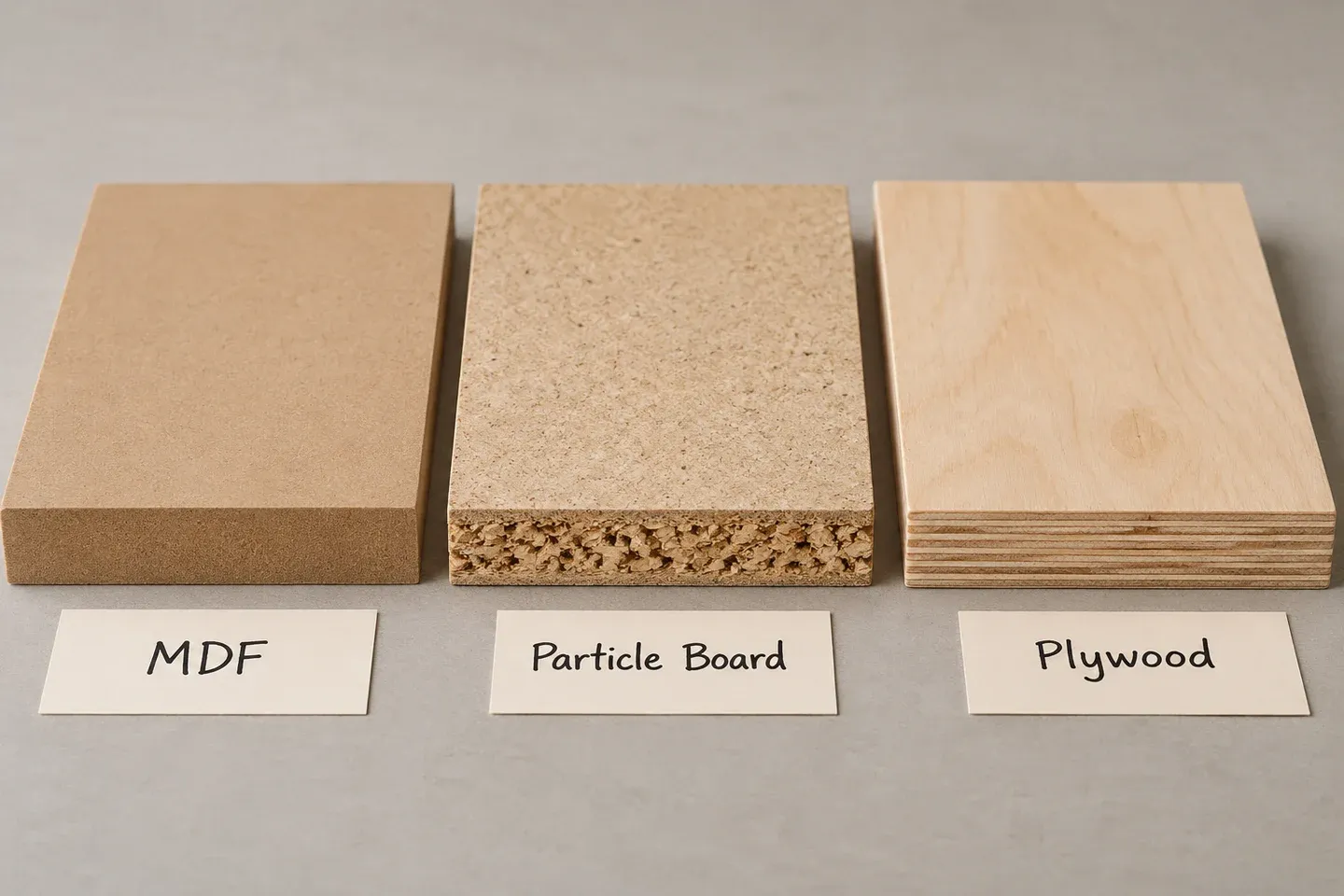
This guide helps you choose by component.
A cabinet can use more than one panel material successfully. The purchase that works best for a shaped door may differ from the purchase that works best for a straight, edge-banded shelf. Bring the component drawing into the comparison and your quotation becomes much more useful.
MDF vs particle board: the practical difference
MDF is made from refined wood fibres. Particle board, also called chipboard, uses wood particles, commonly with finer material near the faces and coarser material in the core. Both are used as furniture substrates, as explained by Oklahoma State University Extension. Their cut edges reveal different structures even when a decorative face looks similar.
For your buying decision, separate three things: the panel grade, the surface you want and the component you are making. “White board” describes appearance; the quotation should also identify the core, face and reverse construction, thickness and edge treatment.
Plywood has a third construction: bonded veneer layers with alternating grain directions. APA explains this cross-laminated structure. Its suitability follows the particular veneer construction, grade, bond classification and component design.
MDF, particle board and plywood compared
| Purchasing question | MDF | Particle board | Plywood |
|---|---|---|---|
| What does the exposed core look like? | Fine, compressed wood fibres | Visible wood particles | Bonded veneer layers |
| Which furniture task is a useful starting point? | Painted fronts, routed details and smooth-faced components | Straight, faced and edge-banded cabinet parts | Components selected for a specified veneer construction and grade |
| What should the machining sample show? | Profile, cut edge, drilled holes and coating preparation | Cut quality, holes, edge band and connector fit | Veneer cut quality, holes, ply condition and finished edge |
| How should the surface be specified? | Raw, painted, melamine or another selected facing | Raw or the selected decorative facing | Face veneer, overlay or finish, plus reverse |
| What determines performance? | Actual grade, thickness, properties and assembly | Actual grade, thickness, properties and assembly | Veneer construction, grade, thickness, properties and assembly |
Use this table to shortlist materials. Choose the final panel using current product information and a representative component, with the same support, hardware and service conditions.
Choose the material by furniture component
Painted doors and routed fronts
MDF's fine-fibre structure and smooth surface make it a practical starting point for shaped, painted fronts. Our Paint Grade MDF page explains the board and coating preparation. Ask for a sample with your actual profile, including the deepest recess and visible edge, then assess it through the intended primer and topcoat sequence.
Carcasses, shelves and straight panels
Faced MDF and faced particle board can both enter this comparison. Specify the decor, reverse, finished thickness, edge band and connector layout together. Compare usable cutting yield, assembly fit and finished cost for the same cabinet part. Melamine MDF is our MDF-core option for these decorative furniture surfaces.
Backs, drawer bottoms and supported inserts
Start with the groove or rebate, unsupported area, fixing arrangement and expected use. The part needs the appropriate fit and support as well as a suitable material. Our hardboard, MDF and HDF comparison helps narrow those thin-panel choices.
Components with a defined load or frequent movement
For a shelf, desk top or hardware-bearing part, provide the span, supports, expected loading and use. Request the properties relevant to that design and check the assembled component. Plywood may also enter the shortlist; our MDF vs plywood guide expands that comparison. A useful selection gives the designer enough information to assess the finished assembly.
Painting, routing and edge banding
Plan the finish before the cutting schedule. For painted MDF, record face sanding, edge preparation, primer, topcoat and the appearance of corners and profiles. A coated first component shows your team the finish it will actually produce.
For melamine-faced panels, compare the face and the edge as one visual set. Record edge-band material, thickness, colour, texture and corner detail. Check the cut and edge-banding result on the actual substrate, using the proposed tooling and adhesive process. The same decorative colour can be applied to different cores, so a melamine finish and an MDF core are separate specification choices.
For routed work, include cutter geometry, recess depth, remaining section, datum and drawing revision. A sample of the most demanding feature is more useful than an untouched colour swatch. Keep that sample and its processing settings available for the first batch and repeat orders.
Screws, hinges and shelf support
Evaluate the connection you will use. Record whether the fastener enters the face or edge, its size and embedment, pilot-hole diameter and depth, edge distance and installation torque. Include the hinge cup, cam fitting or dowel arrangement on the component drawing.
Request relevant product data and run the connection through the intended assembly and use checks. Different grades within a panel family can perform differently. For shelving, thickness works together with span, support and load duration; your component design determines the required stiffness and acceptable deflection.
Density is useful for estimating mass and comparing identified grades. Record it alongside the mechanical properties needed for the part. This keeps handling weight, shelf design and fastener performance as distinct purchasing checks.
Compare the cost of a usable finished part
A fair MDF vs particle board cost comparison starts with the same finished specification. Ask each quotation to show its board or component basis, quantity, currency and delivery term. Then put your own downstream costs alongside the supplied price.
| Cost line | Keep the comparison consistent |
|---|---|
| Panel purchase | Match grade, input size, thickness, face and reverse; align price units |
| Cutting yield | Use the same part list, kerf, grain direction and usable offcut assumptions |
| Secondary work | Include drilling, routing, edge banding, sanding and coating where required |
| Production quality | Use your trial results for accepted yield, rework and rejects |
| Delivery | Include packaging, freight and applicable landed charges on the same delivery basis |
Divide the comparable total by the number of acceptable finished parts. This makes a lower board price meaningful only after you have included the work needed to reach the same result. Your purchasing team can then compare a full-board quotation with a machined-component quotation using a common finished-part basis.
A sample brief for a fair shelf comparison
This example is a purchasing worksheet, with a chosen 600 × 400 × 18 mm shelf as the comparison part. The dimensions are example inputs; final shelf design and loading follow your own drawing.
| RFQ field | Example instruction |
|---|---|
| Component | Shelf S01, drawing revision A, 600 × 400 × 18 mm finished size |
| Alternatives | Quote identified melamine MDF and melamine particle-board grades separately |
| Appearance | Same physical decor reference, agreed texture, gloss and reverse |
| Edges | Same edge-band reference and finished corner detail on all visible edges |
| Assembly | Same support positions and hole schedule, supplied with the drawing |
| Use | State service environment, span, expected load and acceptance checks |
| Commercial basis | Same quantity, pack requirement, destination and delivery term |
Compare the labelled panel samples first, then produce the shelf using each proposed construction. Record dimensions, face condition, edge quality, hole fit and the agreed assembly checks. Keep the selected grade and sample reference with the order so the next batch follows the same specification.
For raw panels, this example part occupies 0.00432 m³: 0.600 × 0.400 × 0.018. Multiply that volume by the quoted panel density to calculate its core mass. A faced, edge-banded part has additional materials; its measured finished weight is the better input for handling trials. This calculation describes volume, rather than a tested strength or load rating.
Weight, packaging and shipment planning
Build the loading plan from the actual sheet or part schedule. Confirm density, net panel mass, facing and edge materials, bundle count, bearers and protective packaging. Use gross pack weight and external packed dimensions when assessing freight and container loading.
For finished furniture parts, agree separators, visible-face protection, supported edges and part labels. Labels should connect each pack to the order and component schedule so your receiving team can locate the correct pieces efficiently. For a mixed order, keep the different constructions identifiable through packing and inspection.
Buyer review checklist
- Identify each component and the reason for comparing materials.
- Match finished dimensions, faces, reverse, edges and machining across quotations.
- Provide supports, hardware, service conditions and the required component checks.
- Request grade-specific documents required by your destination and intended use.
- Compare total cost per acceptable finished part, including delivery.
- Retain the selected sample, grade and drawing revision for production and repeat orders.
Questions furniture buyers ask
Is MDF better than particle board for furniture?
MDF is a useful starting point for painted or routed fronts. For faced carcasses and shelves, compare the offered grades, edges, hardware, support and finished cost. A furniture design can use different materials for different components.
Is particle board the same as chipboard?
Chipboard commonly means particle board in furniture purchasing. Put the actual panel grade and construction on the quotation so your team can identify the product consistently across markets.
Is melamine board always MDF?
Melamine describes the decorative facing. The core may be MDF or particle board. Specify the core separately, along with the face, reverse and finished thickness. Our raw MDF vs melamine MDF guide explains the MDF supply options.
Which material holds screws better?
Compare the identified grades with the actual fastener, face or edge location, pilot hole and embedment. Product data and a representative assembly check support a useful connection decision.
Which material is cheaper?
Compare equivalent grades and finished specifications on the same quantity and delivery basis. Include cutting yield, machining, edging, coating, quality losses and freight to find your cost per usable part.
Which material should I use near moisture?
Select the grade for the exposure and coordinate face, cut-edge, joint and hardware protection with the furniture design. For humidity-sensitive interiors, review our Moisture Resistant MDF options and the documents for the proposed construction.
Can CUZI MDF help compare samples for my component?
Yes. Send the drawing, finish reference, quantity and destination. Our factory can discuss the MDF grade, surface and machining needed for your part, then confirm the sample and quotation details with you.
Discuss your order with our factory
CUZI MDF manufactures and supplies MDF from Shuyang, Jiangsu, China. Whether you need Raw MDF for your own processing, melamine-faced boards or paint-grade panels, send us the component and the finish you want to achieve. We will help turn that requirement into a clear MDF specification and written quotation.
Samples across our range are free. The buyer covers courier costs, which can be credited against the formal order. Samples are normally available from stock; custom preparation, dispatch and transit timing are confirmed for your request. We respond to inquiries within 12 hours.
Request a quotation or request samples. Your quotation includes the agreed specifications, quantity, price and currency, packaging, delivery term and place, lead time, payment conditions and validity.
Further technical reading
Oklahoma State University Extension: wood-composite substrates for cabinet manufacturing explains MDF and particle-board construction. APA: plywood construction and grade selection explains veneer layers and grade considerations. Use the current documents for the panel you are buying alongside these general references.