
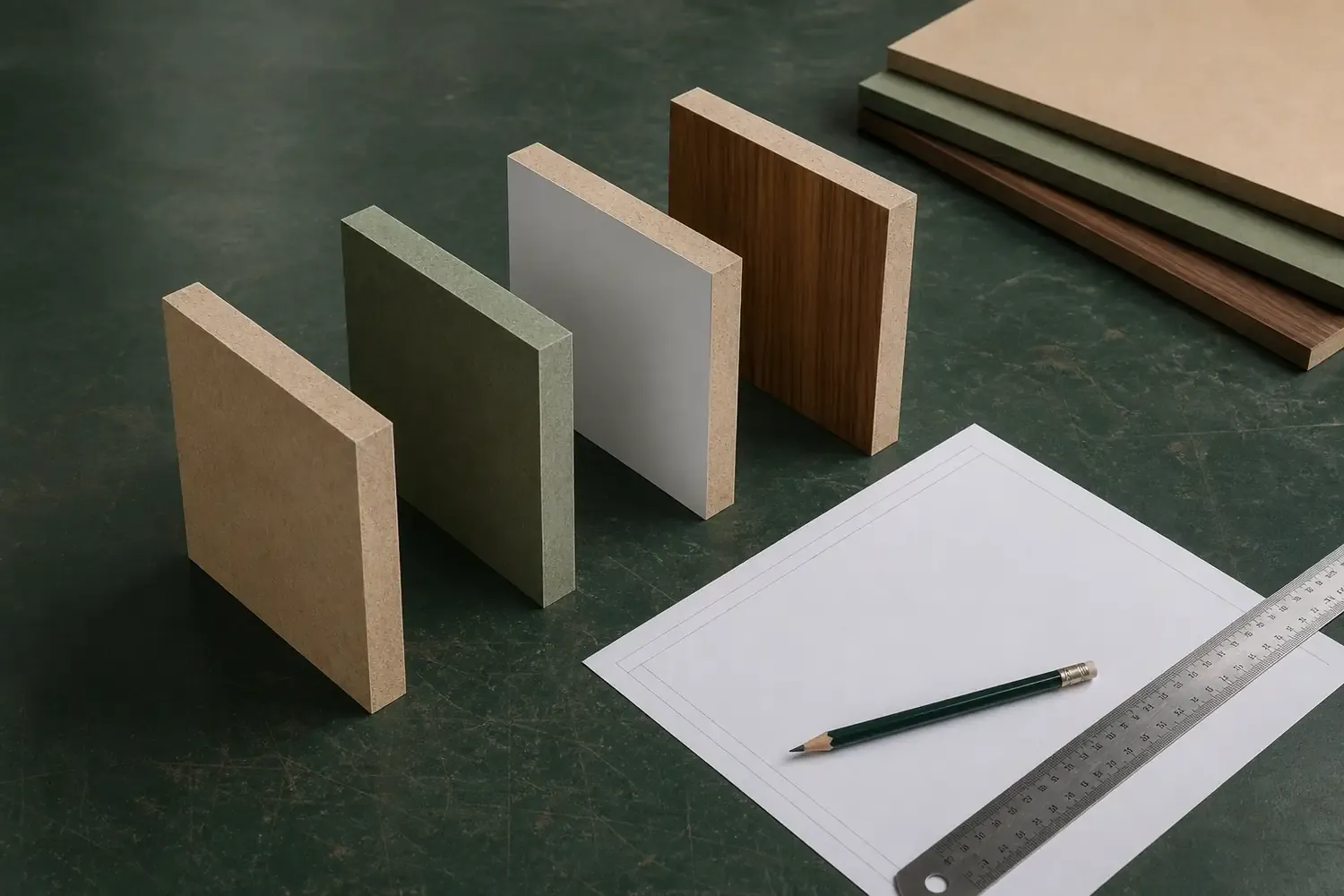
MDF and plywood use different panel constructions and suit different component, machining, appearance and service requirements. A useful comparison places two identified products against the same finished component and purchasing scope.
Compare panel construction
MDF is formed from prepared wood fibres and a bonding system, producing a relatively uniform core and smooth faces. Plywood is formed from veneer layers with grain direction arranged through the panel. These constructions create different edge appearance, machining behaviour and product data.
Compare surfaces and edges
Raw MDF supports smooth painting, routing and faced-panel production. Plywood may offer a visible veneer face or receive overlays and coatings. Compare both faces, edge construction, supplied sanding and finishing work as the basis for selection.
Compare machining
Use representative samples for sawing, routing, drilling, pockets, grooves and fastener details. MDF offers uniform routing characteristics; plywood machining interacts with veneer layers and core construction. Tooling, geometry and acceptance should match the exact offered panel.
Compare support and component design
State span, load path, frame, fixings, hardware and finished weight. The furniture or project designer selects the complete panel and support system. Review a representative assembly with the actual thickness and hardware.
Compare moisture and service conditions
Describe humidity, splash, cleaning, ventilation and direct-water exposure. Standard, MR and HMR MDF provide different protected-interior options. Plywood moisture performance also follows its exact grade, bonding and test reports. Match each product to the defined condition.
Compare finish and appearance approval
Use physical references for paint, veneer, laminate, melamine or another finish. Record natural variation, grain direction, texture, gloss and edge match. Compare complete finished components where the surface constructions differ.
Compare documents by product coverage
Keep emission, moisture, fire, structural or destination documents connected to the identified MDF or plywood product, construction, thickness, method and dates. Each material’s documents support its own quoted scope.
Compare commercial scope
Normalize thickness, dimensions, quantity unit, supplied surface, machining, edges, packaging and delivery basis. Include downstream finishing and reject risk when one offer is raw and another is finished.
Prepare a material comparison RFQ
Send component drawings, service environment, product options, thickness, surface, processing, quantity, required documents, packaging and destination. Use MDF for Furniture Components and request a specification review.