
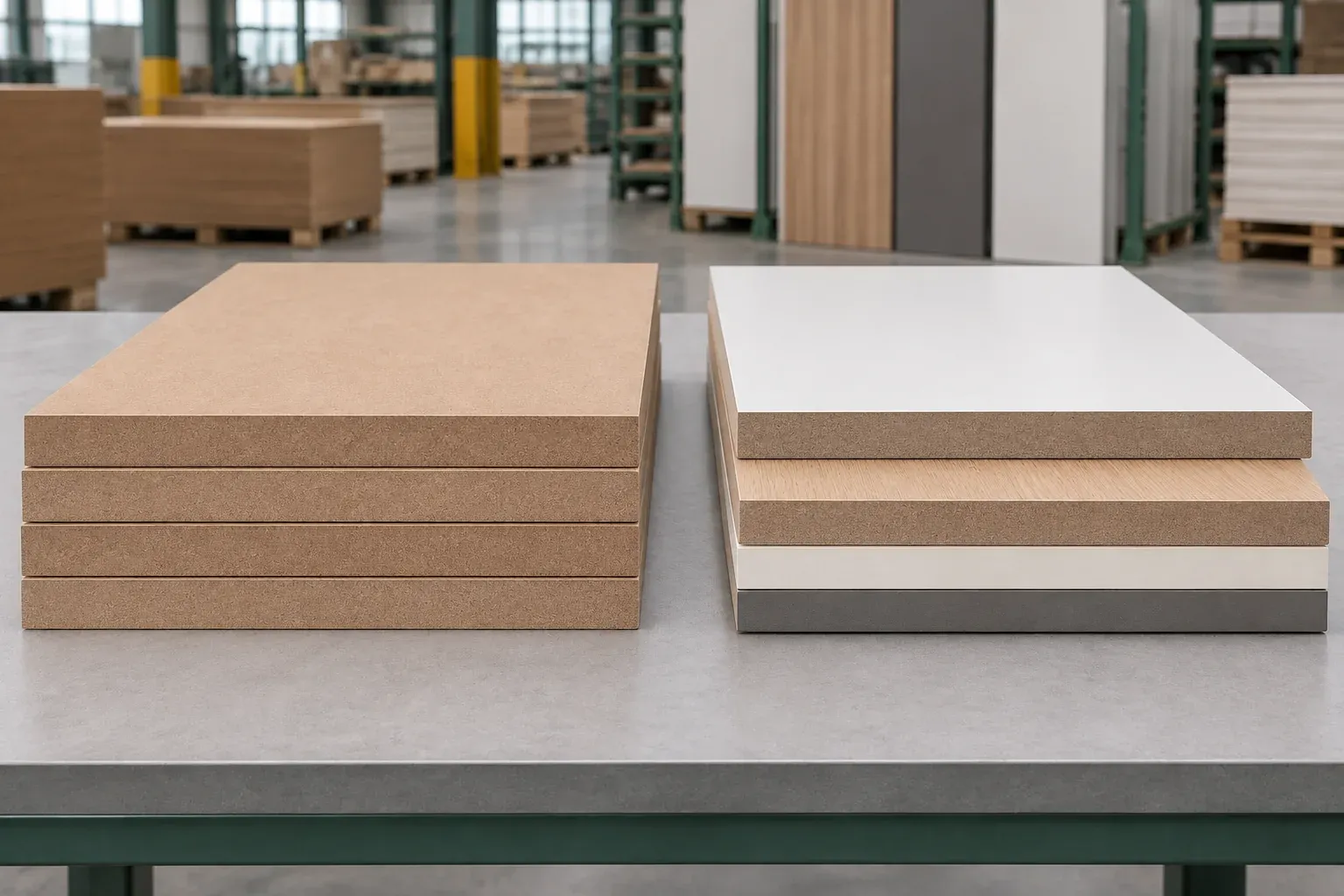
Raw MDF supplies a smooth sanded substrate for a buyer-controlled finishing process. Melamine MDF supplies an MDF core with an identified decorative face and reverse construction. Compare the two options through the finished component, remaining factory work and total delivered cost.
Compare what arrives at the factory
The two products represent different production stages.
| Comparison point | Raw MDF | Melamine MDF |
|---|---|---|
| Supplied surface | Sanded, smooth MDF faces prepared for further processing | Identified melamine decorative construction on the MDF core |
| Primary buyer decision | Select and control the downstream paint, veneer, laminate or pressing process | Approve decor, texture, gloss, direction, face and reverse construction |
| Work commonly remaining | Cutting, machining, surface preparation, finishing, curing and protection | Cutting, drilling, edging, part identification and decorative-face protection |
| Appearance reference | Substrate and finished-process sample | Physical melamine sample or finished corner |
| Typical component option | Painted or buyer-finished furniture parts, routed profiles and panel substrates | Flat cabinet parts, wardrobe panels, office furniture and repeat decorative components |
The purchase order should identify whether the quoted item is a raw sheet, a surfaced full sheet or a finished component. This keeps price and acceptance criteria connected to the same stage of manufacture.
Choose the option from the work the buyer wants to control
Raw MDF places the finishing system with the buyer or the buyer’s selected processor. It fits orders where painting, veneer pressing, laminate bonding, routed profiles or another downstream surface process is part of the buyer’s production plan. Melamine MDF places the decorative face construction into the panel supply. It fits orders that need an approved colour or woodgrain surface ready for cutting, drilling and edge completion.
| Buyer priority | Option to evaluate first |
|---|---|
| Buyer controls paint, veneer, laminate or a specialist finish | Raw MDF |
| Repeat flat decorative panels with an approved melamine face | Melamine MDF |
| Deep routed face or profile that receives a continuous coating | Raw or Paint Grade MDF with a finished profile trial |
| Cabinet carcass or wardrobe components with repeated décor | Melamine MDF with matched edge and hardware details |
| Mixed visible and concealed component faces | Component schedule assigning the correct construction to each part |
The final choice follows the finished component, available processing equipment, appearance approval and accepted output cost.
Compare the indicative board-supply ranges
Current CUZI MDF website planning ranges use different supply bases:
| Product | Indicative range | Supply basis |
|---|---|---|
| Raw MDF | US$138–260 per m³ | Board supply |
| Melamine MDF | US$190–380 per m³ | Surfaced board supply |
These ranges support early budgeting. The order quotation depends on core thickness and density, board format, emission requirement, melamine construction, colour or decor, texture, quantity, packing, delivery basis and destination. Compare quotations only after both options describe the same finished component and delivery scope.
Normalize the MDF core before comparing surfaces
Use the same core thickness, density requirement, board format, tolerance and emission class when the objective is to compare finishing processes. For melamine MDF, confirm whether the quoted thickness describes the input core or the completed faced panel. Record face and reverse construction, finished thickness and direction on the same quotation line. A matched core basis shows which cost and production differences come from the decorative construction and which come from a different MDF product.
Build the total component cost
Convert each option into the cost of one accepted finished component.
**Raw MDF option:** board + cutting and machining + surface preparation + paint, veneer, laminate or pressing material + finishing labour + curing or pressing + inspection + protective packing.
**Melamine MDF option:** surfaced board + cutting and drilling + edge band or exposed-edge treatment + part labels + inspection + decorative-face protection and packing.
Add material yield, setup, sample approval, secondary handling and the expected accepted-output rate for each production line. A buyer with an established coating or laminating line may obtain value from raw MDF, while a buyer seeking a repeat decorative surface may reduce downstream work with melamine MDF.
Calculate yield and work-in-process cost
Compare the quantity that reaches assembly in accepted condition.
| Cost and yield input | Raw MDF option | Melamine MDF option |
|---|---|---|
| Source-board yield | Nested or cut parts per sheet | Nested or cut parts per surfaced sheet with decor direction |
| Setup and trials | Machining plus complete finish-system trial | Decor, edge and first-component approval |
| Work in process | Sanding, cleaning, pressing or coating, curing and intermediate handling | Face-protected cutting, drilling, edge processing and identification |
| Acceptance point | Finished face, edge, profile, colour and coating result | Decor, texture, direction, edge match and machining result |
| Rework method | Surface preparation or coating action defined by the finish process | Part remake or approved decorative-surface action |
**Cost per accepted component = total route cost ÷ accepted components released to assembly.** This connects board yield, processing time, quality acceptance and protective handling to the commercial decision.
Match the product to the component geometry
Component geometry defines which surface construction fits the work.
| Finished component | Practical review process |
|---|---|
| Flat cabinet side, shelf or wardrobe panel | Melamine face/reverse construction, cutting, edge banding and drilling |
| Painted slab door or routed front | Raw or paint-grade MDF, routed sample, edge preparation and complete coating system |
| Veneered or separately laminated panel | Raw MDF core plus the selected facing, adhesive, balance and finishing process |
| Flat office-furniture part with repeated decor | Melamine MDF with approved decor, texture, direction and edge reference |
| Mixed visible and hidden faces | Construction schedule that identifies each face, reverse and exposed edge |
Use the actual component drawing and visible-face schedule. This connects the surface selection with machining, edge work, hardware and assembly.
Place machining in the production sequence
Raw MDF can be cut or routed first so the faces, exposed edges and profiles enter one coordinated preparation and finishing process. Melamine MDF usually enters component production with its decorative faces complete; cutting and drilling follow the approved decor direction, while visible cut edges receive the specified banding or finish. A routed area through the melamine face exposes the MDF core, so the drawing should identify the intended appearance and treatment for that feature. Approve a representative part from the selected sequence before repeat production.
Assign surface responsibility through the process
For raw MDF, identify the party responsible for substrate approval, machining quality, sanding, cleaning, primer or adhesive compatibility, finish application, curing and final appearance. For melamine MDF, identify the party responsible for the approved decor reference, surface pressing, cutting protection, edge solution, hardware machining and finished-part acceptance. Record these responsibilities beside the sample and drawing revisions. Every visible surface then has a named process owner and a defined inspection point.
Specify the core and finished construction separately
Both options begin with an MDF core. State core thickness, thickness tolerance, density, input-board format and E0, E0.5 or E1 destination requirement. For melamine MDF, also state the decorative layer on each face, finished thickness, grain or pattern direction and edge construction. CUZI MDF reference core formats are 1220 × 2440 mm, 2100 × 2800 mm, 1830 × 3660 mm, 1830 × 2440 mm, 2440 × 3660 mm and 1830 × 4200 mm. Confirm the selected product, thickness and format combination in the quotation.
Approve appearance with the right reference
Raw MDF approval records the substrate, supplied sanding and the downstream finish trial. Include a face, cut edge and representative routed profile when the final appearance covers all three. Melamine MDF approval records the physical decor reference, colour, printed pattern, texture, gloss, direction, face/reverse construction and finished edge. Review a larger panel when pattern scale or direction affects adjoining components, and retain the approved reference for repeat orders and replacement parts.
Control repeat orders and replacement parts
Retain the raw MDF product identity together with the approved downstream finish-system record, including preparation, materials, colour reference and completed sample. For melamine MDF, retain the core construction, physical decor reference, texture, gloss, grain direction, face/reverse construction, edge reference and batch record. Replacement parts should carry the original component ID and visible orientation. The supplier can then compare current material availability with the retained reference and present any required approval step before production.
Plan handling and export protection
Raw MDF requires clean, dry, flat support that preserves the sanded faces for the next process. Melamine MDF adds a finished decorative surface that benefits from clean separators, face protection, controlled strap pressure and an agreed protective-film method where applicable. Define pack dimensions, supports, top and bottom cover boards, corners, edges, straps, bundle weight, labels, destination and unloading method from the actual board size, quantity and surface sensitivity.
Inspect each option at its correct acceptance stage
Raw MDF receiving checks can confirm product identity, quantity, thickness, dimensions, face condition, edge condition and pack protection. The buyer’s finishing process then adds its own trial and finished-appearance acceptance. Melamine MDF inspection adds decor identity, colour and texture reference, face/reverse construction, direction, surface condition, edge solution and protective handling. For processed components, inspect dimensions, drilling, part identity and visible finish after the relevant operations are complete. Link results to the approved sample, drawing and purchase-order revision.
Prepare a comparable RFQ
Send the same component and commercial basis for both options:
- finished component, application and service environment;
- raw MDF or melamine MDF option under review;
- core thickness, tolerance, density and board format;
- E0, E0.5 or E1 destination requirement;
- face, reverse, colour, texture, gloss and direction;
- finished thickness and exposed-edge treatment;
- cutting, routing, drilling and hardware details;
- physical sample and first-part requirements;
- quantity by specification or part number;
- packing, labels, destination and delivery basis.
The normal MOQ is 1 × 20'GP for each individual specification, and normal production lead time is 7–15 days after the specification, sample and commercial requirements are confirmed. Use the Raw MDF product page, Melamine MDF product page and Melamine MDF specification guide for the current supply option. Request a specification review with the component, quantity and destination.
Buyer review checklist
Before relying on this guidance, record the finished component, service environment, MDF product or unresolved product requirement, thickness, dimensions, supplied surface, visible edges, machining, hardware, quantity and destination. Identify which values need current technical documents and test reports and which appearance decisions need a physical sample.
For international supply, also confirm drawing and sample revisions, packaging construction, part or bundle labels, handling limits, required documents and the party responsible for finished-product design and destination compliance. Ask the supplier to list unresolved items and exclusions in the quotation, and keep every missing value visible for confirmation.
Compare quotations only after these inputs have been normalized. Check whether the offered price covers a full board, a faced construction, a machined part or a finished component, and whether samples, secondary work, protective materials and documentation are included. Record every change after approval so purchasing, production, inspection and receiving teams use the same revision.
Typical lead time is 7–15 days after requirements are confirmed. Final timing depends on specification, quantity, production scheduling and destination. This planning range covers production; arrival timing also depends on the confirmed logistics route.
Request an MDF quotation
Share the application, specification, quantity, packaging and destination with CUZI MDF for an order-specific review.