
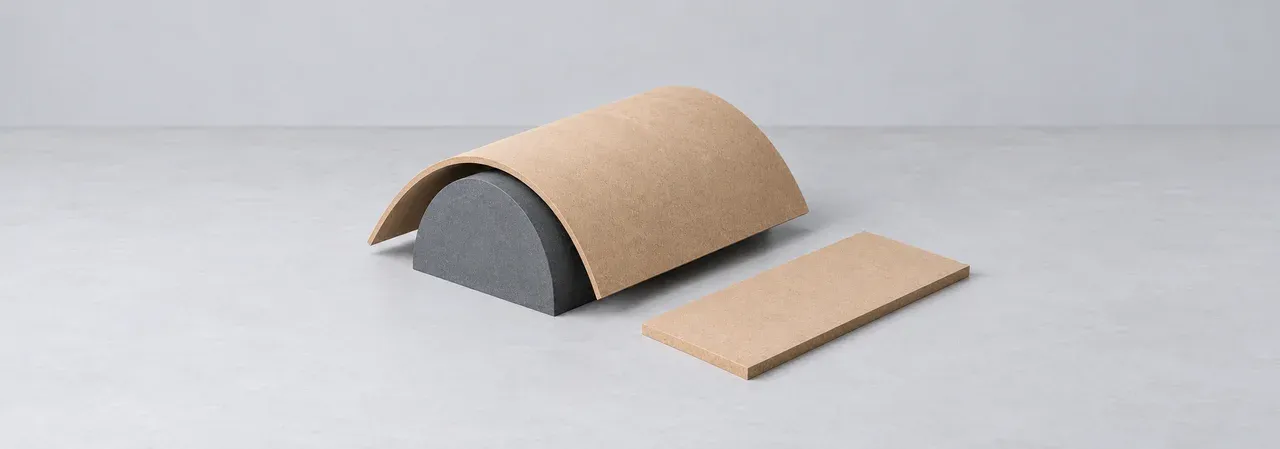
Mark the radius reference, bending direction and component dimensions, then confirm the selected board on a representative supported sample before repeating the part.
A rounded counter, furniture fascia or interior wrap begins with a clear drawing and a useful first sample. Our factory in Shuyang, China helps connect your curve to the supplied sheet, cutting layout and order specification. Start with the Flexible MDF product page for our confirmed supply, then use this guide to prepare the component review.
Choose the continuous sheet for your curved component
Our Flexible MDF is a whole thin board that bends directly, with continuous plain faces. The confirmed range is 3–6 mm, supplied for longitudinal bending. Consider it as a supported curved skin for protected dry-interior furniture and fittings, with the frame or former establishing the final shape.
Describe the finished part: a counter fascia, rounded cabinet side, column wrap or decorative wall module. Identify the visible face, open edges, support and attachment points. Those details help select the sheet and prepare a sample that represents the part your workshop will actually make.
The European Panel Federation's guide to curved MDF constructions describes several different forming processes. A quoted bending material needs its own construction and process description. The sheet covered here has continuous faces and bends as a whole. Grooved MDF Panels describe a separate machined-profile product, selected around its actual surface and application.
For an ordinary thin flat component, compare Thin MDF Board against its stated specification. For a curved component, bring the target geometry, sheet orientation, support and finishing process into the same sample review. A clear supplied construction makes the quotations easier to compare.
Name the radius reference on the drawing
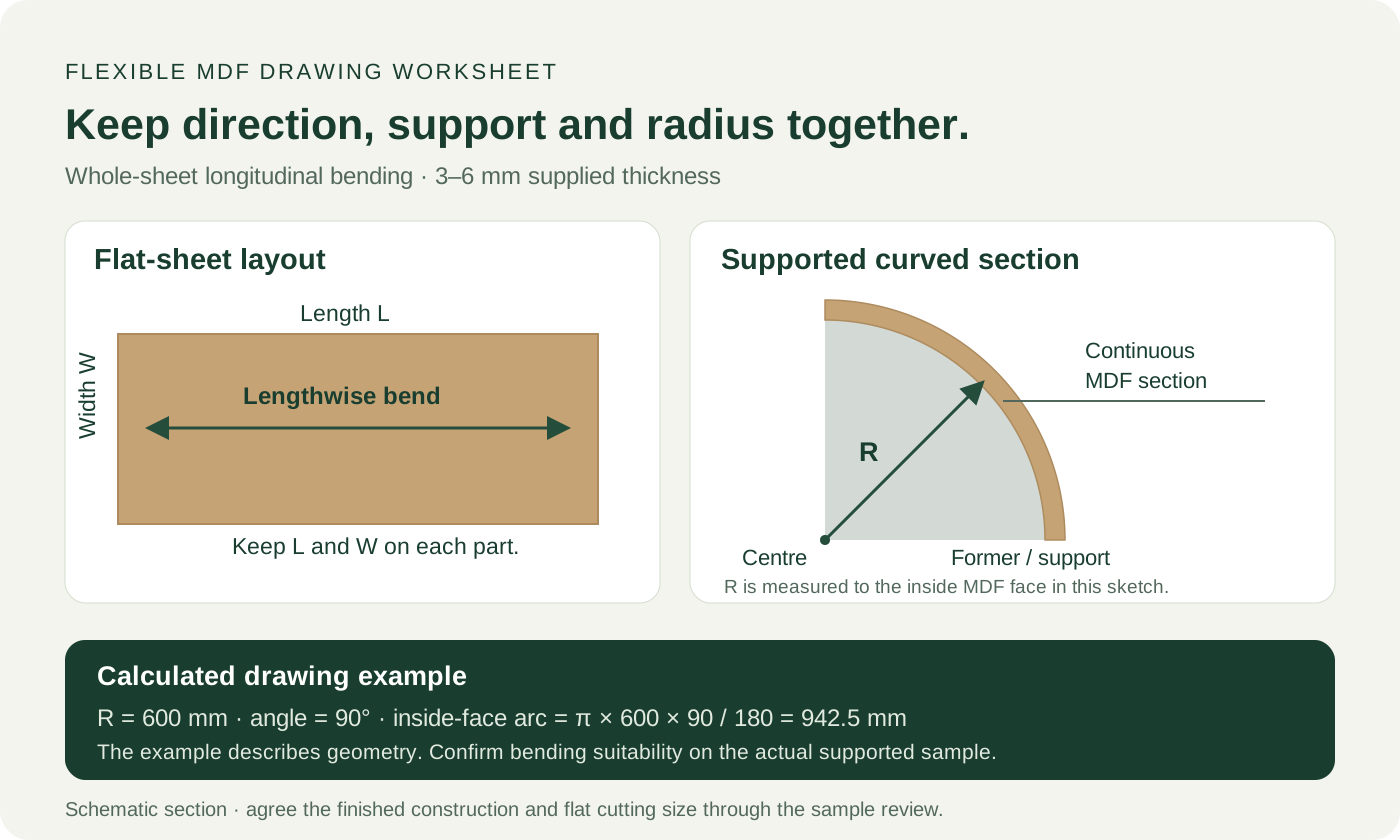
Show the curve in a section or plan view. Give the target radius and arc angle, or provide the profile as a dimensioned drawing. State whether the radius is measured at the inside MDF face, outside MDF face or final decorative surface. Include straight extensions, joints, finished height and the interfaces with neighbouring parts.
For a simple cylindrical curve, the inside and outside MDF faces lie at different radii because the panel has thickness. A coating, veneer or other decorative layer adds to the finished construction. Your drawing should identify the face used for the critical dimension so the former and completed component can be checked against the same reference.
Mark the point where a straight section meets the curve and define any fitting clearance. On an interior wrap, include the existing column or frame dimensions. On a counter, include the top, plinth and adjacent modules. These are practical fit requirements your first assembly needs to answer.
View the Flexible MDF drawing and radius guide for the lengthwise direction, reference radius and supported section. The diagram explains a drawing convention. The suitable bending radius is confirmed on the selected board and complete sample construction.
Keep lengthwise bending in the cutting layout
Mark the original sheet length and width, then show the lengthwise direction that follows the curve. For a simple cylindrical wrap, that direction runs around the curved profile; the other sheet dimension runs along the cylinder's axis. Keep the orientation visible on each component in the cutting plan.
When nesting several parts, retain the original-sheet reference. A rotated rectangle changes which supplied direction follows the curve. Review layout, component height and curved length together before agreeing the available sheet format and yield.
Give each part a code and revision. Identify its visible face, intended bend direction and position in the assembly. If adjacent parts have a veneer or patterned facing, add that decorative direction separately. The bending orientation and the surface pattern each need a clear reference.
Your drawing and cut-to-size specification should use the same units and dimensions. Share the proposed nesting with our factory so the quoted full sheets or cut components preserve the orientation needed for forming.
Select thickness with the frame and finish
Choose within the 3–6 mm range around the actual curve and complete component. Thickness affects how the sheet forms, how the face is supported and how the finished assembly fits its neighbouring parts. Compare the proposed options on the same former and with the same finishing plan.
The support is part of that choice. Describe the shaped ribs, continuous former or frame, the attachment method and the intended handling of the completed piece. Furniture loads and hardware are addressed in the complete assembly design; the thin curved face has its own forming and appearance requirements.
| Design question | Information to send | What the sample should establish |
|---|---|---|
| Which thickness within 3–6 mm? | Target curve, supported shape and finished build-up | Forming, face quality and fit for the chosen board |
| How is the curved face supported? | Former or frame profile, rib layout and attachment points | Contact, retained shape and supported appearance |
| Which surface will be visible? | Paint, veneer or facing, plus open-edge details | Surface preparation, bonding and final appearance |
| How does the part meet the assembly? | Top, base, neighbouring parts and fitting dimensions | Clearance, joint position and complete-component fit |
Use the thin or thick MDF guide for the wider component decision. For this flexible supply, agree the selected thin sheet and supported construction together. The first sample gives you a practical reference for repeat parts.
Confirm the radius on a representative sample
The suitable radius follows the actual thickness, lengthwise orientation, board condition, support, forming method and finish. A useful sample uses the intended curve and captures the features that matter in the full component, including transitions, visible edges and fixing positions.
Begin by recording the board identity and thickness, sample dimensions, direction and condition before forming. The European Panel Federation's moisture guidance explains how transport, storage and surrounding conditions can change MDF moisture content and dimensions. Record the conditions used for your trial so the result has a clear basis for repetition.
Form the sample on the agreed former or frame using the process selected for that board. Inspect the face, reverse and cut edges while supported. Check contact with the former, the critical fit dimensions and any local changes near an attachment or opening. Keep the forming and inspection sequence with the sample record.
Where adhesive is part of the construction, follow its supplier's preparation, pressure and curing requirements. Check retained shape in the state the part will actually be supplied or used, including after the specified cure and handling steps. Record any springback as a measured difference from the drawing reference, together with the support and measurement state.
| Trial record | Record from the actual sample | Why it matters for repetition |
|---|---|---|
| Board and specimen | Product, thickness, dimensions, lot and lengthwise direction | Identifies the material and orientation tested |
| Target shape | Radius reference, arc, former drawing and critical dimensions | Establishes the intended geometry |
| Condition and method | Storage or conditioning, forming process and support | Makes the forming conditions identifiable |
| Bonding and fixing | Adhesive, preparation, pressure or fixtures and cure instructions | Connects the result to the completed construction |
| Inspection state | Supported, cured or otherwise specified state and measurement time | Explains when and how the shape was checked |
| Observed result | Measured geometry, surface condition, fit and photographs | Provides the actual sample result used for approval |
This is a trial-record worksheet. Enter the observations and measurements from your specimen, then agree the selected construction and inspection criteria. A finished sample and its record give purchasing and production the same reference.
Plan forming, bonding and the decorative finish together
Decide which operations take place on the flat sheet and which take place on the formed assembly. Include any bonding layers, balancing construction, primer, topcoat or edge detail. Review the complete process with the selected material and finish suppliers, then use that sequence on the representative sample.
The European Panel Federation's adhesive guidance describes MDF bonding applications and the importance of appropriate adhesive selection. For a curved component, confirm the particular adhesive's instructions and the pressure or holding arrangement your fixture will provide. Keep the shaped support in the construction where the final design requires it.
For paint, check the prepared face and edges, sanding, sealing and coating on the curved sample. For veneer or another facing, include the decorative layer, adhesive and reverse construction in the forming review. The MDF surface finishing guide helps organise those inputs.
Inspect the cured surface under the lighting and viewing distance used for appearance approval. Check joints, edge build-up and transitions with adjacent parts. Retain the accepted sample or an agreed sample reference with the drawing so the finish and fit remain coordinated when the order is repeated.
Calculate the drawing path before finalising the blank
For a circular profile, the arc length at a stated reference line is L = π × R × θ / 180, where R is that line's radius and θ is the angle in degrees. Add any straight extensions to describe the complete reference path on the drawing.
The following is a geometry example for a buyer's proposed drawing. It illustrates a 600 mm inside-face radius and 90° arc, with a 100 mm straight extension at each end. The values describe the drawing path; bending suitability is established by the actual sample trial.
| Drawing input or result | Example value | Meaning |
|---|---|---|
| Radius reference | 600 mm at the inside MDF face | Names the line used for the calculation |
| Arc angle | 90° | A quarter-circle profile |
| Calculated arc length | π × 600 × 90 / 180 = 942.5 mm | Rounded length along the inside-face arc |
| Straight extensions | 100 mm at each end | Separate straight portions of the reference path |
| Calculated reference path | 942.5 + 100 + 100 = 1142.5 mm | Inside-face arc plus the two extensions |
The final flat blank is established with the actual material thickness, bend, joints and trimming allowance. Reference-face arc length and cutting length serve different purposes in the drawing review. Confirm the cut size through the sample fitting and trimming process, then record the accepted blank dimensions for repeat parts.
Provide an existing former, full-size template or component drawing where available. If the curve changes radius or includes several transitions, identify each section and the joining geometry. Our factory can review the supplied sheet and machining around that complete drawing.
Match machining and fixing to the thin supported face
List any shaped edges, openings and holes with the forming plan. Identify which features are cut before forming and which are positioned or finished on the assembly. Include datums and fitting clearances so the opening and its mating component can be checked in the finished state.
For CNC MDF Processing, send the complete part drawing, thickness, feature positions and the required supplied stage. Plan support for the thin material during machining and handling. Include the remaining material around a feature and the way the part will meet its frame.
Select the attachment system for the complete construction. Describe the frame material, attachment positions and how the thin face is held against the curve. Where screws or other hardware carry an assembly load, establish their engagement in the designed support and check the full connection on the sample.
For retail fixtures or interior wall panels, coordinate maintenance access, joints and installation sequence. Curved faces, flat panels and supporting parts can share a part schedule while retaining their own material and machining requirements.
Protect flat sheets and finished curved parts appropriately
State whether the order supplies flat full sheets, flat cut components or an agreed further-processed item. The packing and handling plan should describe the supplied state. Flat thin sheets need even support, clean contact protection and protected edges through storage and delivery.
Give the pack length, width, quantity and unloading arrangements with the quotation request. Keep the longitudinal direction and part references identifiable when components are separated for forming. For any agreed formed supply, confirm shape support, contact protection and the nesting or separation arrangement in its own packing specification.
Plan receiving space and the path from storage to the former or assembly station. Review sheet support during lifting and transfer, particularly where a long thin blank is being handled. Keep the boards in protected dry conditions appropriate to the intended indoor use and agreed forming process.
The MDF storage and conditioning guide explains flat support and moisture-condition checks. Use the agreed board, storage conditions and sample process as the reference for your production planning.
Buyer review checklist
A useful request can read: “Please quote Flexible MDF within your 3–6 mm range for a curved retail-counter fascia. The drawing shows the intended inside-face radius, arc, height and longitudinal bending direction. Please help confirm the suitable thickness and a representative sample for our supporting frame and painted finish.” Attach the drawing and add quantities, supplied dimensions, destination and required timing.
1. Identify the finished curved component and protected interior use. 2. Select the proposed thickness within 3–6 mm and mark whole-sheet longitudinal bending. 3. Name the radius reference, arc and straight transitions on the drawing. 4. Provide the original sheet orientation and proposed cutting layout. 5. Describe the former, frame, bonding and attachment system. 6. Include the face, reverse, edges and full finishing sequence in the sample review. 7. Record actual forming observations, measured shape, inspection state and fit. 8. Agree the accepted blank dimensions, part codes and drawing revision. 9. Confirm supplied stage, packing, documents and commercial terms in the quotation.
The drawing, trial record and finished sample support different parts of the decision. Keep them together with the accepted specification so our factory and your workshop can repeat the same supplied component and checks.
Frequently asked questions
What Flexible MDF construction does CUZI MDF supply?
We manufacture and supply 3–6 mm Flexible MDF for longitudinal bending. The whole thin sheet bends directly with continuous plain faces. Select the board around your supported curved component and confirm its forming and finishing on a representative sample.
What is the minimum bending radius for 3 mm or 6 mm MDF?
We confirm the suitable radius for the actual thickness, longitudinal direction, board condition, former or frame, forming method and finish. Send the required curve and complete construction so the sample trial can establish the selected board and agreed radius.
What does longitudinal bending mean on my component drawing?
Mark the original sheet length and the direction that follows the curve. For a simple cylindrical part, that direction runs around the curved profile, with the other dimension along the cylinder's axis. Retain the reference when cutting and labelling parts.
Which face should the radius dimension refer to?
Name the inside MDF face, outside MDF face or final decorative surface on the drawing. Include thickness and finishing build-up so the former and final component are checked against the correct reference.
Can I use the calculated arc length as the flat cutting length?
Use arc length to define the stated drawing path. Confirm the final flat blank on the actual supported sample, including material thickness, joints and trimming allowance. Record that accepted blank size for repeated components.
Can I paint or veneer the curved panel?
Yes, plan the chosen finishing process with the supplied board and supported curve. Trial surface and edge preparation, bonding, reverse construction and the complete forming sequence. Keep the accepted finished sample as the appearance and fit reference.
How should the curved face be supported?
Use the former, shaped frame or other support defined by the component design. Describe the support profile and attachment method, then check contact, retained shape, joints and the complete assembly on the sample.
How is this supply different from a grooved MDF product?
This guide covers a continuous plain sheet that bends as a whole. Grooved MDF Panels are a separate machined-profile supply. Specify the actual construction, surface and intended application when comparing the offered materials.
What should I send to request samples and a quotation?
Send the drawing or sketch, thickness options, radius reference, bend direction, dimensions, quantity, support, finish and destination. Add your required supplied stage and documents. We confirm the representative sample and written supply terms for the proposed order.
Discuss your order with our factory
Bring the curve you want to create to CUZI MDF. Our Shuyang factory supplies the thin board and helps connect your drawing, longitudinal orientation and sample plan to the product specification. We reply within 12 hours, then confirm available sheet format, cut layout, quantity, MOQ, packing, price and currency, production schedule and required documents for this order.
Samples are free across our range and normally available from stock. Buyers pay the courier charge, which can be credited against the formal order amount. We confirm any preparation needed for the representative sample, dispatch and estimated transit timing for your request.
The written quotation includes the specification, supplied processing stage, quantity, price and currency, packing, FOB Qingdao or FOB Lianyungang, lead time, T/T or L/C terms and validity. Buyer-arranged third-party inspection is supported; shipment ports are Lianyungang or Qingdao. Production and sample timing are confirmed for the actual Flexible MDF order.
Request a Flexible MDF sample, discuss the curve and drawing, or request a quotation.
The cover image illustrates a supported whole-sheet curve. The geometry example explains a drawing calculation. Actual bend suitability and accepted component dimensions are established in the representative sample and its order records.