
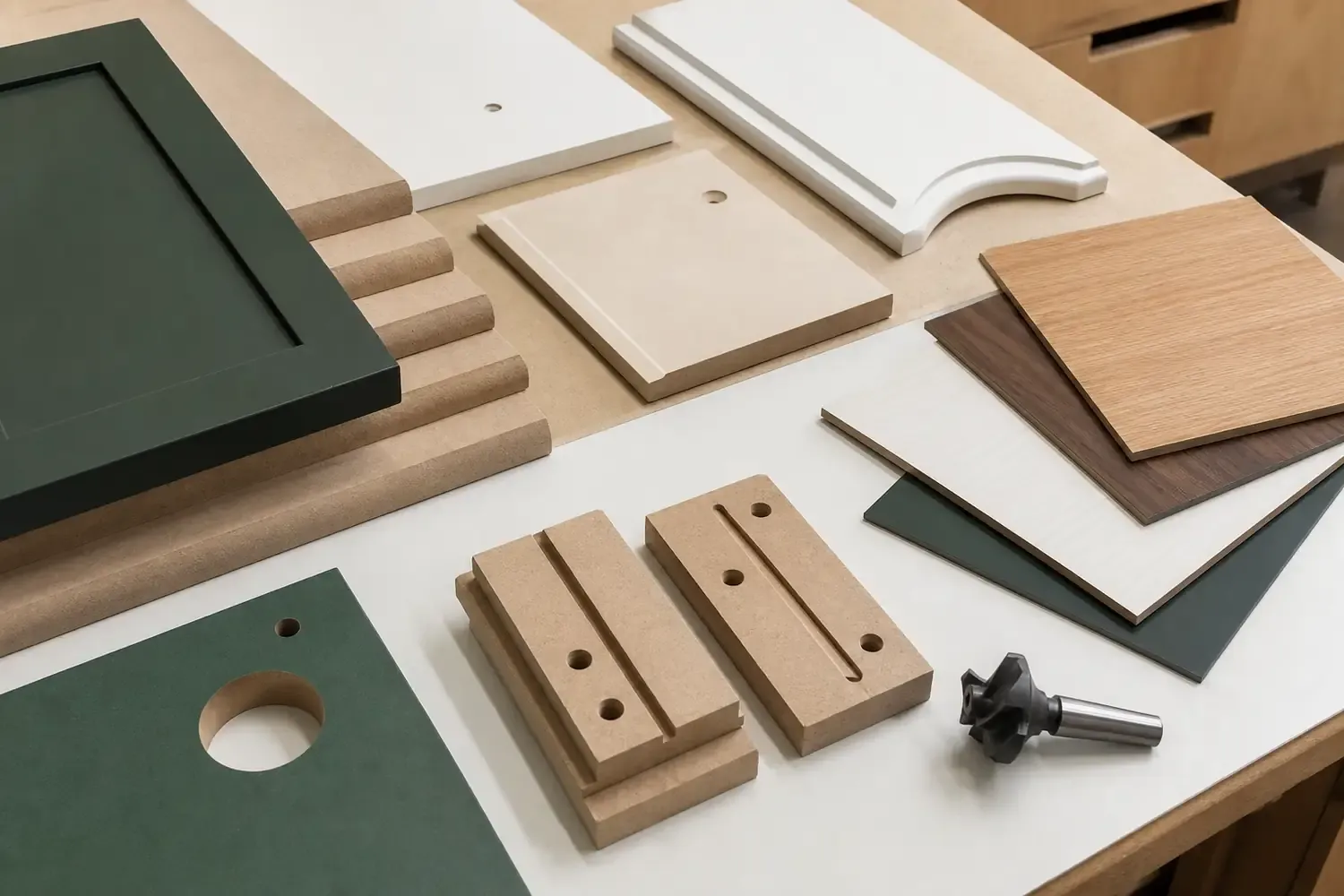
MDF surface finishing starts with the complete supplied construction. Buyers should connect the MDF substrate, front and reverse faces, cut edges, routed geometry, adhesive or coating process, approved sample, inspection and protective packing to the same finished component. This approach produces a quotation and sample that represent the actual manufacturing requirement.
Start with the required form of supply
State whether the order covers full raw sheets, surfaced panels, cut-to-size blanks, CNC-machined parts, prepared components or completely finished parts. The delivered stage determines which factory controls belong in the quotation and which downstream processes remain with the buyer.
| Form of supply | Details to define |
|---|---|
| Raw or sanded sheet | MDF product, thickness, format, face condition and intended downstream process |
| Faced panel | Substrate, front face, reverse or balancing layer, total thickness and surface reference |
| Machined component | Part ID, drawing revision, geometry, visible face, edges and supplied preparation stage |
| Finished component | Complete construction, colour or veneer reference, edge finish, acceptance sample and protection |
Identify the complete MDF construction
Record the selected raw, sanded, paint-grade, melamine-faced, veneered, laminated, PVC-faced, acrylic-faced or other confirmed construction. Define the substrate, nominal thickness, front face, reverse face, total finished thickness, directional surface and edge condition. A quotation should repeat this complete construction beside its price.
Match raw and sanded MDF to the downstream process
Raw MDF provides a uniform fibre surface for painting, melamine pressing, veneering, laminating and other further processing. State the intended process, adhesive or coating family, pressing or curing conditions supplied by the responsible process provider, and the required face preparation. A representative trial can then confirm adhesion, surface appearance and dimensional result on the proposed board.
Coordinate faced panels as complete constructions
Every decorative option combines the substrate with surface-specific controls.
| Surface construction | Buyer controls that shape the result |
|---|---|
| Melamine | Physical decor, texture, gloss, front/reverse construction, grain direction and edge construction |
| Natural veneer | Species, cut, matching, face veneer, balancing layer, grain direction, sanding and finishing process |
| Laminate | Laminate reference, adhesive construction, reverse balance, finished thickness and edge detail |
| PVC membrane | Film reference, profile geometry, radius, reverse transition, adhesive process and heat-forming trial |
| Acrylic | Surface reference, gloss or matte finish, reverse balance, protective film, edge system and handling |
| Paint | Substrate, face and edge preparation, primer, coating build, colour, sheen and curing process |
The approved construction schedule should travel with drawings, samples, inspection and repeat-order records.
Separate faces, edges and routed geometry
Factory faces, sawn edges, routed profiles, grooves, inside corners and drilled openings expose different fibre structures and receive finish differently. List each surface type on the component and assign its preparation and finish construction. Include the most demanding edge, corner and routed feature in the representative sample.
Build the painted finish as a system
Define substrate preparation, sanding sequence, dust removal, edge treatment, primer, intermediate preparation, topcoat, colour, sheen and curing as one approved route. Compare the face, cut edge, routed profile and inside corner under the same lighting. The dedicated MDF edge preparation guide covers the detailed edge workflow.
Convert appearance into controlled references
Use a physical reference suited to the decision. A larger panel shows pattern scale and gloss; adjoining samples show colour and grain relationships; a finished corner shows the face-to-edge transition; a machined component shows coating or film behaviour across the real geometry. Record the sample ID, date, orientation, viewing conditions and accepted variation.
Carry surface direction into drawings and nesting
Show part ID, units, drawing revision, datums, visible face, top direction, grain or pattern arrow, paired parts and finished edges. Section views should define routing depth, radii and remaining material. The same orientation should appear in the cut list, nesting plan, inspection record, label and pack sequence.
Qualify adhesives, coatings and pressing on the actual construction
Adhesion and appearance depend on the substrate, surface material, preparation, process settings and finished geometry. Use the proposed material combination and representative equipment for the process trial. Record the construction, preparation, settings supplied by the responsible process team, conditioning time and inspection result so the accepted process can be repeated.
Approve a representative first component
Inspect the first component for product identity, dimensions, squareness, face and reverse, pattern direction, machining, edge preparation, colour, texture, sheen, veneer variation, hardware fit and protection. Place adjoining or paired parts together where continuity matters. Transfer every accepted change into the current drawing, sample register and process record before repeat production.
Inspect the batch against the accepted process
Select samples across production lots, shifts, finishes or component groups according to the agreed inspection plan. Compare identity, dimensions, surface condition, direction, machining, edge quality, finish and labels with the approved references. Keep emission, moisture, fire or other technical documents and test reports connected to the exact offered product and its applicable scope.
Compare quotations through the finished component
Panel price represents only one part of a surface-and-processing decision. Compare the same substrate, face/reverse construction, supplied processing stage, edge work, sample approval sequence, inspection, protective materials, packing and delivery basis. Also record downstream preparation, coating, assembly, rejection and handling inputs that remain outside each quotation.
Protect the accepted surface through shipment
Use clean separators, protective film where applicable, corner and edge protection, stable supports and controlled strap pressure. Separate incompatible or abrasion-sensitive finishes, preserve face orientation and group parts by installation sequence. State covered storage, lifting points, unloading method and protective-film removal timing for the receiving team.
Prepare the surface-and-processing RFQ
Send the form of supply, MDF substrate, front/reverse construction, physical sample reference, drawings, processing method, finish system, quantity, inspection plan, packaging, destination and requested timing. Include the most demanding representative component so capability, sample scope and price cover the real order. Request a specification review with the controlled files and surface references.