
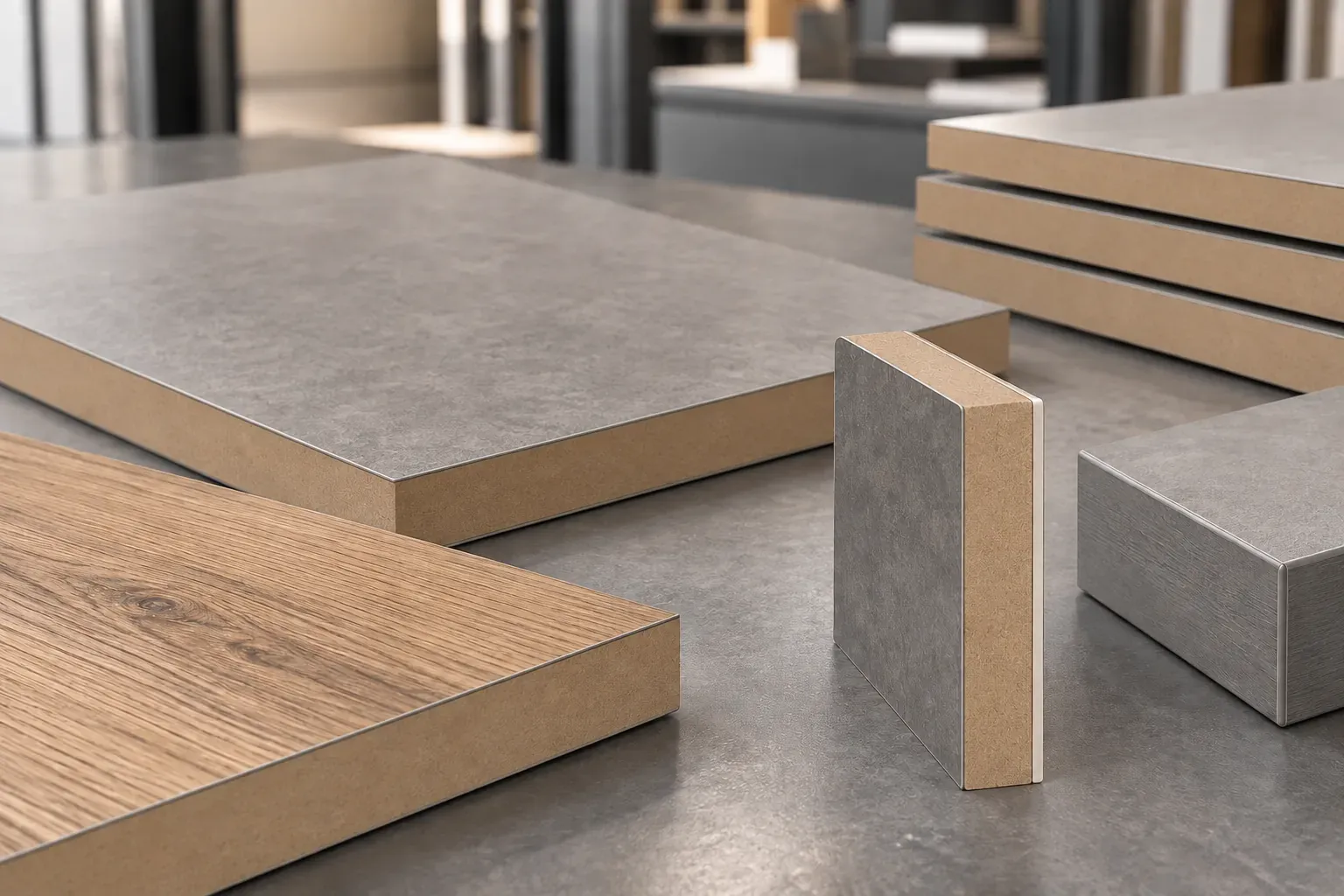
Laminated MDF combines a separately manufactured laminate sheet, an identified MDF core and a defined reverse construction. A useful quotation names every layer, finished thickness, decorative reference, edge construction, processing stage and supplied component so buyers can compare the same finished construction.
Define laminated MDF before comparing quotations
In this guide, laminated MDF means a separately manufactured decorative laminate bonded to an MDF substrate. The purchase description should name the laminate category and reference, MDF core, reverse layer, adhesive or bonding process, total construction and delivery stage. This creates a common scope for suppliers and receiving teams.
Separate laminate-faced MDF from melamine MDF
The two products use different surface constructions and approval records.
| Construction | How the decorative face is described | Main buyer approval |
|---|---|---|
| Laminate-faced MDF | A separately manufactured laminate sheet is bonded to MDF | Laminate reference, physical sample, layer schedule, edge and bonding process |
| Melamine-faced MDF | Resin-impregnated decorative paper is pressed as the panel face | Decor reference, texture, gloss, face/reverse construction and pressed-board sample |
Commercial names vary between markets, so the quotation should state the physical construction. Use the Melamine MDF specification guide when the required surface is melamine-faced board.
Choose the laminate category for the intended component
State whether the proposal uses HPL, CPL or another identified decorative laminate system. Record the manufacturer or supplier reference where available, nominal laminate thickness category, finish, intended use and relevant technical data. The accepted physical sample should represent the actual surface proposed for production.
Write a complete layer schedule
Record the panel from face to reverse and keep the schedule beside the drawing and sample reference.
| Layer | Information to confirm |
|---|---|
| Decorative face | Laminate category, reference, colour, pattern, texture, gloss and direction |
| Bonding layer | Adhesive or production process proposed for the component and service environment |
| MDF core | Product, thickness, density expectation, dimensions and emission class |
| Reverse layer | Balancing laminate, backing material or specified decorative finish |
| Finished panel | Total thickness, dimensions, tolerance and supplied processing stage |
Select the MDF core as part of the construction
Define the MDF product, nominal thickness, density expectation, board format, thickness tolerance and emission class. Coordinate the substrate with component size, machining, edge treatment, hardware and service environment. Current product data should identify the exact core offered for the laminate construction.
Control total thickness and finished dimensions
A laminate face, bonding layer and reverse construction add to the substrate thickness. State whether drawings and hardware interfaces use MDF core thickness or finished panel thickness. Record length, width, total thickness, tolerance and the measurement stage for full sheets and finished components.
Design the face and reverse as one panel
Coordinate face laminate, reverse material, adhesive system, panel dimensions, storage and final use as one construction. The reverse can provide a specified visible finish or act as a balancing layer. Large doors, work surfaces and appearance-sensitive components benefit from review of a representative full-size panel or finished component.
Approve colour, texture, gloss and pattern direction
Review the physical laminate sample under lighting relevant to the finished room or furniture. Record sample ID, colour reference, texture, gloss, pattern scale and accepted variation. Add grain or directional arrows to elevations, cut lists and nesting plans so adjoining parts retain the approved orientation.
Define the delivered production stage
State whether supply covers full laminated sheets, rectangular cut parts, CNC-machined components, edge-banded parts or assembly-ready panels. Assign part IDs, quantities and revision status to each finished component. The selected delivery stage determines which processing, inspection and protection belong in the quotation.
Choose an edge construction for every visible condition
Match each edge to the component drawing and appearance target.
| Edge construction | Review point |
|---|---|
| Exposed MDF edge | Sanding, sealing or later finishing requirement |
| Edge band | Material, thickness, colour, sheen, joint line and corner quality |
| Laminate strip or return | Layer visibility, trimming, corner detail and direction |
| Profiled or postformed edge | Supported laminate system, radius, section and finished trial |
Coordinate cutting, drilling and routing
Issue controlled drawings for dimensions, holes, cut-outs, grooves and profiles. Tool access, laminate side, face orientation and edge sequence should follow the selected construction. Inspect a first processed component for dimensions, laminate chipping, bond-line condition, surface marks and finished edge quality.
Match the construction to the service environment
Describe the protected-interior application, expected humidity, nearby heat, cleaning products, contact surfaces and horizontal or vertical orientation. Review current laminate and adhesive information for that use. Project-specific fire, food-contact or other regulated requirements should connect to the applicable product or system test reports.
Approve a representative finished sample
Use a sample that includes the proposed MDF core, face laminate, reverse layer, adhesive system, finished edge and any critical machining. Review it beside adjoining materials under relevant lighting. Record the sample ID, layer schedule, drawing revision and accepted visual range in the order file.
Inspect the first production set
Check laminate identity, face and reverse construction, total thickness, dimensions, direction, surface condition, bond line, edge treatment, machining and labels. Compare adjoining parts as a set where pattern, colour or direction continues across an elevation. Release repeat production against the recorded first-set result.
Compare total component cost
Compare offers at the same delivery stage. Include laminate and reverse construction, cutting yield, machining, edge treatment, sample work, inspection, protective materials, packing and destination terms. A component-level comparison shows which activities remain with the buyer after the panels arrive.
Plan handling, protection and receiving
Use clean separators, protected faces and corners, level supports and stable bundles suited to the component dimensions. State whether removable film is supplied and define the inspection stage before film removal. Group components by decor, part family or installation sequence and carry those IDs onto the packing list.
Buyer review checklist
Before releasing a laminated MDF order, confirm:
- the laminate category, reference and physical sample are identified;
- the layer schedule names the face, bond, MDF core and reverse;
- core thickness and finished panel thickness are clearly separated;
- total dimensions, tolerances and supplied processing stage are recorded;
- pattern direction follows the elevation, cut list and nesting plan;
- every visible edge has an approved material and corner detail;
- machining drawings and part IDs use one controlled revision;
- the representative sample contains the actual construction and edge;
- first-set inspection, protective film, packing and receiving checks are defined.
Request an MDF quotation
Send the laminate category and reference, physical sample ID, complete layer schedule, MDF core, finished dimensions, face and reverse construction, direction, edge constructions, machining drawings, quantity, inspection, packaging and destination. Review the current supply scope on Laminated MDF, then request a construction and quotation review.