
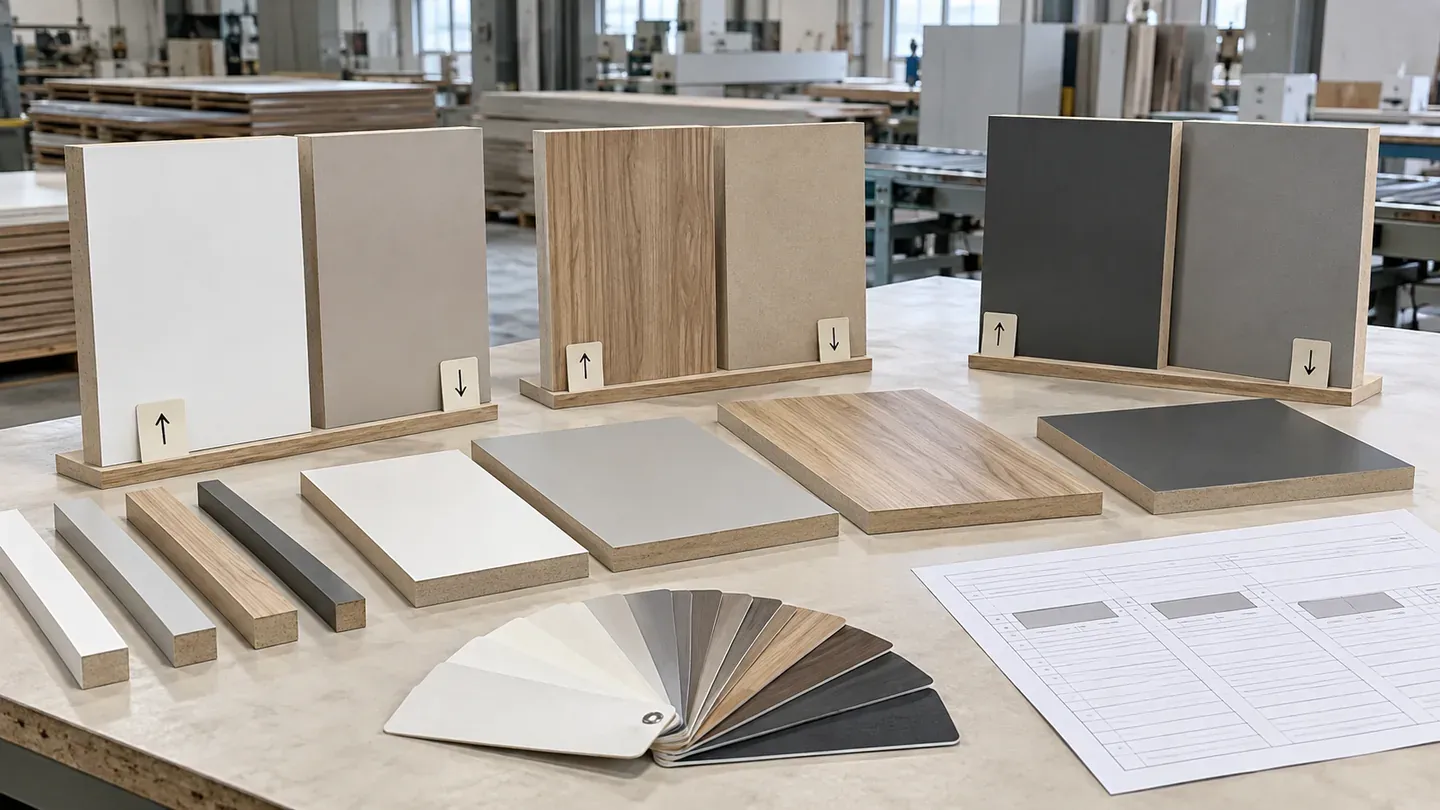
A production-ready melamine MDF specification defines the substrate and decorative construction together. Connect the MDF core, face and reverse surfaces, physical decor reference, texture, gloss, direction, dimensions, edges, machining, inspection and packing so quotations cover the same finished component.
Define the product and delivery condition
State whether the order covers full melamine MDF sheets, cut rectangular parts, machined components or assembly-ready furniture parts. Identify the end use, visible surfaces, service conditions and destination. This establishes which dimensions, surfaces, edges, labels and packing operations belong in the supplier’s quotation.
Specify the MDF substrate
Record the MDF product type, nominal thickness, density expectation, board format or finished component size, thickness tolerance and emission class. Connect E0, E0.5 or E1 to the applicable test method, selected product and destination requirement. Where moisture performance, fire performance or machining behaviour matters, define the relevant substrate and order documents and inspection records in the same schedule.
Confirm the decorative surface construction
Identify the requested product as melamine-faced MDF and record how the decorative paper and resin system are applied to the MDF. If the project uses a separately bonded laminate, move that construction to the Laminated MDF product option. Clear construction naming helps buyers compare surface performance, thickness build-up, edge details and price on the same basis.
Schedule the face and reverse independently
Describe both sides of the panel because the reverse construction affects appearance, processing and component balance.
| Surface field | Principal face | Reverse face |
|---|---|---|
| Material and system | Melamine-faced construction | Matching melamine, balancing decor or specified back |
| Decor reference | Controlled code plus accepted physical sample | Controlled code plus accepted physical sample |
| Texture and gloss | Named and sampled finish | Named and sampled finish |
| Direction | Length, width or non-directional | Length, width or non-directional |
| Use in component | Main visible surface | Visible, semi-visible or concealed surface |
| Protection | Required handling or removable film condition | Required handling or removable film condition |
Approve colour, pattern, texture and gloss
Review a physical sample under lighting representative of the finished furniture or interior. Use an area large enough to show colour, print scale, pattern repeat, embossing and reflection. Record the sample ID, supplier decor code, texture, gloss, viewing orientation and approval date. The melamine decor approval guide provides the deeper workflow for appearance decisions.
Map direction and visual sequence to components
Mark the visible face, top edge and grain or pattern direction on elevations, cut lists and labels. Identify paired doors, mirrored parts, continuous runs and end panels that require a common direction or controlled sequence. Carry the approved orientation into nesting so material-yield proposals preserve the intended appearance.
Match texture and gloss to the application
Texture affects touch, reflected light, cleaning behaviour and the visibility of marks. Gloss changes how colour and joints appear across large surfaces. Evaluate the selected combination on the intended component, especially doors, wide wall panels, tabletops and adjoining parts, and include the accepted face and reverse finish in the sample record.
Build the edge specification around a finished corner
List the edge-band material, colour, thickness, texture and gloss, then mark every edge that receives it. State whether finished length and width include the applied edge. Approve a completed corner or representative part because face, edge and joint appearance interact under light; record the adhesive line, trimming condition and corner detail expected in production.
Define sheet and finished-part dimensions
Separate source-board format from finished component size. For full sheets, state nominal thickness, length, width and accepted tolerances. For cut or machined parts, issue a controlled cut list with part IDs, finished dimensions, orientation and quantity. Reference the cut-to-size MDF specification guide when dimensional conversion and kit packing form part of the order.
Set surface and pressing acceptance points
Include decor identity, face-to-reverse construction, uniformity, cleanliness and the agreed visual comparison method in the inspection plan. Review the selected product for blisters, local lifting, wrinkles, resin or pressure marks, surface damage and contamination. Define the inspection lighting, viewing distance, sample basis and disposition process appropriate to the order.
Coordinate machining with the surface
Issue controlled drawings for cutting, drilling, routing, grooves, hardware locations and edge work. The machining process should protect decorative faces while maintaining the required cut and edge condition. Where routed profiles expose the MDF core, define the finishing process for those areas and confirm whether the component remains suitable for the intended design.
Approve a first component or assembly set
Inspect the first parts for MDF identity, thickness, decor, reverse construction, direction, finished dimensions, edge match, chipping, joint quality, hole locations and label accuracy. Assemble representative adjoining components where alignment and visual continuity matter. Link approval to the current drawings, cut list and physical sample before repeat production continues.
Control batch identity and repeat orders
Connect production and inspection records to the accepted sample, decor code, substrate, order and batch. Agree the comparison method for additions, replacement parts and later repeat orders. A newly accepted sample and revision should document any change in decor source, texture, gloss, reverse construction or edge match.
Protect decorative surfaces through delivery
Specify clean separators, stable face orientation, corner and edge protection, supported bundles and labels that remain readable through the pack. Group components by decor, part family and assembly sequence. Select moisture protection, bundle dimensions and lifting method around the route, unloading equipment and storage conditions at destination.
Buyer review checklist
Before releasing a melamine MDF order, confirm:
- the delivery condition covers full sheets, cut parts, machined components or assembly-ready parts;
- the MDF type, thickness, density expectation, format, tolerance and emission class are recorded;
- the principal face and reverse face each have a defined construction;
- colour, pattern, texture, gloss and physical sample references are traceable;
- grain or decor direction is mapped to every directional component;
- edge material, treated edges and finished-dimension basis are clear;
- cutting, machining and exposed-core finishing belong to the quoted scope;
- surface acceptance, first-part approval and batch inspection are documented;
- labels, replacement matching and transport protection support the receiving workflow.
Request an MDF quotation
Send the substrate specification, face and reverse schedule, physical decor reference, component drawings, direction map, edge schedule, quantities, inspection requirements, packaging and destination. Review available construction options on the Melamine MDF product page, then request a melamine MDF quotation with the completed specification.