
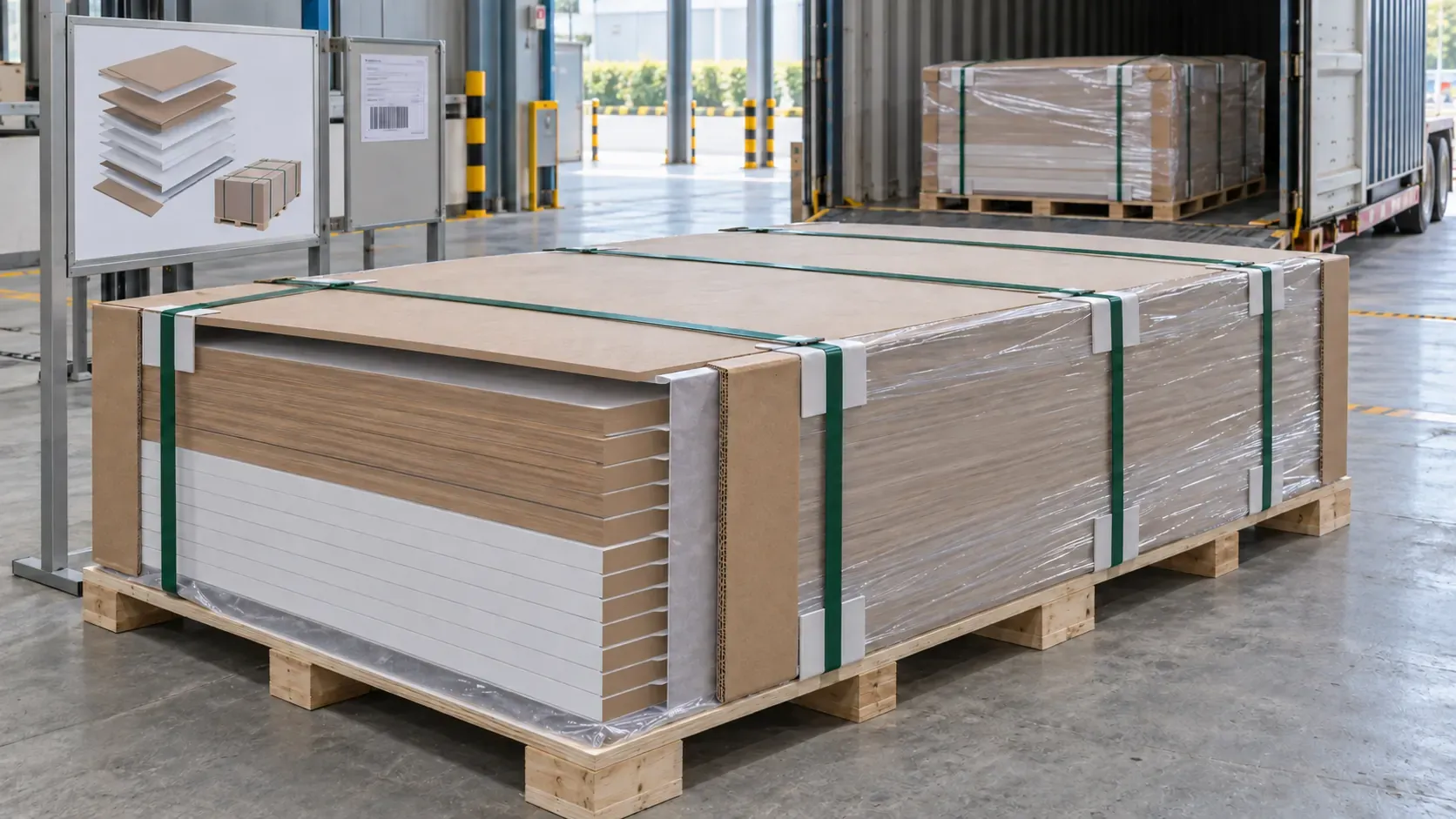
This Procurement Scenario is an educational decision model for a common sourcing situation. It presents a reusable workflow independent of any named CUZI MDF customer project, completed delivery or claimed commercial result.
Decorative MDF packaging protects an approved product construction through factory handling, truck transfer, port operations, ocean transport, unloading and storage. The pack design should follow the panel dimensions, quantity, surface, profile, route, destination equipment and buyer requirements. Veneered, melamine-faced, painted, grooved and routed panels may therefore use different separators, support, cover and grouping rules inside one shipment.
Start with a panel and transport-risk schedule
List each panel family, construction, dimensions, thickness, quantity, confirmed weight, visible face, reverse face, edge condition, profile, protective film, orientation and destination group. Add the planned transport route, transfer points, loading method, unloading equipment and storage conditions. Assign a risk level for surface marking, edge damage, profile pressure, bending, moisture exposure and identification errors.
Define the packaging construction in layers
Prepare a written layer sequence from the wooden base upward: runners or bearers, bottom protection, panel stack, separators, side and end protection, top cover, corner guards, wrapping, straps and labels. State the material, thickness or grade, position and purpose of each layer. A section drawing or packing sample helps buyers compare proposed packs on the same basis.
Protect decorative faces with clean contact materials
Use clean, smooth and compatible separators against melamine, veneer, paint, acrylic, PVC or other approved surfaces. Confirm whether protective film stays in place through transport and how it will be removed. Review separator spacing and stack pressure so faces remain supported and isolated from abrasive particles, printed transfer or exposed fasteners.
Isolate edges, corners and routed profiles
Select full-length edge protection and stable corner guards for the panel geometry. Routed faces, fluted panels, fragile corners and exposed decorative edges need pressure-free zones or shaped support that keeps loads on safe areas. Locate strap pads and side covers so tightening force reaches the protective structure and the base while delicate profiles remain pressure-free.
Support thin, long and large-format panels
Use a flat base with support positions matched to panel length, width and stiffness. Thin panels benefit from continuous support and controlled stack handling. Long or large formats need enough base rigidity for forklift movement, truck transfer and unloading. Confirm fork-entry direction, tine spacing, lifting clearance and the equipment available at destination.
Control the bottom and top of the bundle
The bottom layer separates panels from the skid and limits contact with dust and incidental surface moisture. A rigid top cover distributes strap pressure and shields the stack during handling. Side and end covers protect exposed edges and help retain the wrapping. Keep all protective boards dimensionally aligned with the panel stack.
Use wrapping as part of a dry transport plan
Select an inner moisture barrier or external wrapping suited to the route and product. Fold and seal it around the bundle in a repeatable sequence while providing the handling access required by the agreed method. Wrapping supports short-duration protection during normal export handling; covered loading, dry transport, prompt receiving and suitable storage complete the moisture-control plan.
Position straps through protected load paths
Choose strap material, number, spacing and tension according to bundle dimensions, weight and cover construction. Use broad pads beneath straps at top edges and corners. Align straps with base support where practical and keep them clear of routed recesses, exposed decorative edges and label areas. Recheck tension after the pack settles.
Confirm bundle dimensions and gross weight
Calculate net product weight from confirmed thickness, size, quantity and density, then add the skid, covers, separators, wrapping, guards and straps. Record final length, width, height, net weight and gross weight for every pack. These values support truck planning, container position, lifting review, port handling and destination unloading.
Select container or breakbulk shipment by order conditions
Container transport suits many regular and smaller export orders because the packs remain within an enclosed unit from loading to destination release. Large-volume heavy orders may use breakbulk or general cargo vessel service where route, port handling, vessel schedule and total shipment economics support that choice. Compare both methods using confirmed pack data, transfer points, handling exposure and destination capability.
Prepare packs for truck transfer to the port
Match bundle footprint and gross weight to the truck deck, axle limits and loading equipment. Use stable blocking, restraint and weather protection appropriate to the approved route. Arrange packs in unloading order and keep labels accessible. Record truck condition, loaded pack numbers, restraint and departure condition before transfer.
Plan container loading around real pack data
Use final bundle dimensions, gross weights, floor-loading considerations, door opening, forklift clearance and legal transport limits. Position packs for stable weight distribution and practical unloading. Record dunnage, blocking and restraint, then link the container position plan with pack numbers and the packing list. Quantity claims follow the confirmed product mix and approved loading plan.
Prepare stricter handover controls for breakbulk cargo
Breakbulk cargo can pass through truck, terminal, crane and vessel handling stages. Use robust weather-resistant outer protection, clear lifting and handling information, protected labels and a pack structure suited to the confirmed terminal and vessel method. Coordinate tally records, condition photographs, terminal acceptance, stowage information and destination discharge planning with the logistics parties.
Label every bundle for traceable receiving
Show purchase order, product or construction code, surface reference, dimensions, quantity, pack number, net and gross weight where confirmed, destination group and handling orientation. Add installation zone, room, module or production sequence where it improves receiving. Place duplicate protected identification where the agreed route benefits from it and match every pack to the final packing list.
Inspect the completed pack before release
Verify product identity, surface and edge condition, stack alignment, separator placement, cover boards, guards, wrapping, strap position, base integrity, fork access, labels, dimensions and gross weight. Photograph representative sides, top, base, labels and loading condition. Record the inspection date, pack numbers, order revision and any approved correction.
Coordinate destination unloading and storage
Confirm equipment capacity, fork length, lifting access, receiving area, covered space and flat supports before shipment. The receiving team checks pack count, labels, visible condition and moisture indicators where specified, then records any transport observation before unpacking. Store panels flat, dry, supported and protected according to the accepted product and pack plan.
Compare packaging quotations on one specification
Issue each supplier the same product schedule, risk classification, layer construction, bundle limits, labels, transport route, loading method and destination requirements. Ask quotations to identify included skid, cover boards, separators, guards, wrapping, straps, inspection, truck or container work and any special port requirement. Compare the full protected-delivery scope along with pack weight and handling efficiency.
Request an MDF quotation
Send the panel schedule, approved surface references, dimensions, quantities, confirmed weight basis, packing layer specification, bundle limits, labels, route, container or breakbulk preference, unloading equipment and destination conditions. Use the MDF packaging and shipment guide for pack planning, the container loading guide for booking data, and request a decorative-panel packaging review with the complete transport brief.