
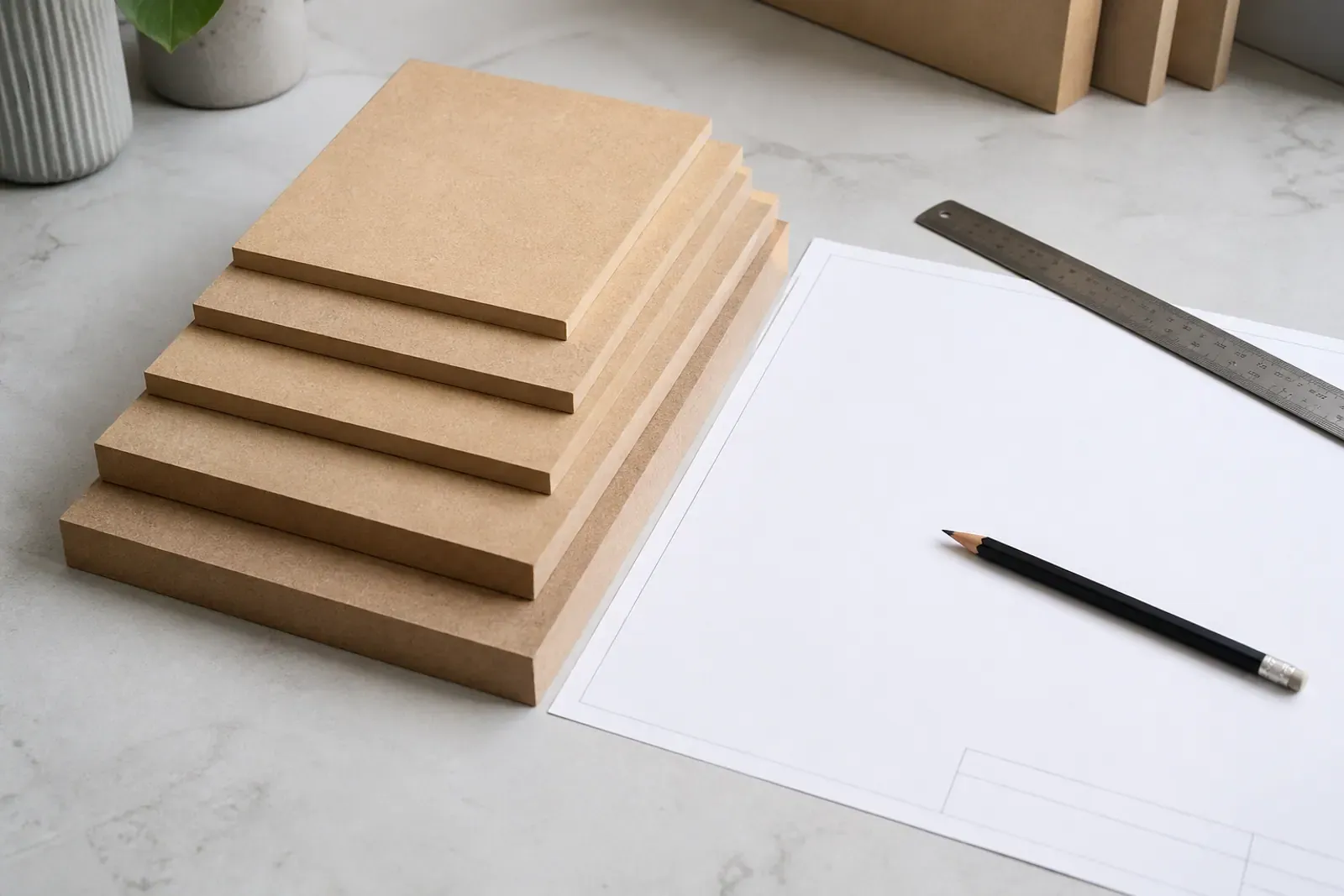
MDF thickness and board format affect component design, machining, yield, handling, packaging and transport. Buyers gain a useful comparison when every option is connected to the same finished part and production process.
Start with the finished component
List the part function, finished length and width, span, support, hardware, visible faces, edge construction and service environment. Doors, shelves, backs, routed fronts and wall modules can require different thickness and support decisions within one project.
Use the available thickness schedule
CUZI MDF supplies MDF-family panels from 2–35 mm. Density follows the selected product and thickness. Treat nominal thickness, agreed ±0.1 mm tolerance, density range and supplied surface as one order line, then connect that line to the component drawing.
Match board format to nesting
CUZI MDF board formats include 1220 × 2440 mm, 2100 × 2800 mm, 1830 × 2440 mm, 1830 × 3660 mm, 2440 × 3660 mm and 1830 × 4200 mm. Compare each format through usable yield, grain or decor direction, saw kerf, trim allowance, machine capacity and offcut plan.
Review machining depth and remaining material
Routing, grooves, hinge cups, connector holes and edge profiles remove material. Use section drawings to show machining depth and remaining thickness at the most demanding point. Coordinate opposing operations and hardware zones before releasing the component.
Calculate component and bundle weight
Theoretical sheet weight equals thickness × length × width × density. Add face materials, edges, hardware and packaging separately. Use finished component weight for handling and hardware review, and confirmed packed gross weight for loading and freight planning.
Check support and hardware interfaces
The furniture or project designer defines spans, fixing, hinges, runners, connectors and supports for the completed assembly. Trial representative parts with actual hardware. Record fit, alignment, movement and adjustment against the released drawing.
Inspect the first parts
Check product identity, thickness, finished dimensions, squareness, orientation, machining, edge condition and label. For directional surfaces, assemble adjoining pieces to confirm pattern alignment. Release repeat production through the accepted revision.
Plan packing for the selected format
Large and thin panels need continuous support, suitable bundle height, stable fork access and protected corners. Decorative faces need clean separators. State pack dimensions, bundle weight, labels, loading method and destination handling limits.
Prepare the size-and-thickness RFQ
Send component schedule, selected MDF product, thickness, input board format, finished sizes, machining, finish, quantity, sample requirement, packing and destination. Use the MDF weight and CBM calculator for planning and request a quotation with the cut list.