
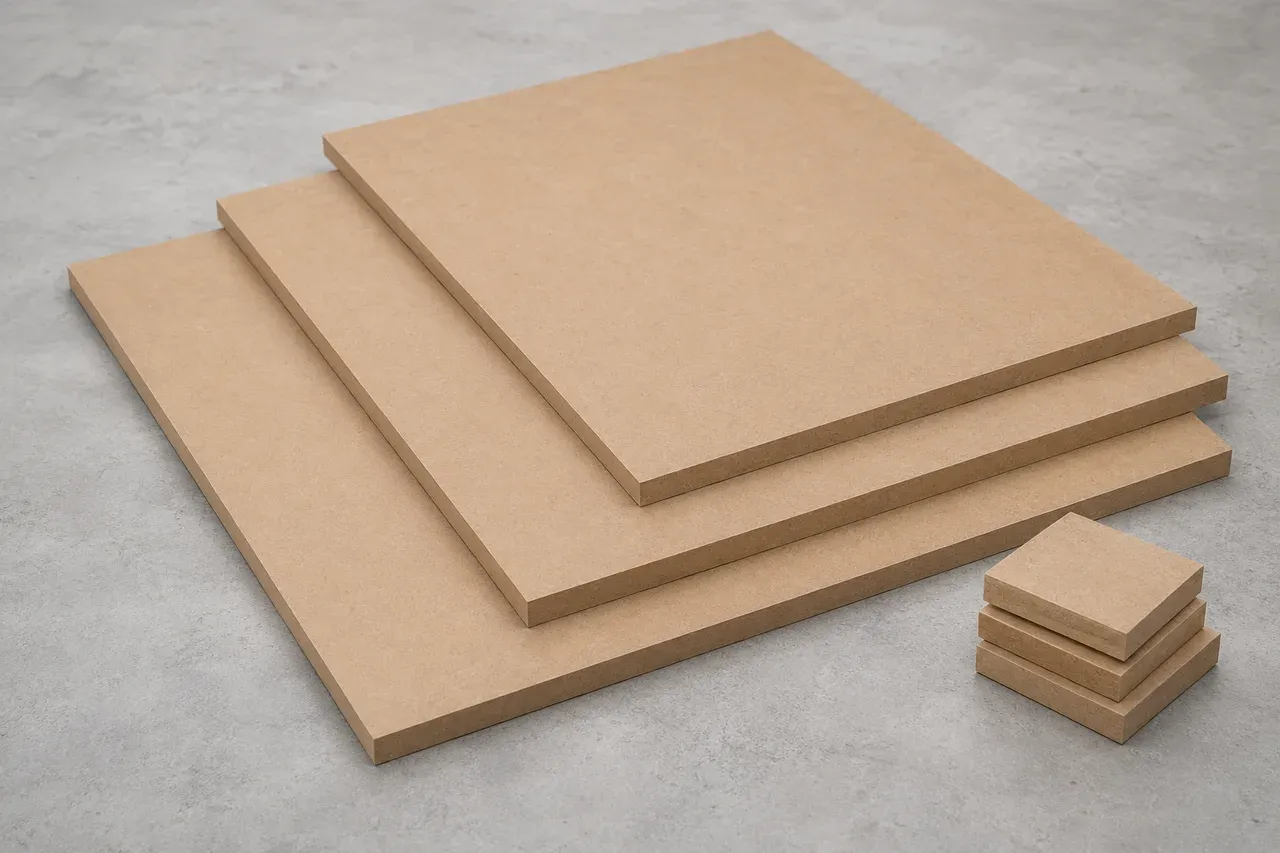
That small distinction can matter at a cabinet joint, on a CNC bed or in a cutting plan. Start with the dimensions your production needs, then choose a board format around them. CUZI MDF manufactures MDF and supplies cut components, so you can discuss the parent sheet, finished parts and packing in one inquiry.
Start with the size your production actually needs
An order may use inches while a drawing, machine or supplier schedule uses millimetres. Identify the controlling unit on the purchase order and drawing. If both appear, state which one governs production and acceptance, and use the converted value as its reference.
Separate three dimensions: the supplied parent sheet, the usable area after squaring and trimming, and the finished component. A distributor stocking whole sheets needs the first; a cabinet factory buying ready-cut parts needs the last, along with machining and edge details.
Use our board size and thickness guide for the broader design and handling choices. This guide focuses on the inch-to-millimetre specification that connects a US order to those choices.
MDF inch thickness conversion table
The international inch is exactly 25.4 mm, as explained by NIST's length-unit guidance. Multiply inches by 25.4 to obtain millimetres; divide millimetres by 25.4 for inches. Calculate from the original dimension and round once to the precision used in your order.
| Inch thickness name | Exact conversion to mm | What to put in the order |
|---|---|---|
| 1/8 in | 3.175 mm | Confirm the actual target thickness and tolerance |
| 1/4 in | 6.35 mm | Identify the supplied board construction |
| 3/8 in | 9.525 mm | Confirm the target before selecting drill or cutter settings |
| 1/2 in | 12.7 mm | Use this value if literal half-inch thickness is required |
| 5/8 in | 15.875 mm | Keep the controlling dimension on the drawing |
| 3/4 in | 19.05 mm | Match grooves, joints and hardware to the agreed actual thickness |
| 1 in | 25.4 mm | Confirm the product grade, thickness and tolerance together |
These are exact conversions of the stated inch dimensions. They help define a requirement; the quotation identifies the actual thickness, tolerance and construction we will supply. Our established MDF range is 2–35 mm, with the available combination confirmed for the chosen grade and finish.
For Thin MDF Board, include the supporting structure and whether the part is a back, drawer bottom or facing panel. For decorative boards, state whether the thickness is the core alone or the completed panel with its face and reverse layers. The finished thickness is the value your assembly must accommodate.
Is 18 mm MDF the same as 3/4 inch MDF?
18 mm is approximately 0.709 in. Literal 3/4 in is 19.05 mm, a difference of 1.05 mm. These are separate targets, even when a purchasing shorthand groups them into a similar furniture thickness category.
For a cabinet factory, the practical question is the assembly fit. Check grooves, rebates, connectors, hinge recesses and any remaining section after machining against the selected board thickness. Agree an 18 mm construction if the drawing works with it, or specify a 19.05 mm requirement when the design needs that dimension.
Record the permitted variation independently from the conversion. A conversion tells you what the dimension means in another unit; a tolerance tells you the acceptable supplied range. Include how and where thickness will be checked, the sampled boards and their condition in your inspection agreement.
An example inquiry can say: “Please quote raw MDF, 1220 × 2440 mm parent sheets, actual target thickness 19.05 mm. Please identify the thickness and sheet-size tolerances in the offer. Our attached millimetre drawing governs the component dimensions.” Add your grade, surface, quantity and destination to make that request specific to your order.
If an existing design is being converted from inch-based supply, send the relevant joint or component drawing with your request. A representative sample lets your production team review fit before the full order is made.
4×8, 49×97 and 5×10 MDF sheet sizes in mm
The foot contains 12 inches. The following calculated dimensions use the exact 25.4 mm per inch conversion. The labels refer to sheet formats, with the units made explicit.
| Sheet format in an inquiry | Dimensions in inches | Exact dimensions in mm | Supply detail to confirm |
|---|---|---|---|
| Literal 4 × 8 ft | 48 × 96 in | 1219.2 × 2438.4 mm | Exact sheet size and dimensional tolerance |
| Metric 1220 × 2440 mm | Approximately 48.031 × 96.063 in | 1220 × 2440 mm | Whether this metric format meets the cutting or stocking requirement |
| 49 × 97 in | 49 × 97 in | 1244.6 × 2463.8 mm | Suitable larger parent format, trim and supplied cut size |
| 5 × 10 ft | 60 × 120 in | 1524 × 3048 mm | Parent format, machine handling and finished-size requirements |
1220 × 2440 mm is 0.8 mm wider and 1.6 mm longer than literal 4 × 8 ft. The near-equivalent format may work for your production, especially when the board will be trimmed, but the order should identify the dimensions actually accepted.
A 49 × 97 in sheet is one inch wider and one inch longer than literal 48 × 96 in. That extra material is useful only when the agreed cutting plan allocates it. The usable allowance also depends on edge trimming, squareness, cutting kerf and the condition of the sheet.
How we plan 49×97 and 5×10 sheet requirements
Our established metric formats include 1220 × 2440, 1830 × 2440, 2100 × 2800, 1830 × 3660, 2440 × 3660 and 1830 × 4200 mm. The selected grade, face construction and order determine the suitable parent sheet and supplied format.
For 49 × 97 in, a parent needs to accommodate at least 1244.6 × 2463.8 mm, plus any required process allowance. For example, a 1830 × 3660 mm rectangle can contain that cut size geometrically. A 1830 × 2440 mm sheet has sufficient width but its 2440 mm length is shorter than 2463.8 mm.
A 5 × 10 ft target converts to 1524 × 3048 mm. A 1830 × 3660 mm parent can contain that rectangle geometrically, leaving 306 mm across the width and 612 mm along the length before allocating trimming and cutting losses. This is a size comparison; the actual cutting schedule uses the supplied sheet, tools and process allowances.
When requesting these inch-based formats, send the finished dimensions, quantity, grade and surface. We confirm the parent format, cutting arrangement, tolerance and packing in the quotation. This keeps a made-to-size requirement clear alongside the established metric range.
Allow for trim and saw kerf in the cutting plan
The kerf is the width removed by the saw cut. Edge trimming, cutter paths and finishing allowances consume material too. Count them before comparing how many finished components each parent format can provide.
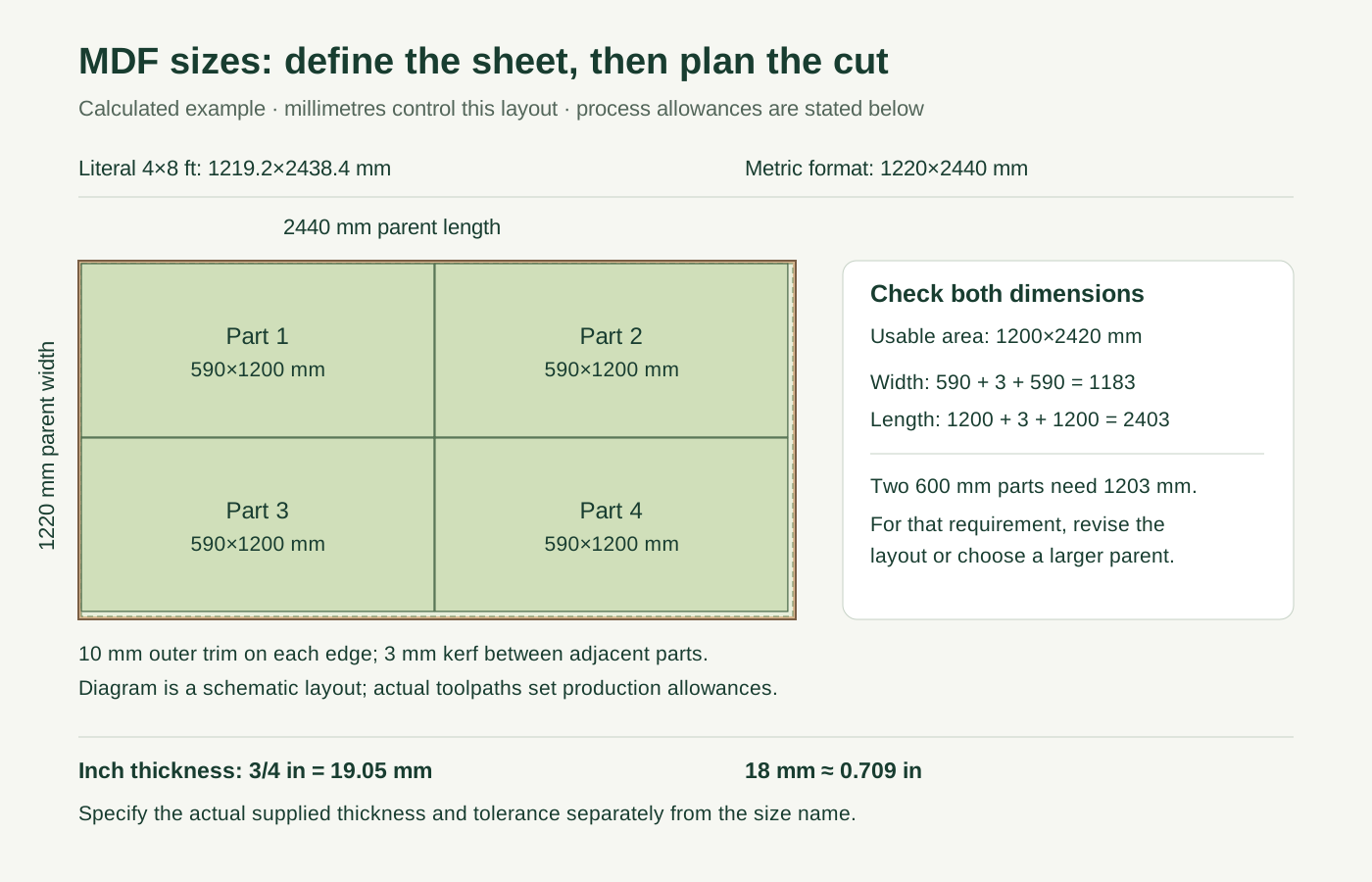
Here is a calculated layout example: start with a 1220 × 2440 mm parent, assume 10 mm trim on each outer edge, and use a 3 mm saw kerf between adjacent parts. The resulting usable rectangle is 1200 × 2420 mm. Four finished parts of 590 × 1200 mm can fit as two across and two along under those assumptions.
| Check in the example | Calculation | Result |
|---|---|---|
| Usable parent width | 1220 − 10 − 10 | 1200 mm |
| Usable parent length | 2440 − 10 − 10 | 2420 mm |
| Two 590 mm parts across | 590 + 3 + 590 | 1183 mm; fits the usable width |
| Two 1200 mm parts along | 1200 + 3 + 1200 | 2403 mm; fits the usable length |
| Two 600 mm parts across | 600 + 3 + 600 | 1203 mm; requires a revised layout or parent format |
View the sheet and cutting-layout diagram. It shows the stated calculation assumptions. Production yield also depends on actual sheet dimensions, squareness, surface selection, handling and the cutting sequence.
For routed parts, use the cutter path and holding arrangement in the nesting review. Add finishing stock where the component will be calibrated, profiled or trimmed again. Our Cut-to-Size MDF team can review the part list and drawing before confirming the supply plan.
Keep decorative direction and component identity in the drawing
Raw MDF has a uniform fibre structure; a woodgrain face, natural veneer or directional pattern introduces an appearance requirement. Identify the face direction on each part and specify how adjacent components should align in the finished furniture.
A layout that maximizes the number of rectangles may place a decorative face in the wrong direction. Keep part IDs, visible faces, required grain or pattern direction and drawing revision with the cut list. Confirm the same references on the sample and repeat-order documents.
For edge-banded components, state whether the requested size is before or after banding. Holes and hardware coordinates should use the finished drawing's datum. Those details give your assembly team a clear fit reference when the order arrives.
Compare wholesale cost on the same supplied basis
For a 4x8 MDF wholesale inquiry, compare the exact dimensions, actual thickness, grade, surface and quantity together. Then compare board price, usable component output and the work included in the offer. A full-sheet price and a ready-cut component price cover different amounts of processing.
If prices are quoted per cubic metre, use the agreed actual dimensions to calculate volume. A 1220 × 2440 × 18 mm board is 0.0535824 m³; at the same face dimensions and 19.05 mm thickness, it is 0.05670804 m³. These are calculated geometric volumes, which you can multiply by the quoted price per m³ when that is the agreed commercial basis.
Ask for sheet quantity, net material volume, included cutting or facing, packaging and delivery terms in the offer. For mixed thicknesses or multiple decors, keep a line-by-line schedule so your team can compare the same supplied items. Our quotation comparison guide explains the wider commercial review.
Check handling, packing and container space for larger formats
A larger sheet format changes the handling plan as well as the cutting plan. Confirm rack and machine capacity, lifting arrangements, receiving access, pallet dimensions and supported storage before choosing a 5×10 requirement for regular supply.
Separate the net board dimensions from the packed dimensions. Pallets, covers, separators and edge protection add size and weight. Loading quantity is calculated from the agreed product dimensions, density, pack arrangement and the container's usable space and payload.
CUZI MDF supplies on FOB terms, with shipment through Lianyungang or Qingdao. Send the destination and receiving constraints with the cut-size inquiry. Our container loading guide helps you collect the packing and shipment details needed before booking.
Buyer review checklist
1. Write the size name with its units: for example, 49 × 97 in or 5 × 10 ft. 2. State the controlling actual width, length and thickness, with tolerances. 3. Identify core thickness or finished panel thickness and the required grade and surface. 4. Separate parent sheet size, usable cutting area and finished component size. 5. Allocate outer trim, saw kerf, cutter paths and further finishing allowance. 6. Keep part IDs, face direction, edge banding and machining datums on the drawing. 7. Confirm supplied quantities, pack dimensions, delivery terms and destination. 8. Keep the accepted drawing and sample with the repeat-order specification.
Frequently asked questions
How many millimetres is 3/4 inch MDF?
3/4 in converts exactly to 19.05 mm. Put the agreed actual thickness and its tolerance in the order. For faced panels, specify whether that figure describes the MDF core or the finished board including the facing layers.
Can I use 18 mm MDF for a 3/4 inch design?
18 mm is 1.05 mm thinner than literal 3/4 in. Review the joints, grooves, hardware and finished assembly against 18 mm before agreeing the substitution. A representative component sample can help your team confirm fit.
Is a 1220×2440 mm MDF sheet exactly 4×8 ft?
Literal 4 × 8 ft is 1219.2 × 2438.4 mm. The metric sheet is slightly larger. Specify 1220 × 2440 mm when that is the accepted format, and retain a separate tolerance and trimming requirement.
What is 49×97 MDF in millimetres?
49 × 97 in is 1244.6 × 2463.8 mm. It needs a parent format that accommodates both dimensions and process allowances. Send the grade, finish, quantity and supplied cut-size requirement for a matched quotation.
What is 5×10 MDF in millimetres?
5 × 10 ft is 1524 × 3048 mm. Larger established metric parent formats can be reviewed for that cut size. The quotation confirms the selected construction, cutting arrangement, supplied tolerance and packing.
Which unit should govern an MDF cutting drawing?
Choose the unit used to control production and acceptance, and state it on the drawing. Show a converted reference value where helpful. Keep the original dimension through calculation and round once to the agreed order precision.
How much allowance should I add for cutting?
Use your actual edge trim, saw blade kerf or CNC cutter path, holding method and finishing stock. The 10 mm trim and 3 mm kerf in this guide are inputs to one calculated example. Your production process establishes the allowances for the real cut list.
Can CUZI MDF quote full sheets and ready-cut parts together?
Yes. Send the full-sheet schedule and component cut list as separate items, including units, grade, surface, tolerances and quantities. We confirm the supplied formats, processing and packing for each line so the quote is useful for your purchasing and production teams.
Discuss your order with our factory
Send your required dimensions in the unit you use, plus grade, surface, quantity and destination. Add the component drawing when fit, decorative direction or machining matters. We reply within 12 hours and can discuss full sheets or cut-to-size supply from our factory.
Samples across our range are free and normally available from stock. Buyers pay courier charges, which can be credited against the formal order amount. We confirm any custom preparation, dispatch and transit timing for your request. A written quotation includes the specification, quantity, price and currency, packing, delivery terms and place, lead time, payment terms and validity.
Request a size-based quotation, request a thickness or component sample, or request product specifications.
Conversion references: NIST SI Units — Length and NIST Unit Conversion. The tables use exact unit factors; the cutting and volume examples are calculated from the stated inputs.