
This Procurement Scenario is an educational decision model for a common sourcing situation. It presents a reusable workflow independent of any named CUZI MDF customer project, completed delivery or claimed commercial result.
A multi-decor melamine MDF order combines several products inside one purchasing project. Each decor, texture, substrate, thickness and face-and-reverse construction creates a separate order line. The buyer gains reliable colour, grain, quantity and assembly control when every finished component remains connected to an approved physical sample and a current construction code.
Build one line-by-line decor schedule
Create one row for every required construction. Record the buyer's decor code, supplier reference, physical sample ID, colour family, texture, gloss, grain direction, MDF type, substrate thickness, finished thickness, face decor, reverse face, board format, component or full-board scope, quantity, edge solution and destination group. Assign a schedule revision and release date so quotation, sampling, production and receiving teams work from the same list.
Separate surface identity from the MDF substrate
The decorative face and MDF substrate answer different purchasing questions. The surface schedule controls visual identity, texture, gloss and direction. The substrate schedule controls MDF product, nominal thickness, agreed tolerance, density range and the E0/E0.5/E1 destination requirement for the selected product. Connect both schedules through one construction code such as D-01/18-MR so each quotation line describes a complete panel.
Give every finish a controlled physical reference
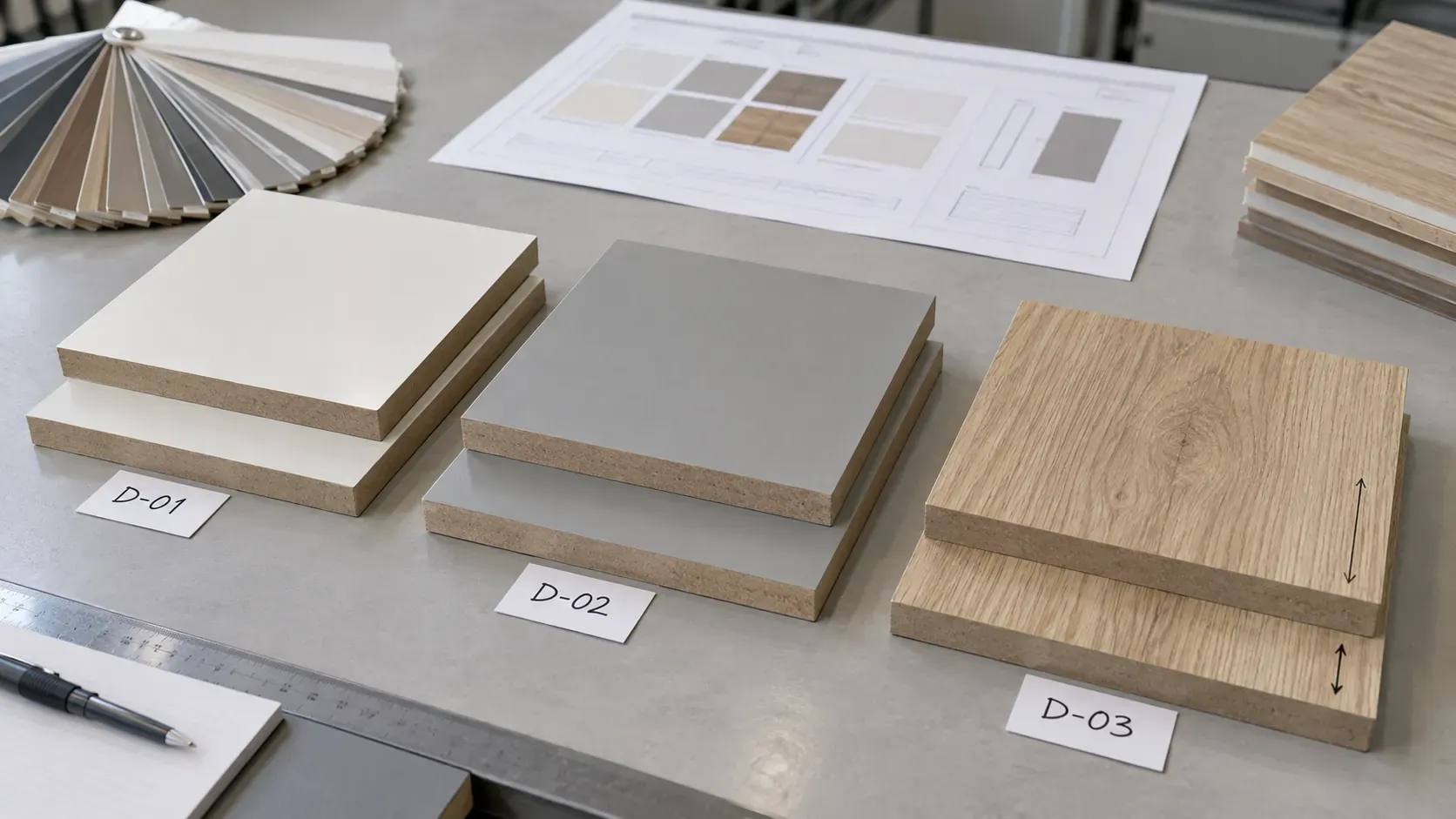
Approve colour and texture from a labeled physical sample viewed under representative lighting. The sample record should state the attributes it controls, its code, supplier reference, date, revision and retained location. Screen images, catalogue names and verbal descriptions remain useful for selection; the signed or otherwise accepted physical sample carries the production reference.
Define the face-and-reverse combination
State the principal face and reverse face for every line. Options may include matching decor on both sides, decorative face with a coordinated solid reverse, or another confirmed balancing construction. Record texture and gloss on both sides, total finished thickness and visible-face orientation. This allows suppliers to quote the same construction and helps processors orient parts correctly.
Approve texture and gloss with colour
Two panels using a similar colour can appear different when texture depth, pore direction or gloss changes. Review the physical sample at a shallow viewing angle as well as straight on. Record whether the approved reference controls colour only or the full colour-texture-gloss combination. Use an agreed viewing distance and lighting condition for appearance-sensitive components.
Lock grain direction to the finished component
For woodgrain and directional textures, mark an arrow on the approved sample and connect it to the component drawing. Each door, side, shelf, drawer front and filler should show its finished orientation. Paired doors and adjoining panels also need a sequence or pairing rule. Direction control belongs in the cut list, nesting plan, first-component review and pack label.
Map each decor to rooms, modules and part IDs
Create a finish allocation matrix linking every decor code to furniture module, room type, component ID and quantity. This reveals shared finishes, room-specific accents and replacement requirements. A visual elevation or assembly drawing can show how neighbouring parts meet, while the part schedule supplies the exact purchasing and production quantities.
Calculate quantities by complete construction
For full-board supply, state sheets by decor, thickness, format and construction. For component supply, calculate parts and complete assembly sets by part ID, then add the agreed spare or replacement quantity. Keep fixed decor demand separate from optional or forecast demand. This supports a clear minimum-order discussion and prevents one popular colour from hiding a small, costly special line.
Review minimum quantities and controlled overage
Ask the supplier to state the minimum quantity, production increment and permitted quantity variation for each construction. Decide whether small decor lines will proceed, increase to an economical quantity, move to a later shipment or use an approved alternative. Record the decision beside the affected code. Quotation comparison then reflects the same assortment and the same treatment of residual boards or components.
Use a staged sample approval process
Begin with representative decor samples for colour, texture and gloss. Follow with a constructed sample when face-and-reverse balance, edge banding, film, machining or finished thickness matters. Use a first finished component for directional grain, paired parts, drilling, routed details and assembly interfaces. Each stage records the accepted attributes and transfers them into the current construction schedule.
Inspect the first production group
Select representative panels or components from every approved construction. Check sample code, face and reverse, colour family, texture, gloss, grain direction, thickness, dimensions, edge combination, drilling or routing, protective film and label identity. Assemble a paired or adjoining group where appearance continuity matters. Record approval against the current schedule and drawing revision.
Control production batches and retained references
Record production batch identity for each decor and retain a suitable reference sample from the approved supply. Inspect appearance across representative sheets or components under the agreed viewing conditions. Connect inspection records, pack numbers and replacement parts to the same decor code. This traceability supports repeat orders and focused review if a receiving question arises.
Coordinate cutting, edging and machining
The cut list should carry decor code, visible face, grain direction, finished dimensions, quantity and edge schedule. Edge-band references should state colour, material, thickness and application position. Drilling and routing drawings should retain the same part IDs and orientation marks. A first assembly confirms how face, reverse, edge and hardware appear together.
Pack and label each finish for receiving
Use clean separators, suitable face protection, supported stacking, corner and edge protection, and controlled strapping pressure. Group packs by decor, thickness, module or assembly sequence according to the receiving plan. Labels should show purchase order, schedule revision, construction code, decor, grain direction where relevant, part IDs or board format, quantity, pack number and destination group.
Plan loading from confirmed quantities and weights
Build the loading plan after constructions, quantities and packaging are confirmed. Different MDF thicknesses, formats and pack designs change bundle weight and container use. Check verified order weights, bundle dimensions, transport limits, unloading equipment and storage sequence. Keep every finish traceable through the packing list and container position plan.
Compare quotations on the same assortment
Issue the same decor schedule, physical references, substrate requirements, dimensions, quantity, sample approval sequence, processing, protection, labels, packaging, destination and delivery basis to each supplier. Ask quotations to show line-level construction, minimum quantity, permitted variation, sampling, edge work, machining, protective film, packing and validity. Compare total delivered cost by approved construction and by complete furniture set where applicable.
Request an MDF quotation
Send the current decor schedule, sample photographs and reference IDs, physical sample plan, substrate and emission requirements, face-and-reverse combinations, component drawings, grain directions, quantities, edge and machining scope, packing groups, destination and required dates. Use the melamine MDF specification guide for construction details, the decor and texture approval guide for sample control, and request a multi-decor quotation review with the complete schedule.