
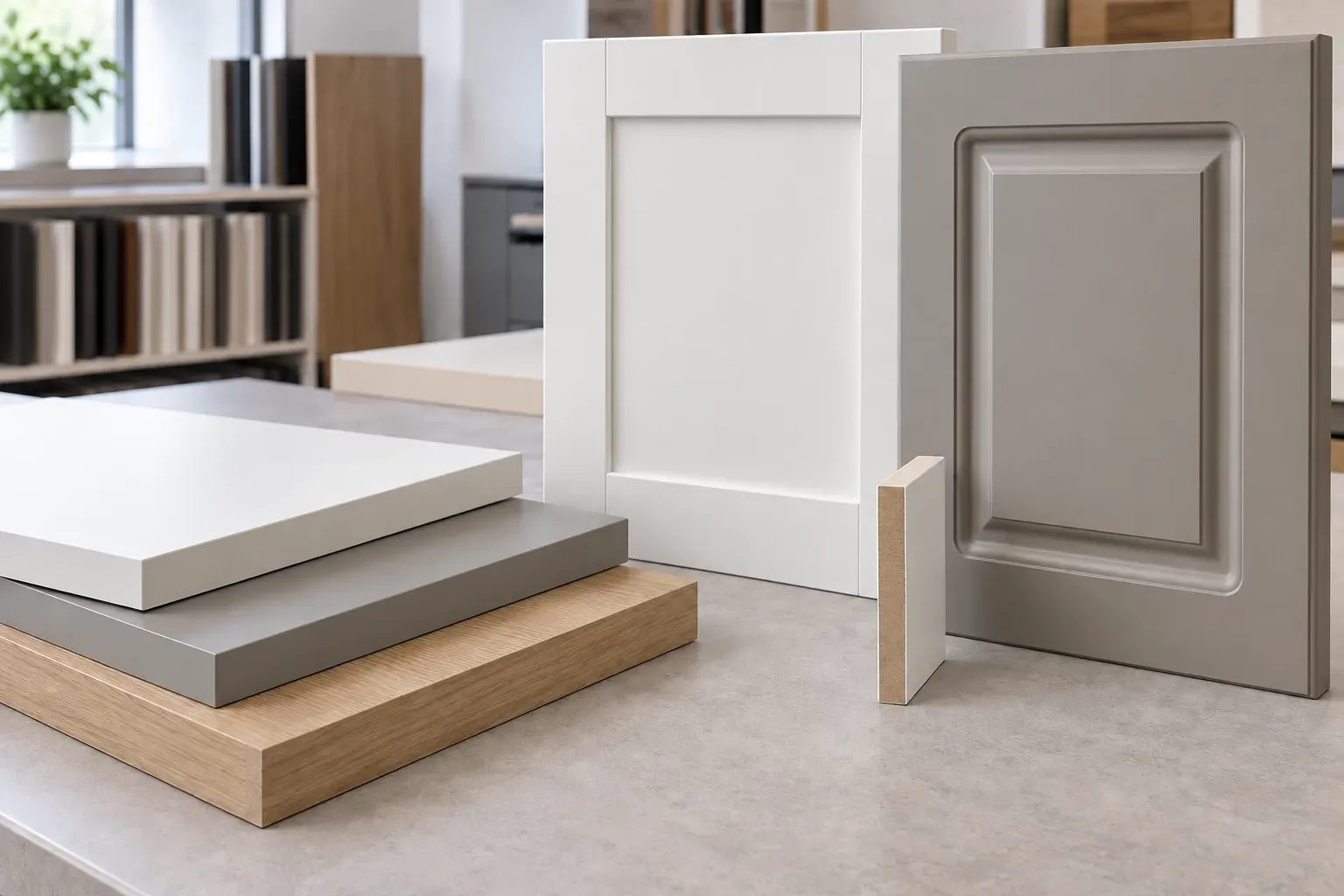
PVC faced MDF can describe a flat laminated panel or a routed door wrapped through a membrane or vacuum-press process. A production-ready inquiry identifies the construction, film, MDF substrate, profile geometry, face and reverse construction, service environment, first article and finished-component acceptance.
Choose the manufacturing process first
The component geometry and required edge appearance determine the production process.
| Route | Main specification focus |
|---|---|
| Flat PVC-faced sheet | Film reference, layer construction, sheet dimensions, face/reverse and later processing |
| Cut and edged component | Flat face, edge material, drilling, cut-outs and finished corners |
| Routed thermofoil door | Film forming, profile section, continuous edge wrap and reverse transition |
Record the construction on the quotation, drawing, sample and purchase order.
Use clear terminology for the supplied product
State flat PVC-faced MDF for a flat laminated sheet or component. State thermofoil, membrane-pressed or vacuum-pressed routed MDF door when film follows a machined three-dimensional profile. Add the delivery stage: full sheet, cut panel, machined blank, wrapped front or hardware-ready component.
Specify the PVC film through a physical reference
Record film supplier or range where available, colour, pattern, texture, gloss, nominal thickness category, grain direction and approved sample ID. Include an agreed range for colour and texture where production lots may vary. Directional films should carry arrows across elevations, cut lists and part labels.
Select the MDF substrate for the process
State MDF product, nominal thickness, density expectation, surface condition, dimensions, tolerance and emission class. Routed doors benefit from a smooth face, compact fine-fibre profile and controlled thickness. Coordinate the substrate with the deepest cut, smallest radius, hinge drilling and finished door weight.
Define face, edges and reverse as one construction
For flat panels, identify the PVC face, reverse layer and edge-band or edge-finishing process. For membrane-wrapped doors, show how the film continues across the face, routed profile and outer edges, then define the reverse face and transition line. Record total finished thickness and which surfaces remain visible after installation.
Draw the complete routed profile
Provide front and section views showing groove width and depth, internal and external radii, bevels, edge shape, panel thickness and remaining section. Mark profile datums, face direction and any changes between door sizes. The section drawing gives machining and pressing teams one controlled surface path.
Coordinate radii, depth and film forming
Smooth transitions and process-compatible radii support even film contact around recesses, corners and outer edges. Review the deepest groove, narrowest land, steepest transition and smallest proposed radius with the selected film and pressing process. A representative trial converts these features into an accepted production reference.
Place hardware and back machining on the same drawing
Add hinge cups, pilot holes, handle holes, connector positions and reverse machining to the controlled door drawing. Compare their depth and edge distance with the routed face and remaining MDF section. Use separate part IDs for left, right, upper, lower and mirrored components.
Match film, adhesive and pressing process
Identify the adhesive or bonding system and the production process proposed for the selected film, substrate and component. Current supplier process information should support temperature, activation, pressing and conditioning decisions. Keep the film reference, adhesive system and trial component linked in the production record.
Describe heat, humidity and cleaning exposure
PVC-faced MDF performs as a protected-interior component whose durability depends on the complete construction. Record nearby ovens, radiators, direct sunlight, room humidity, intermittent splash, ventilation and cleaning products. Design clearances, heat management, protected holes, reverse face and edge transitions around the actual cabinet location.
Explain short-term moisture contact accurately
A continuous PVC face and wrapped edge can slow short-term moisture entry at those covered surfaces. Prompt removal of standing water, sealed or protected machining, a defined reverse face and sound plumbing or ventilation preserve the finished component. The accepted scope should reflect the real exposure of faces, edges, holes and joints.
Approve a complete physical sample
Use the proposed film, MDF substrate, adhesive system, profile, wrapped edge, reverse transition and any critical hardware machining. View colour, texture, gloss, direction and profile definition under relevant lighting. Record sample ID, drawing revision, film reference and accepted surface range.
Inspect the first production article
Check component identity, dimensions, squareness, profile geometry, colour, pattern direction, surface conformity, outer edges, reverse transition, holes and hardware fit. Compare the finished door with the approved sample and controlled drawing. Record the result before repeat production begins.
Review typical forming and finishing conditions
Use consistent lighting and viewing distance during inspection.
| Area | Condition to review |
|---|---|
| Flat face | Colour, texture, gloss, cleanliness and surface marks |
| Routed recess | Film contact, profile definition, bridging and trapped marks |
| Corners and transitions | Smooth conformity, wrinkles, film thinning and visual consistency |
| Outer edge | Continuous wrap, trimming and edge profile |
| Reverse | Back-face finish, transition line, adhesive cleanup and identification |
Compare quotations at the finished-component level
Align the film and substrate, machining, profile complexity, reverse construction, holes, sample work, inspection, protective materials and packing. State whether the buyer receives sheets, wrapped doors or hardware-ready fronts. This reveals the processing and quality-control steps included in each offer.
Pack doors according to their profile
Use clean soft separators, protected corners and level support. Arrange raised profiles and routed faces so stacked weight is distributed across suitable contact points. Group handed parts, door families and installation sequences together, with part ID, face, top and grain direction on the outer labels.
Buyer review checklist
Before releasing PVC faced MDF or thermofoil doors, confirm:
- flat lamination or membrane wrapping is clearly identified;
- film reference, colour, texture, gloss and direction match the approved sample;
- MDF product, thickness, density expectation and emission class are recorded;
- face, wrapped edges, reverse layer and transition form one construction;
- profile radii, depths and remaining MDF section appear in a controlled drawing;
- hardware drilling and reverse machining share the same revision;
- heat, humidity, splash and cleaning conditions are described;
- the first article contains the most demanding profile and edge detail;
- inspection, labels, separators and packing suit the finished components.
Request an MDF quotation
Send the manufacturing process, film reference and sample ID, MDF substrate, face and reverse construction, finished dimensions, profile and hardware drawings, quantity, environment, first-article requirement, inspection, packaging and destination. Review the current scope on PVC Faced MDF, then request a thermofoil door or flat-panel quotation.