
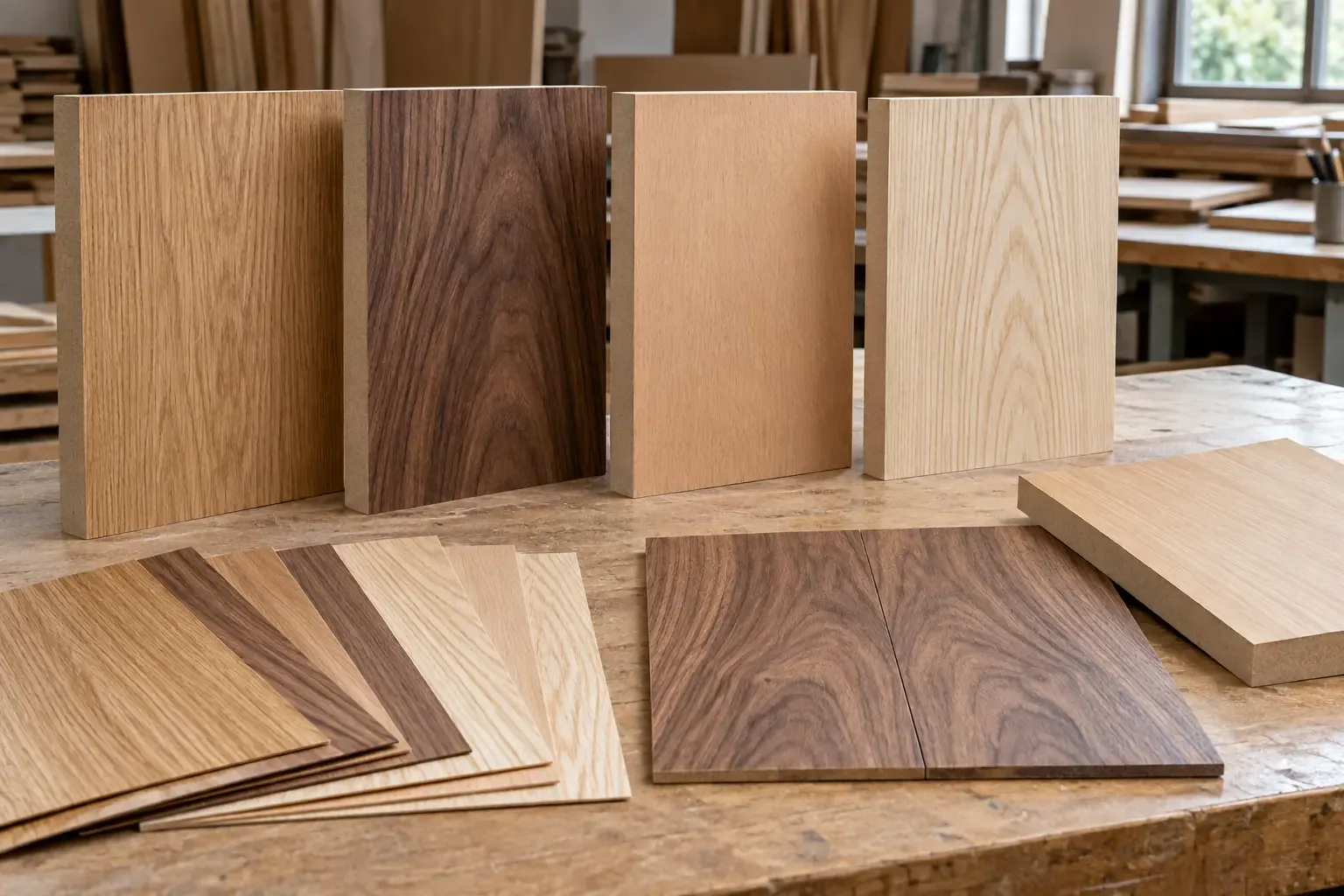
A veneered MDF quotation becomes comparable when the buyer specifies the complete construction and intended visual result. Connect wood species, veneer cut, leaf jointing and matching, grain direction, face grade, balancing layer, MDF core, supplied finish, component layout and the accepted range of natural variation.
Define the delivered veneered MDF product
State whether the supplier will deliver full veneered sheets, cut panels, machined furniture components or finished parts. Identify the final use, visible faces, adjoining components, edge treatment and coating stage. This sets the quoted supply scope for veneer selection, pressing, sanding, machining, finishing, inspection and packing.
Name the wood species and visual target
State the natural veneer species, such as oak, walnut, beech, ash, cherry, maple or another confirmed option. Add a physical reference that represents the desired colour family, grain character and figure. Record whether sapwood, heartwood contrast, knots, mineral streaks or other natural features contribute to the accepted appearance.
Choose the veneer cutting method
The cutting method changes grain shape, figure, leaf width, yield and the way adjoining leaves appear.
| Veneer cut | Typical visual characteristic to review |
|---|---|
| Rotary cut | Broad, flowing grain produced as the log is peeled |
| Flat or plain sliced | Cathedral and varied grain through the growth-ring structure |
| Quarter sliced | Straighter grain with species-specific ray figure |
| Rift cut or rift-style selection | Linear grain with reduced cathedral character where available |
Confirm the offered cut through an identified physical sample because species, log structure and slicing selection all influence the actual result.
Specify veneer thickness and grade approach
Record the agreed face-veneer thickness category and the condition at which it is measured or supplied. Define the grade through visible acceptance criteria: colour range, grain character, sapwood policy, joint quality, repaired areas and the natural features accepted for the component. A representative sample set gives production and receiving teams a practical grade reference.
Define how veneer leaves are joined
Describe how individual veneer leaves form the panel face. State the intended leaf width range where appearance depends on it, joint direction, joint spacing, joint visibility and the treatment of narrow closing leaves near panel edges. The splicing quality should support clean closed joints and the approved pattern across the full panel.
Choose the leaf-matching method
Select the matching method according to the intended appearance and the available veneer sequence.
| Matching approach | Visual effect to approve |
|---|---|
| Book match | Alternating leaves mirror the grain around each joint |
| Slip match | Sequential leaves repeat with the same face orientation |
| Random or plank match | Deliberate variation between leaves creates a less formal composition |
| Sequence-matched set | Identified leaves continue across related panels or components |
Use the veneer grain matching guide for the detailed elevation and sequence-planning workflow.
Map grain direction across components
Use elevations to mark vertical or horizontal grain, top edge, visible face, door pairs, drawer fronts, returns and end panels. Assign stable part IDs and direction arrows. Where several components form one elevation, define the starting position, sequence and joint relationship so cutting, labelling and installation preserve the accepted layout.
Specify face veneer and balancing layer
Record the face species, cut, thickness category, grade and matching method, then define the reverse veneer or balancing layer as part of the same construction. The balancing layer helps equalise stresses created by veneer, adhesive, moisture exchange and finishing across the two faces. Coordinate it with the face, MDF core, panel dimensions, adhesive and coating system; identify reverse faces that remain visible and give them an appearance requirement.
Define the MDF core and total construction
State the MDF product, nominal core thickness, density expectation, source-board format or finished dimensions, thickness tolerance and emission class. Add face and reverse veneer, adhesive system and the required finished thickness. Where moisture or fire performance forms part of the project, connect the proposed core and complete construction to the applicable order documents and inspection records.
State dimensions, machining and edge treatment
Separate full-sheet dimensions from finished component sizes. Provide controlled drawings and part IDs for cutting, drilling, routing, grooves and hardware features. Define whether edges show the MDF core, receive matching veneer, solid wood lipping or another treatment, and state whether finished dimensions include the applied edge construction.
Define the supplied surface and finishing stage
Specify whether panels arrive sanded and unfinished, sealed, stained, clear coated or fully finished. Record sanding condition, stain or colour reference, sheen, coating system and the treatment of faces, edges and machined profiles. Approve the chosen finish on the actual veneer construction because coating changes colour, contrast, figure and perceived uniformity.
Approve a representative panel and component set
Review enough area to show leaf joints, matching, colour range, grain direction and natural features. Add a finished edge and the selected coating, then place adjoining panels or doors together under relevant lighting. Record sample IDs, layout revision, finish system and the accepted natural range against the purchase order.
Inspect first production and the batch
Check first panels for core and construction identity, veneer species and cut, face and balancing layer, joint quality, matching, direction, dimensions, surface condition and edge treatment. Compare selected samples across the batch with the approved reference and record panel or part IDs, production batch and inspection result.
Plan repeat orders and replacement pieces
Retain the veneer source, sample IDs, leaf sequence, component layout and finish reference in the order history. Later additions can be reviewed beside installed surrounding parts and the retained sample. A fresh approval set and revision can document the best available match when the natural veneer source or log sequence changes.
Protect veneer through processing and transit
Use clean face separators, supported flat bundles, corner and edge protection, and moisture protection suited to the route. Mark sequenced panels and installation order clearly on labels and packing lists. Select protective materials that remain compatible with the supplied sanding or coating condition and the destination’s unloading method.
Buyer review checklist
Before releasing a veneered MDF order, confirm:
- the delivery condition covers full sheets, components or finished parts;
- the species, veneer cut, thickness category and grade approach are recorded;
- natural colour, grain and feature acceptance is represented by physical samples;
- leaf jointing, matching method and visible joint expectations are defined;
- direction, pairs, elevations and sequence positions use stable part IDs;
- face veneer, reverse veneer or balancing layer form one controlled construction;
- MDF core, total thickness, emission class, dimensions and tolerances are clear;
- machining, edge construction, sanding and finishing stages belong to the quoted scope;
- first-panel approval, batch inspection, repeat-order records and packing preserve traceability.
Request an MDF quotation
Send the species and physical reference, cut, grade approach, veneer and balancing-layer construction, matching method, elevations, MDF core, dimensions, machining, edge treatment, finish, quantity, inspection requirements, packing and destination. Review the current supply scope on the Veneered MDF product page, then request a veneered MDF quotation and sample review.