
The guide below helps purchasing and receiving use the same specification for the order.
Specify the Hardboard your workshop will receive
The right sheet is the one your cutting, finishing and assembly teams can use consistently. Begin with the part you make, then specify the Hardboard product, dimensions, faces and supplied stage together. A clear order line lets us prepare a useful sample, quote the agreed work and label the delivery for your receiving team.
CUZI MDF manufactures and supplies Hardboard from our factory in Shuyang, Jiangsu, China. Our published range is 1.5–5 mm at 810–960 kg/m³. Hardboard has its own sheet formats, surface constructions and dimensional requirements. Put the required format and tolerance in the request so our quotation identifies the particular Hardboard you will receive.
| Order field | What to specify | What the written order identifies |
|---|---|---|
| Product | Hardboard and intended component or process | Selected product and current technical reference |
| Thickness | Nominal board thickness and supplied measurement stage | Agreed thickness and tolerance |
| Density | Required value or the proposed product range | Product-specific density basis and any required test |
| Sheet format | Length, width, units and cutting-line requirement | Confirmed full-sheet size and dimensional tolerances |
| Face and reverse | Each side's construction and supplied finish | Face A, Face B and retained sample reference |
| Supplied work | Full sheets, cut components or agreed processed parts | Included operations, drawings and finished dimensions |
| Quantity | Sheets or components per specification | Order quantity, quotation unit and pack allocation |
| Delivery | Destination, named trade point and required timing | Packing, commercial terms and production schedule |
Hardboard, HDF and Thin MDF Board are separate product choices. Compare their actual product records, surfaces, dimensions and performance for the proposed part. Density is a mass-per-volume value; relevant product tests and an assembly trial answer the particular machining, finishing or furniture requirement. The Hardboard, MDF and HDF comparison explains the material decision in more detail.
The Composite Panel Association's Hardboard overview describes panels formed from wood-based fibres under heat and pressure, with product classes based on thickness and physical properties. That industry background helps define the material category. Our selected product record, quotation and sample identify the construction supplied for your order.
Use the Hardboard product page for our current range and discuss your sheet specification with the required format, quantity and destination. We reply within 12 hours. A furniture back or drawer bottom also needs its fit and support details; the Hardboard furniture specification guide covers those assembly decisions.
Approve the actual face and reverse
Two sheets with similar brown colour can present different surfaces to your production line. Identify the smooth, patterned or treated side of the actual proposed board, then connect each side to its intended use. A visible cabinet interior, drawer contact face and bonding face can each need a different preparation or finish.
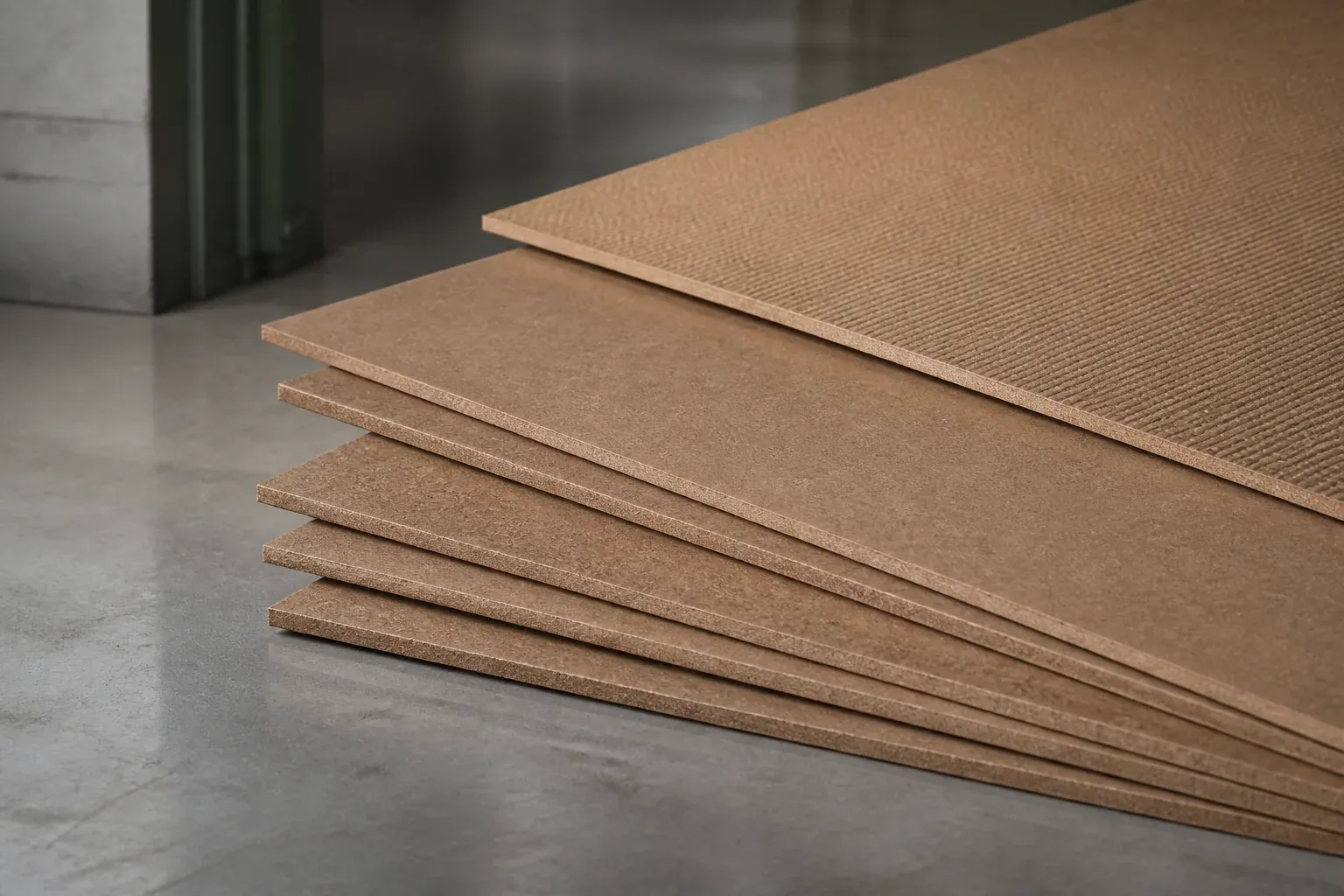
Some Hardboard constructions have a smooth face and screen-pattern reverse; other face arrangements follow the particular product. Our retained presentation shows a smooth brown face and patterned reverse. A physical sample establishes the supplied surfaces, texture and appearance for the selected order. Describe treatments and finishes as part of that specific construction.
- Mark Face A and Face B on the retained sample and product schedule.
- Photograph both sides under suitable lighting and identify the sample reference.
- State the installed visible or contact side and the intended reverse-side use.
- Record raw, coated, printed, overlaid or other agreed supplied conditions for each side.
- Identify the reference edge and datum where cutting or features depend on orientation.
- Retain the sample, drawing revision and acceptable appearance variation with the order.
Commercial descriptions such as smooth one-side and smooth two-sides describe a surface arrangement. A treatment or grade name needs its own product identity and supporting information. Record the proposed construction, relevant properties and finishing trial together. A familiar product name becomes a useful purchasing reference when it is linked to the sheet your team has actually reviewed.
For coated or printed work, inspect the appearance on the selected face after the intended preparation and finishing sequence. For a bonded overlay, check the contact face, adhesive and pressing conditions on representative material. Include the reverse and completed panel condition in the trial. The surface finishing guide helps organize a process record while the selected Hardboard retains its own material requirements.
Send both-side photographs or an identified reference with your sample request. Product samples are free and usually available from stock. You pay the courier charge, which can be credited against the formal order amount. We confirm the requested sample, preparation and estimated transit time before dispatch.
Match full sheets and processed parts to the cutting plan
Record the input sheet your workshop needs separately from the component it will produce. The input format affects equipment fit, handling and cutting layout; the finished cut size affects assembly. A coated or faced part may also have its own completed thickness and dimensions. Keep these stages visible on the drawing and order line.
| Supplied stage | Information we need | Reference for acceptance |
|---|---|---|
| Full Hardboard sheets | Input format, thickness, faces and quantity | Sheet specification and product sample |
| Rectangular cut components | Finished length/width, part IDs, quantity and orientation | Cut list and labelled first parts |
| Drilled, punched or shaped parts | Units, face view, datums, features and drawing revision | Agreed operations and representative processed sample |
| Prepared or finished components | Supplied finish, layer build-up, edges and measuring stage | Approved construction and completed part reference |
A cut list works best with one row per part ID and revision. Give the finished dimensions, quantity, designated face, reference edge and any openings or corner details. State whether the dimensions describe a plain cut part or the completed finished component. The cut-to-size specification guide provides a useful list structure; your Hardboard order uses the format and tolerances agreed for that material.
Mother-sheet size alone gives the available input. Actual output also depends on trimming, tool allowance, part orientation, openings and the cutting layout. For mixed parts, retain the proposed layout with the cut list and check the resulting quantities by part. A change to the sheet format or part revision can change the plan and should appear in the updated order.
Thin sheets need appropriate support, tooling and workholding through cutting and transfer. Check cut edges, corners, holes and narrow sections on representative Hardboard. State the drawing face for asymmetric features, then relate any reverse-side operation to the same physical datums. Our cut-to-size supply and CNC processing pages explain how we organize component work; the quotation names the actual Hardboard and included operations.
For captured furniture backs, the finished thickness and outside size connect to the actual groove and assembly sequence. For a drawer bottom, identify the perimeter and intermediate support, contents and relevant assembly checks. Our backs and drawer-bottom application guide helps purchasing connect the supplied part to the finished furniture.
Agree finishing and product documents for the intended use
A product requirement is most useful when it names the property, measuring or test method and supplied construction. Match the document to the Hardboard being quoted, including its treatment or finish where relevant. For a project with destination requirements, share the country, application and requested document wording at the inquiry stage.
| Requirement | Information to record | Reference for the selected order |
|---|---|---|
| Dimensions and flatness | Measurement stage, conditioning, positions and limits | Agreed sheet or component inspection method |
| Physical properties | Required properties, grade and test method | Product-specific technical data or applicable report |
| Coating, print or bonding | Contact face, preparation and complete finish system | Representative process trial and appearance sample |
| Emissions or destination documents | Country, application, requested method and product scope | Applicable documents matched to the quoted construction |
| Fire or special project performance | Required classification, method and installation | Relevant tested construction and document scope |
Where a grade or treatment is requested, describe it explicitly and retain the corresponding product reference. Where E0, E0.5, E1 or another emission description is part of your specification, name the required method and result for the selected Hardboard. Product names, density and a visually similar sample each answer their own questions; the applicable report answers the stated test requirement.
Finishing trials should use the same contact face and preparation planned for production. Record sanding or cleaning, adhesive/coating, application, curing or pressing and any subsequent handling. Evaluate appearance, adhesion, panel condition and the completed dimensions relevant to the component. Layer build-up belongs in the finished-thickness record, with measuring conditions and tolerances agreed for that stage.
For paint or another finish applied in your workshop, describe the supplied board condition and the work your team will complete. For finished components supplied by our factory, identify the included finish, reverse, edges and openings in the quotation. The sample approval guide helps keep the product sample, finish trial and first component connected to one reference.
Request Hardboard product documents with the selected thickness, surface construction, destination and required properties. We can then identify the relevant information for the quoted product and help your purchasing team complete its review.
Separate sheet volume, net mass and packed volume
Use the sheet count as the link between purchasing, packing and receiving. A quotation per sheet, a quotation per cubic metre of board and a freight calculation using outer pack dimensions describe different quantities. State the unit beside each number and retain the calculation inputs.
For an illustrative bundle, assume 200 bare Hardboard sheets, each 3 mm × 1220 × 2440 mm. These are demonstration inputs, separate from a confirmed stock format, bundle design or measured shipment. Sheet area is 1.220 × 2.440 = 2.9768 m². Board volume per sheet is 0.003 × 1.220 × 2.440 = 0.0089304 m³. The 200-sheet board volume is 1.78608 m³, and the nominal sheet stack height is 200 × 3 = 600 mm.
Using the published Hardboard density range of 810–960 kg/m³ gives a calculated bare-board mass of 7.23–8.57 kg per sheet, or 1446.72–1714.64 kg for the bundle. Bundle mass is calculated from the unrounded volume and density inputs. Coatings, overlays, moisture variation and packing add their own mass to the actual supplied shipment.
| Example quantity | Calculation or assumed input | What it represents |
|---|---|---|
| Sheet count | 200 bare sheets | Quantity of the stated demonstration specification |
| Sheet area | 1.220 × 2.440 = 2.9768 m² | Nominal face area of one sheet |
| Board volume per sheet | 0.003 × 1.220 × 2.440 = 0.0089304 m³ | Nominal material volume |
| Bundle board volume | 200 × 0.0089304 = 1.78608 m³ | Board quantity for a material-volume quote |
| Nominal sheet stack height | 200 × 3 = 600 mm | Bare sheets before pack allowances |
| Calculated bare-board mass | 1.78608 × 810–960 = 1446.72–1714.64 kg | Planning estimate from the stated density range |
| Assumed outer dimensions | 1280 × 2500 × 760 mm | Demonstration packing envelope |
| Outer packed volume | 1.280 × 2.500 × 0.760 = 2.432 m³ | Outside space occupied by that example pack |
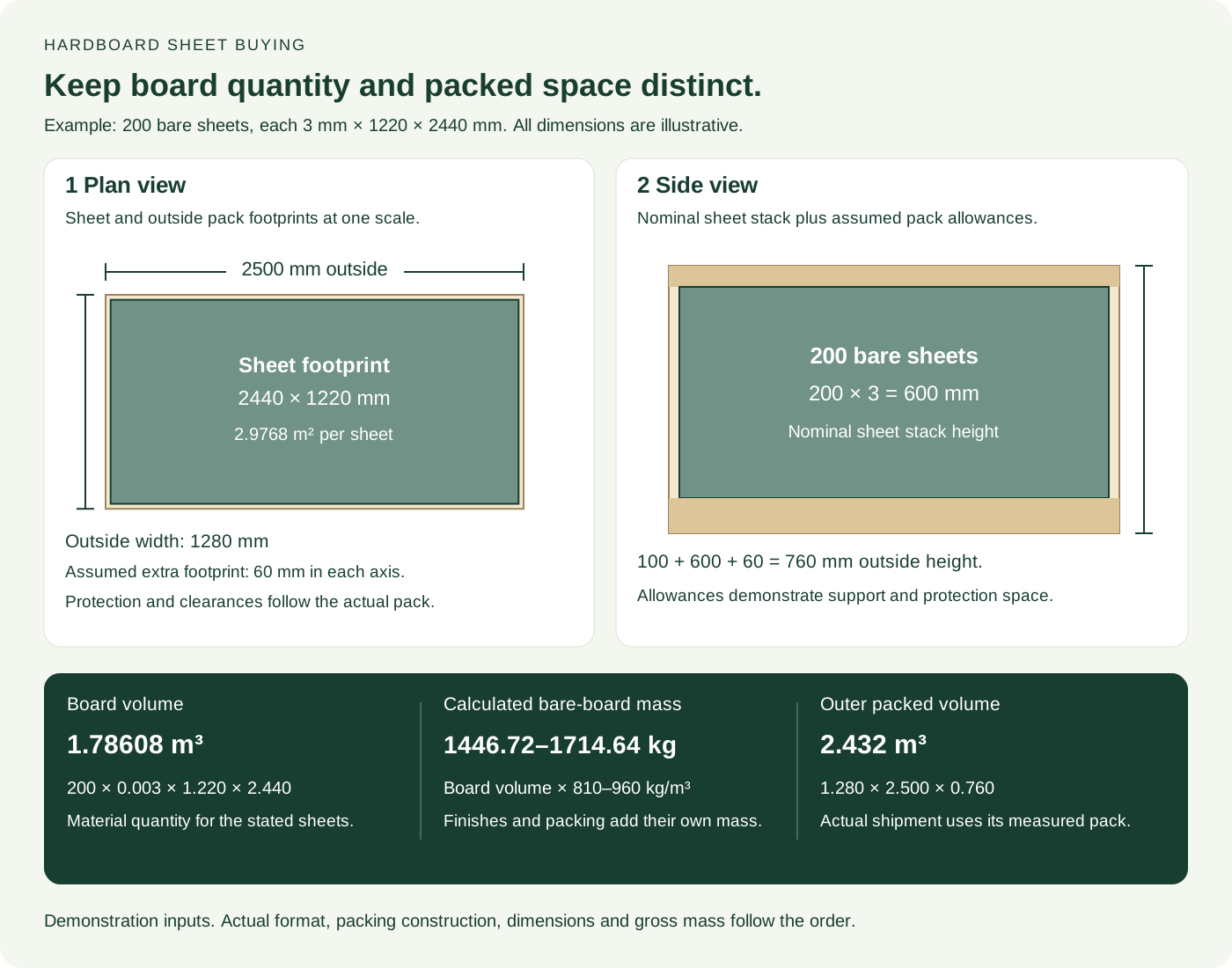
The diagram shows two views. The plan view compares the 1220 × 2440 mm sheet footprint with the assumed 1280 × 2500 mm outside footprint. The side view uses an assumed 100 mm lower allowance and 60 mm upper allowance: 100 + 600 + 60 = 760 mm overall. These allowances illustrate protection and support space; the actual bearer, cover, wrapping and handling construction is agreed for the order.
The 1.78608 m³ board quantity and 2.432 m³ outer packed volume therefore have different uses. A unit-price comparison per m³ of board uses the board volume. Freight and loading use the actual pack envelope, measured gross mass, clearances, support and container plan. Gross pack mass includes the supplied boards, any finishes and all packing materials; the calculation above estimates bare-board mass only.
For another specification, enter its own dimensions and density in our sheet weight and CBM calculator. The container-loading information guide explains the actual pack and transport data to confirm. Keep Hardboard on its own packing-list line, with its sheet count and outside dimensions recorded together.
Compare quotations through the delivered specification
Your useful comparison is the cost of the same accepted sheet or component delivered on the same commercial basis. Match the Hardboard product, thickness, faces, format, processing and quantity first. Then compare the named delivery term, included services and payment/timing conditions. This gives your team a clearer basis for choosing the offer that fits its production plan.
| Quotation item | Basis to make comparable | Detail to retain in the order |
|---|---|---|
| Material | Same selected product, thickness and surface construction | Product reference and sample |
| Quantity unit | Sheets, board m³ or finished components | Dimensions and conversion calculation |
| Included work | Cutting, holes, finishing and labels | Drawings, operations and supplied stage |
| Packing | Pack quantities, protection and handling needs | Packing construction and estimated/actual records |
| Delivery term | FOB Qingdao or FOB Lianyungang | Included logistics and buyer arrangements |
| Commercial conditions | Currency, payment, lead time and validity | Current written quotation and confirmed schedule |
For a per-m³ board quotation, price per sheet equals that unit price multiplied by the specified sheet's board volume. In the example above, the conversion uses 0.0089304 m³ per sheet. A per-sheet price divided by the same volume gives its equivalent price per m³ of board. Carry the selected construction, dimensions and included work through both calculations so the comparison describes the same supply.
CUZI MDF provides a written quotation identifying specification, quantity, price and currency, packaging, FOB Qingdao or FOB Lianyungang, production lead time, T/T or L/C payment terms and validity. Our normal MOQ is 1 × 20'GP per specification. We confirm the quantity allocation and schedule for the requested Hardboard order, including any mixed specifications or processing.
Typical production lead time is 3–10 days after requirements are confirmed. The confirmed production schedule depends on specification, quantity and included work. Arrival planning also includes handover, vessel timing, destination clearance and inland receiving. Shipment ports are Lianyungang or Qingdao, as agreed for the order. The lead-time planning guide helps work back from your required receiving date.
Request a Hardboard quotation with one schedule row per specification and a named destination. Add the expected cutting or finishing work and packing needs. We can then quote the delivery your workshop plans to use. The quotation and landed-cost guide helps organize your destination-cost comparison alongside the factory offer.
Plan supported packing, handling and receiving
Thin sheets travel best as clearly identified packs with suitable support and protection for the selected format. Agree sheets per pack, pack height, support/bearer layout, top and bottom protection, edge/corner protection, wrapping and protected strap positions. The packing plan should also suit the handling equipment at dispatch and at your receiving warehouse.
| Packing or receiving detail | What to agree | What the shipment record captures |
|---|---|---|
| Sheet grouping | Specification, face orientation and quantity per pack | Pack ID and sheet/part count |
| Flat support | Suitable base, bearers and transfer support | Actual support and forklift-entry arrangement |
| Surface protection | Clean separators and top/bottom protection as needed | Selected materials and protected contact faces |
| Edges and straps | Protected edges/corners and controlled strap pressure | Agreed construction and completed pack condition |
| Dimensions and mass | Outer envelope and net/gross measurement basis | Pack dimensions and actual gross mass |
| Receiving and storage | Unloading method, dry covered location and support | Delivery condition, identification and receiving checks |
Keep wrap, protection and restraints connected to the actual thin-sheet bundle. Wrapping contributes to the selected transport protection, while dry covered handling and appropriate storage remain part of the receiving plan. Container condition, loading positions, support and restraints are considered with the confirmed pack geometry and transport requirements.
Ask your receiving team for its forklift entry direction, lifting equipment, storage arrangement and any pack-height or handling limits before packing is finalized. Relate those requirements to the actual gross pack mass. A product's nominal density helps estimate the board mass; the finished packing list and measured shipment data establish the actual load being handled.
On arrival, record the shipment and pack IDs, outside condition, sheet count and any visible edge or surface damage. Check sampled sheets against the agreed specification and retained reference. Keep photographs and measured results connected to the affected pack so a receiving query can be followed through the order record.
Store received sheets flat and supported in a dry covered area, with appropriate separators and protected handling for the selected surface. Record the conditioning and measurement stage where the order's acceptance method requires it. The packaging and shipment planning guide explains the order information that connects protection, loading and receiving.
Inspect the agreed sheet before shipment release
Agree the inspection scope with the selected Hardboard specification and supplied work. Identify sampling across packs and sheets, measurement positions, conditioning, equipment, dimensional limits, appearance references and the result format. This turns a general quality request into checks your inspection and receiving teams can use consistently.
- Check the product reference, thickness, density basis and supplied faces against the order.
- Measure the agreed dimensions, squareness and relevant flatness under the specified conditions.
- Inspect face, reverse, edges and corners using the retained appearance reference.
- Check any cutting, holes, finishing, part IDs and drawing revisions included in supply.
- Reconcile pack labels, sheet quantities, outside dimensions, gross mass and packing condition.
- Record sampled pack/sheet IDs, results, photographs and the shipment decision under the current order.
Where a specimen property is required, use the applicable method and product-specific sampling/reporting basis. A full-sheet mass check can support a planning comparison when its dimensions and condition are recorded. A formal density or performance result follows the agreed specimen, method and conditioning. Keep these records identifiable so each result answers the appropriate specification question.
Third-party inspection can be arranged against the agreed order and inspection plan. Coordinate the inspection stage and time with production, included finishing and packing. The pre-shipment inspection checklist helps organize checks and records, with Hardboard dimensions, faces and acceptance criteria carried through as their own specification.
For repeat orders, retain the product and both-side sample, format, tolerance, finish, drawing revision and packing reference. Record changes to the construction or included work in the new order and confirm the relevant sample or first-part checks. Your purchasing, production and receiving teams then work from the same supplied-product reference.
Send a complete Hardboard request to our factory
You can begin with the sheet your workshop needs or the part you plan to make. Send the known requirements in one concise schedule, with photographs, samples or drawings where they make the selected faces and work clear. Our factory team will help connect the specification, sample and written quotation.
- Product: Hardboard, intended component/process and selected product or sample reference.
- Board: nominal thickness, density requirement and any product-property documents needed.
- Format: full-sheet length/width or finished cut list, units and dimensional requirements.
- Surfaces: Face A, Face B, raw or finished condition and the appearance reference.
- Processing: cutting, holes, shaped features, finishing, datums and current drawings.
- Quantities: sheets or components per specification and preferred pack allocation.
- Delivery: packing/handling requirements, destination and FOB named port/place.
- Timing and review: required receiving date, sample, first-part and inspection needs.
We reply to inquiries within 12 hours. Product samples are free and usually available from stock; the buyer pays the courier charge, which can be credited against the formal order amount. We confirm sample availability, preparation and estimated transit time before dispatch. For machined or finished trial parts, we agree the supplied processing stage and preparation schedule with you.
Your written quotation includes the selected specification, quantity, price and currency, packaging, trade term and named place, production lead time, payment conditions and validity. Before production scheduling, we connect the confirmed sheet or part, faces, drawings and sample references to the order. Use the Hardboard quotation request, product sample request or product-document request for your next purchasing step.
Questions buyers ask
What Hardboard thickness and density does CUZI MDF supply?
Our published Hardboard range is 1.5–5 mm at 810–960 kg/m³. The quotation identifies the selected thickness, density basis, format, faces and supplied stage. Product-specific tolerances and requirements are agreed for the Hardboard order.
Which Hardboard sheet size should I request?
Send the full-sheet format your equipment and cutting layout need, or a cut list with finished part dimensions and quantities. We confirm the Hardboard input format and included work in the quotation. The 1220 × 2440 mm format in this article is a demonstration input for the calculation.
Does Hardboard always have a screen-pattern reverse?
Face and reverse construction depend on the selected product. Review both sides of the actual sample, name Face A and Face B and describe their installed or processing use. The quotation and retained sample identify the surfaces supplied for your order.
How do I specify a treatment, finish or grade?
Name the required construction and relevant properties, then match them to the proposed product record and applicable documents. For a finish, specify the contact face, preparation, supplied stage and representative trial. The selected product and sample establish the order reference.
Can I request cut or processed Hardboard parts?
Yes. Send the cut list, quantities, face orientation and current drawings for the intended operations. We agree the included cutting, features or finishing and the completed dimensions in the quotation. A representative first part connects the supplied work to your assembly.
How is a Hardboard price per m³ converted to price per sheet?
Multiply the price per m³ of board by the specified sheet volume in metres. The illustrative 3 mm × 1220 × 2440 mm sheet has a volume of 0.0089304 m³. Use that material volume with the agreed construction and included work for the conversion.
Why is packed CBM different from board volume?
Board volume measures the stated quantity of material. Packed volume uses the actual outside pack dimensions, including support and protection space. The example gives 1.78608 m³ of bare boards and 2.432 m³ outside packed volume; the actual order uses its confirmed packing data.
What is the weight of a Hardboard bundle?
Calculate an initial bare-board estimate from sheet dimensions, sheet count and the selected density range. Add finishes and packing on their own mass basis, then use the measured gross pack mass for actual handling and shipment. The example's 1446.72–1714.64 kg is a calculated bare-board range.
How can I obtain samples and product documents?
Send the selected thickness, faces, format and intended use. Product samples are free and usually available from stock; the buyer-paid courier charge can be credited against the formal order amount. For documents, add the required property or method and destination so we can identify the applicable product information.
What are the MOQ, production lead time and delivery terms?
Our normal MOQ is 1 × 20'GP per specification. Typical production lead time is 3–10 days after requirements are confirmed, with the actual schedule agreed for the order. We quote FOB with a named place, T/T or L/C payment terms and shipment from Lianyungang or Qingdao as agreed. Third-party inspection is supported against the confirmed inspection plan.