
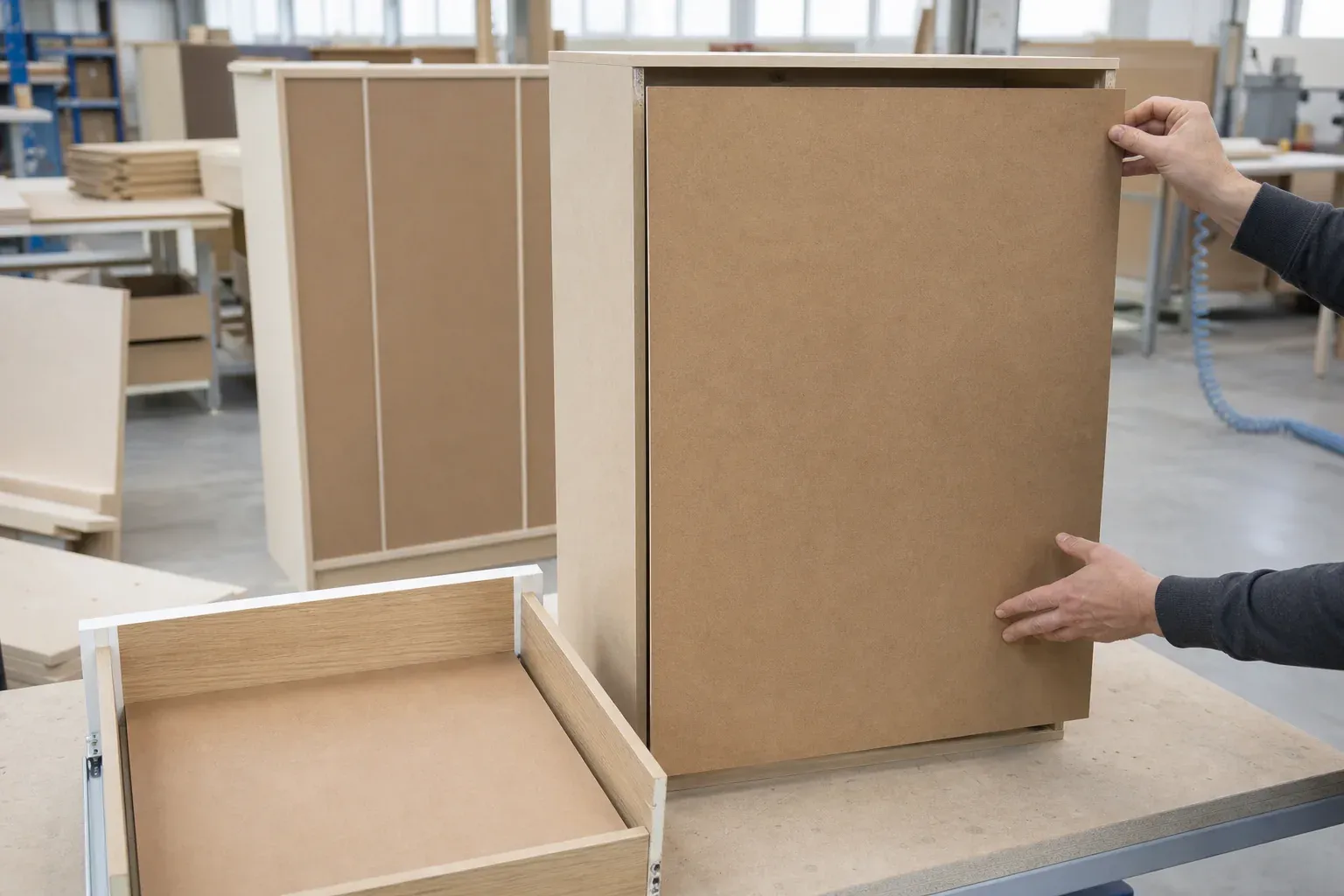
Specify a hardboard back or drawer bottom as part of the furniture assembly. Component dimensions, face orientation, groove or fixing interface, support, exposure, finish, trial fit and flat packing determine the delivered part.
Identify the component function
Separate cabinet backs, wardrobe backs, drawer bottoms, framed infill and protective dividers. Record finished dimensions, orientation, visible side, expected support and any opening or hardware. Each component follows its own assembly drawing.
Record face and reverse
State which smooth, coated, printed or decorative face is visible and which reverse construction is supplied. Mark face direction on the drawing and label. Approve the actual sheet or finished sample because hardboard face and reverse can perform different visual roles.
Define the assembly interface
Dimension the hardboard together with the receiving furniture part.
| Interface | Information to confirm |
|---|---|
| Groove | Width, depth, position, fit allowance and insertion sequence |
| Rebate | Depth, support width and fixing method |
| Surface fixing | Fastener type, spacing, edge distance and cover detail |
| Drawer bottom | Groove position, supported perimeter and drawer dimensions |
| Removable back | Access, clips or screws and service clearance |
Coordinate thickness and tolerance
State the hardboard nominal thickness and agreed product-specific tolerance. Review groove or rebate dimensions with the actual board sample. Keep hardboard values separate from MDF or HDF schedules and identify the product clearly in the bill of materials.
Review support and finished loading
The furniture designer establishes spans, supports, fasteners and permitted loads for the completed cabinet or drawer. Trial the actual back or bottom in a representative frame and use the intended hardware and assembly sequence.
Control cutting and openings
Provide finished length, width, squareness, holes, notches and cut-outs with named datums. Select cutting and punching methods suited to the product and finish. Inspect edge quality and orientation on first parts.
Approve a representative assembly
Fit the hardboard into the actual groove, rebate or fixing method. Check insertion, squareness, joint closure, face direction, hardware clearance and completed appearance. Record the accepted component and drawing revision before repeating the cut list.
Pack thin components flat
Use continuous flat support, clean separators and suitable strapping pressure. Protect corners and finished faces, keep moisture protection appropriate to the route, and label part IDs and orientation. Plan lifting around bundle flexibility and size.
Prepare the hardboard component RFQ
Send product identity, thickness, component drawing, face/reverse, interface, quantity, sample, labels, packing and destination. Use Hardboard for Furniture Backs and Drawer Bottoms for the application guidance and request a fit review.
Buyer review checklist
Before relying on this guidance, record the finished component, service environment, MDF product or unresolved product requirement, thickness, dimensions, supplied surface, visible edges, machining, hardware, quantity and destination. Identify which values need current technical documents and test reports and which appearance decisions need a physical sample.
For international supply, also confirm drawing and sample revisions, packaging construction, part or bundle labels, handling limits, required documents and the party responsible for finished-product design and destination compliance. Ask the supplier to list unresolved items and exclusions in the quotation, and keep every missing value visible for confirmation.
Compare quotations only after these inputs have been normalized. Check whether the offered price covers a full board, a faced construction, a machined part or a finished component, and whether samples, secondary work, protective materials and documentation are included. Record every change after approval so purchasing, production, inspection and receiving teams use the same revision.
Typical lead time is 7–15 days after requirements are confirmed. Final timing depends on specification, quantity, production scheduling and destination. This planning range covers production; arrival timing also depends on the confirmed logistics route.
Request an MDF quotation
Share the application, specification, quantity, packaging and destination with CUZI MDF for an order-specific review.