
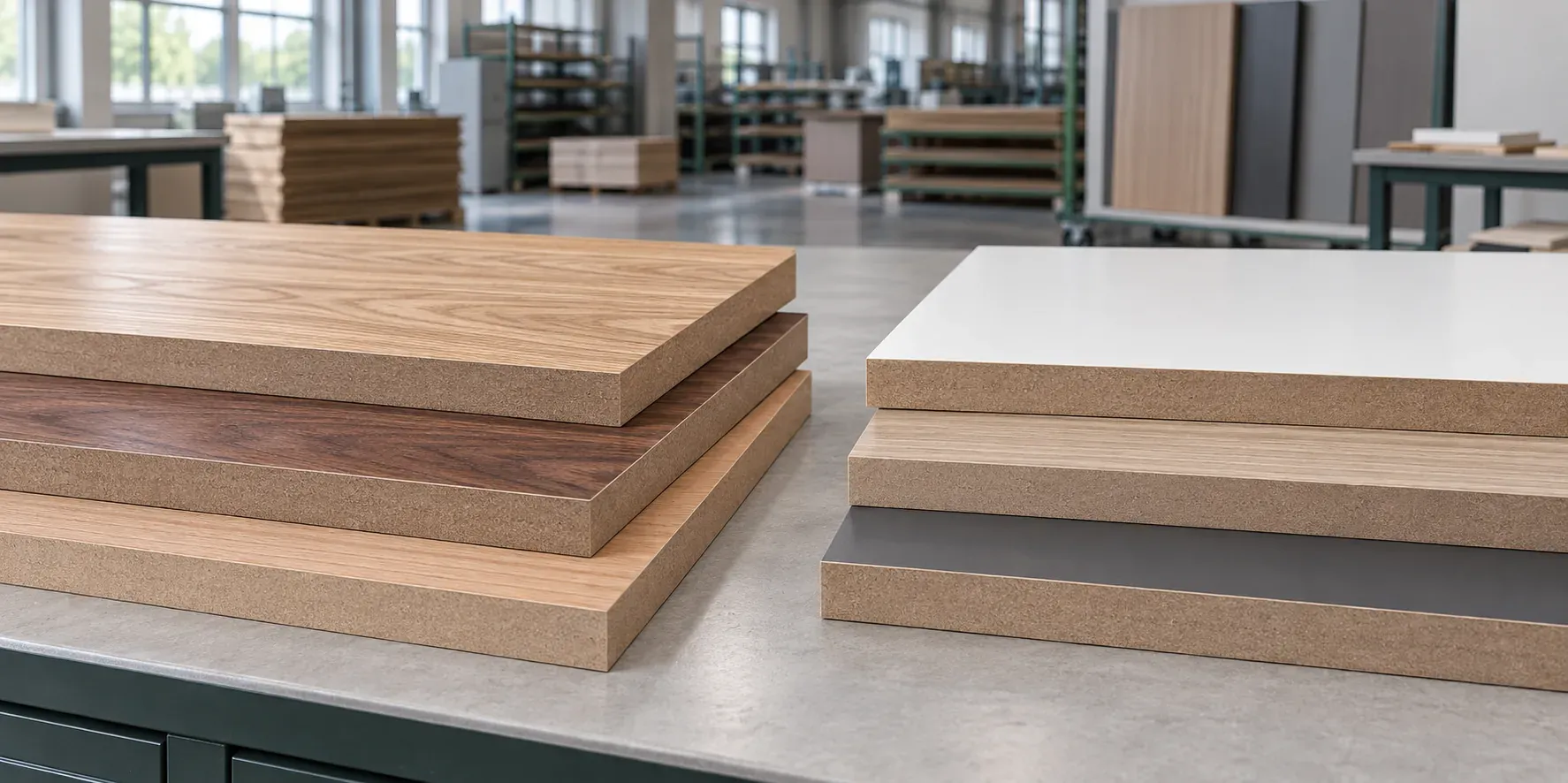
Veneered MDF gives furniture a real wood surface controlled through species, veneer cut and leaf matching. Melamine MDF provides an identified decorative surface controlled through decor, texture and face construction. Compare finished appearance, production work, repeat orders and total component cost.
Compare the supplied constructions
Both products use an MDF core, while their surface systems create different purchasing and production decisions.
| Comparison point | Veneered MDF | Melamine MDF |
|---|---|---|
| Surface material | Thin layer of real wood veneer | Resin-impregnated decorative paper pressed to MDF |
| Appearance control | Species, cut, leaf sequence, matching, grain direction and accepted natural variation | Decor reference, colour, printed pattern, texture, gloss and direction |
| Face and reverse | Decorative veneer plus reverse veneer or compatible balancing layer | One- or two-sided melamine construction with identified reverse face |
| Work after board supply | Cutting, machining, edge treatment, sanding and the agreed stain, sealer or coating process | Cutting, drilling, edge banding, part identification and surface protection |
| Repeat-order reference | Retained physical veneer set, sequence record and accepted variation | Retained physical decor sample, decor code, texture and batch record |
| Typical use | Natural-finish furniture, hotel casegoods, wall panels and visible doors | Cabinet carcasses, wardrobes, office furniture and repeat decorative parts |
The purchase order should state whether pricing covers full sheets, surfaced cut parts or finished components. This keeps product comparison, inspection and delivered cost tied to the same supply stage.
Compare the indicative board-supply ranges
Current CUZI MDF website planning ranges use different surfaced-board supply bases:
| Product | Indicative range | Supply basis |
|---|---|---|
| Veneered MDF | US$260–470 per m³ | Natural-veneer faced board supply |
| Melamine MDF | US$190–380 per m³ | Melamine-faced board supply |
The order quotation depends on core thickness and density, board format, emission requirement, veneer species and cut, matching or decor reference, face/reverse construction, finishing scope, quantity, packaging, delivery basis and destination. The meaningful comparison is the total cost of accepted furniture components with the required appearance.
Choose through the finished appearance and production process
The surface decision becomes clearer when the buyer defines the finished furniture result first.
| Buyer priority | Veneered MDF option | Melamine MDF option |
|---|---|---|
| Natural wood character | Real wood figure, tone movement and leaf-to-leaf variation form part of the accepted appearance | Printed decor and texture create a controlled visual reference |
| Large visible elevation | Veneer leaves can be selected, matched and sequenced across adjoining panels | Decor direction and component nesting can be scheduled across adjoining parts |
| Custom stain or clear finish | Stain, sealer and topcoat can develop the selected species and cut | The supplied decorative face already carries the approved colour and texture |
| Repeat production | Retained veneer samples, sequence records and coating controls guide the next batch | Decor code, texture, gloss, direction and batch reference guide repeat supply |
| Factory work after panel supply | Includes the agreed sanding, coating and handling route | Focuses on cutting, edge banding, drilling, assembly and surface protection |
Veneer suits projects where real wood character supports the design value. Melamine suits programs where a specified decorative surface, efficient component processing and repeatable part control lead the decision. A mixed furniture schedule can assign each construction to the components where it contributes the strongest value.
Normalize the MDF core and supplied stage
Compare both options on one defined commercial basis. Record the MDF grade, thickness, tolerance, density band, board format and E0, E0.5 or E1 destination requirement, then identify the exact stage delivered by the supplier.
| Supply stage | Scope to record |
|---|---|
| Surfaced full sheet | MDF core, decorative face, reverse or balancing layer, sheet size and protective packing |
| Cut component | Full-sheet construction plus nesting, finished dimensions, machining, part identification and usable yield |
| Finished furniture part | Cut component plus edge treatment, veneer coating or melamine edge band, hardware preparation, inspection and component packing |
This normalized basis separates the value of the surface system from differences in core specification and processing scope. It also gives procurement, production and quality teams one shared definition for quotation review.
Build the natural veneer specification
Start with the intended furniture elevation and select the natural characteristics that create it.
- **Species:** common options include beech, walnut, oak, ash and maple, subject to sample and availability confirmation.
- **Veneer cut:** rotary-cut veneer gives broad flowing figure; sliced veneer produces individual leaves. Crown or flat slicing can show cathedral grain, while quarter slicing creates a straighter visual rhythm.
- **Leaf matching:** book match mirrors consecutive leaves; slip match keeps them in one direction; random match produces a varied natural face; running match carries consecutive leaves across the panel.
- **Grain direction:** state lengthwise or crosswise direction for the full sheet and identify the finished orientation for doors, drawer fronts and wall panels.
- **Sequence:** paired doors, adjoining modules and large elevations benefit from a numbered leaf and panel sequence.
Approve a representative physical layout that shows several adjoining panels. This establishes the accepted relationship between natural variation, matching and the finished elevation.
Build the melamine decor specification
Identify the physical decor reference, colour, printed pattern, texture, gloss level and grain or pattern direction. Record the decorative face and reverse face separately, including single- or double-faced construction and any balancing requirement. For doors and adjoining cabinet parts, place the direction on the component drawing so cutting, edge banding and assembly preserve the approved visual flow. A larger physical panel shows pattern scale and repetition, while a finished corner sample confirms the relationship between face, core and edge band.
Control face balance and panel flatness
A veneered panel combines the decorative veneer, adhesive, MDF core and reverse-side veneer or compatible balancing layer as one construction. The balancing layer helps equalize stresses and moisture response across both faces, improving dimensional balance and reducing bowing or warping risk during pressing, finishing and use. Melamine MDF also requires a defined face/reverse construction so each side receives the intended surface and the panel build remains controlled. Store both products flat and condition them for the planned processing environment.
Match the surface construction to the furniture component
Use the finished component and production process to select the surface.
| Finished component | Practical review process |
|---|---|
| Hotel headboard, visible wardrobe door or feature panel | Veneer species, cut, matching, sequence, balance and coating sample |
| Cabinet carcass, shelf or office storage part | Melamine decor, face/reverse construction, direction, edge band and drilling |
| Natural-wood desk front or meeting-table detail | Veneered MDF with elevation layout, finished edge and coating approval |
| Repeat wardrobe or office-furniture program | Melamine MDF with retained decor reference and component direction schedule |
| Mixed premium face and standard internal parts | Component schedule assigning veneer and melamine constructions by part number |
This component schedule also identifies visible faces, exposed edges, hardware, service openings and the required pack sequence.
Calculate accepted component cost and material yield
Convert each quotation into the cost of accepted components ready for the next production stage. For veneered MDF, include veneer grade and available leaf width, matching and sequence yield, balancing material, pressing, sanding, coating trials, colour adjustment, edge construction and protection between visible faces. For melamine MDF, include decor direction, sheet nesting, edge-band combination, drilling, protective film where specified and surface-safe handling.
Use the same calculation structure for both options:
**surfaced-board cost + processing + finishing + edges + inspection + packing + expected production loss ÷ accepted component quantity**
A full-sheet price can favour one option while the finished-component result favours the other. The component drawing, visible-face schedule and nesting plan provide the quantities needed for a useful comparison.
Plan machining, edges and finishing
Veneered MDF can be cut, drilled and routed with tooling and handling selected for the real wood face. Define veneer over-edge, solid-wood lipping, matching veneer tape or another approved exposed-edge construction, then qualify sanding, stain, sealer and clear coat on the actual veneer. Melamine MDF commonly uses a coordinated edge band after cutting and drilling; specify edge material, colour, thickness and visible joint standard. Approve the deepest route, most visible edge and representative hardware detail before repeat production.
Assign surface and finishing responsibility
State which party supplies and approves each surface operation. A veneered MDF order may end at pressed and sanded panels, or it may include stain development, sealer, topcoat, sheen control and finished-part protection. Record the approved coating system, application sequence, target appearance and repair reference with the veneer sample set.
A melamine MDF order may end at faced sheets, machined components or completed parts with coordinated edge banding. Record decor and edge-band references together because the face, edge and corner create one visible furniture construction. Assigning these responsibilities in the quotation keeps supplier scope, buyer processing and final inspection aligned.
Approve appearance at furniture scale
Use a veneer sample set that shows species, cut, several adjoining leaves, matching method, grain direction, accepted tone range and the intended coating. Use a melamine sample that records decor code, texture, gloss, direction, face/reverse construction and finished edge. Review veneer sequences and melamine pattern scale under relevant lighting through a representative door pair, furniture elevation or corner assembly. Retain the approved references with the quotation, drawings and purchase order.
Plan repeat orders and replacement parts
For veneer, retain the approved sample set, species and cut details, panel sequence, coating record and acceptance range. Future batches are matched to this record while preserving the natural character of newly sourced wood. Reserve sequenced spare panels when a project requires close alignment across a visible elevation. For melamine, retain the physical decor sample, decor and texture references, direction and batch information. Review a new production batch against the controlled reference before replacement parts enter the furniture set.
Inspect each surface at the stage where quality is visible
Use inspection points that match the construction and supply stage.
| Inspection stage | Veneered MDF | Melamine MDF |
|---|---|---|
| Incoming surface | Species, cut, leaf match, sequence, grain direction, face/reverse construction and visible defects | Decor, colour, texture, gloss, direction, face/reverse construction and surface condition |
| Machined component | Veneer protection, edge quality, routed profile, drilling and part sequence | Face protection, cut quality, edge-band joint, drilling and part identity |
| Finished component | Tone range, coating build, sheen, adjoining-panel continuity and exposed edges | Decor continuity, edge colour, corner appearance, pattern direction and hardware alignment |
| Shipment release | Approved-reference match, component labels, face protection, pack order and moisture-safe packaging | Approved-reference match, component labels, surface protection, pack order and moisture-safe packaging |
The inspection record should identify the approved physical reference, drawing revision, part number, quantity and pack number so the furniture maker can trace each visible component after delivery.
Prepare a comparable RFQ
Send one component and commercial basis for both options:
- finished component, application and visible elevation;
- veneered MDF or melamine MDF option under review;
- MDF core grade, thickness, tolerance, density and board format;
- E0, E0.5 or E1 destination requirement;
- veneer species, cut, matching, grain direction and sequence, or melamine decor, texture, gloss and direction;
- decorative face, reverse face and balancing construction;
- cutting, routing, drilling, edges and hardware;
- veneer coating process or melamine finished-edge reference;
- physical sample, first component and appearance acceptance;
- quantity by specification or part number;
- packaging, labels, destination and delivery basis.
CUZI MDF reference board formats are 1220 × 2440 mm, 2100 × 2800 mm, 1830 × 3660 mm, 1830 × 2440 mm, 2440 × 3660 mm and 1830 × 4200 mm. The normal MOQ is 1 × 20'GP for each individual specification, and normal production lead time is 7–15 days after the surface reference, complete construction and commercial requirements are confirmed. Use the Veneered MDF product page, Melamine MDF product page, Veneer grain matching guide and Melamine specification guide for the current supply option. Request a specification review with the component, quantity and destination.
Buyer review checklist
Before relying on this guidance, record the finished component, service environment, MDF product or unresolved product requirement, thickness, dimensions, supplied surface, visible edges, machining, hardware, quantity and destination. Identify which values need current technical documents and test reports and which appearance decisions need a physical sample.
For international supply, also confirm drawing and sample revisions, packaging construction, part or bundle labels, handling limits, required documents and the party responsible for finished-product design and destination compliance. Ask the supplier to list unresolved items and exclusions in the quotation, and keep every missing value visible for confirmation.
Compare quotations only after these inputs have been normalized. Check whether the offered price covers a full board, a faced construction, a machined part or a finished component, and whether samples, secondary work, protective materials and documentation are included. Record every change after approval so purchasing, production, inspection and receiving teams use the same revision.
Typical lead time is 7–15 days after requirements are confirmed. Final timing depends on specification, quantity, production scheduling and destination. This planning range covers production; arrival timing also depends on the confirmed logistics route.
Request an MDF quotation
Share the application, specification, quantity, packaging and destination with CUZI MDF for an order-specific review.